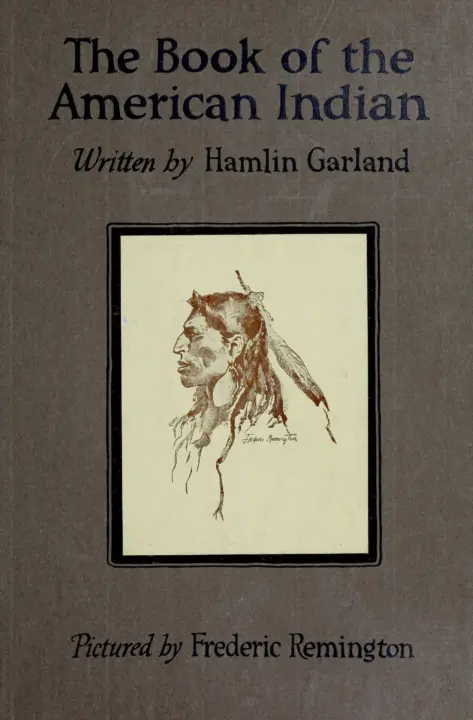
The book of the American Indian
Hamlin Garland
THE CLASSIC COLLECTION · 1908
"The Shadow World" by Hamlin Garland is a novel written in the early 20th century. The book explores themes of spiritualism and the phenomena associated with it, centering around a group of intellectuals who engage in discussions and experiments involving psychics and the supernatural. The narrative begins to unfold through the interactions and debates amongst the characters, setting the stage for a deeper exploration of the unknown. The opening of the book introduces a dinner party where various guests express differing views on telepathy and spiritualism. The main character takes a leading role in discussing these phenomena, mentioning his involvement with the American Psychical Society and his experiences with mediums. As the conversation progresses, the guests become increasingly intrigued by the topic, leading to a proposal for a psychic séance. This sets the groundwork for potential revelations and encounters with the "shadow world" that will unfold in later chapters. The atmosphere is charged with curiosity and skepticism, reflecting the tension between belief and disbelief that pervades the narrative.
Introduction adapted from the source catalogue; source summaries may be automatically generated.
Free to read · English · 68,177 words · No account needed
MAKE TIME FOR A GOOD BOOK
On by default. Untick to stop anonymous reading totals. Each page counts after 10 seconds in view. How this works.
Anonymous counting is on unless you have switched it off.
Mrs. Quigg sharply queried, "Whom are you talking to?"
"The 'guides,'" I answered.
"The 'guides'!" she exclaimed. "Do you believe in the guides?"
"I believe in the belief of the guides," was my cryptic rejoinder.
"Sing again, please."
I really had no faith in the conditions of the circle, but for the joke of it I kept my sitters in place for nearly an hour by dint of pretending to hear creakings and to feel throbbings, until at last little Miss Brush became very deeply concerned. "I feel them, too," she declared. "Did some one blow on my hands? I felt a cold wave."
Harris got up abruptly. "I'll join the doubters," said he. "This tomfoolery is too idiotic for me."
Cameron followed, and Mrs. Quigg also rose. "I'll go with you," she said, decidedly. I was willing to quit, too, but Mrs. Harris and Miss Brush pleaded with me to continue.
"Close up the circle, then. Probably Harris was the hoodoo. Things will happen now," I said, briskly, though still without any faith in the experiment.
Hardly had Harris left the table when a shudder passed over Mrs. Harris, her head lifted, and her eyes closed.
"What's the matter, Dolly?" whispered Mrs. Cameron. "Do you feel faint?"
"Don't be alarmed! Mrs. Harris is only passing into a sleep. Not a word, Harris!" I said, warningly. "Please move farther away."
In the dusky light the faces of all the women looked suddenly blanched and strange as the entranced woman seized upon the table with her hands, shaking it hard from side to side. The table seemed to wake to diabolic energy under her palms. This was an unexpected development, and I was almost as much surprised as the others were.
"Sing again," I commanded, softly.
As they sang, Mrs. Harris withdrew her hands from the table and sat rigidly erect, yet with a peaceful look upon her face. "She does it well," I thought. "I didn't think it in the quiet little lady." At length one hand lifted and dropped limply upon the table. "It wants to write," said I. "Where is the pad? I have a pencil."
As I put a pencil under the hand, it was seized in a very singular way, and almost instantly Mrs. Cameron gasped, "That's very strange!"
"Hush!" said I. "Wait!"
Holding the pencil clumsily as a crippled person might do, the hand crept over the paper, and at last, after writing several lines, stopped and lay laxly open. I passed the pad to Brierly. "Read it aloud," I said.
He took it to the light and read:
Your reading position is saved on this browser. Take it to another device with a library code. Reading pages adapt to text, rather than matching a printed edition.
Hamlin Garland
Hamlin Garland
Hamlin Garland
Hamlin Garland
BEHIND THE BOOK
This eBook is for the use of anyone anywhere in the United States and most other parts of the world at no cost and with almost no restrictions whatsoever. You may copy it, give it away or re-use it under the terms of the Project Gutenberg License included with this eBook or online at www.gutenberg.org. If you are not located in the United States, you will have to check the laws of the country where you are located before using this eBook. Read the source licence.
The original source file, including credits and licence, is retained by this library. Request an original-format copy at no charge. Please include the book title and Project Gutenberg identifier #22593.
KEEP YOUR CURIOSITY GOING
Coulson Kernahan

Maurice Baring
Frances Wright
Cécile Tormay

Frederic Jesup Stimson

W. H. P. (William Henry Pope) Jarvis