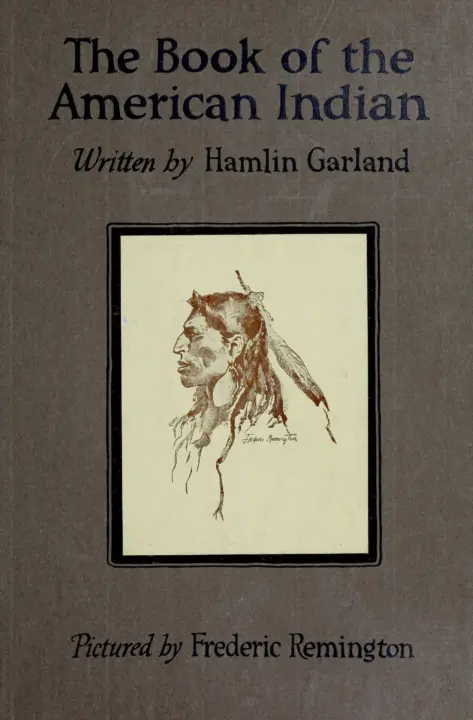
The book of the American Indian
Hamlin Garland
THE CLASSIC COLLECTION · 1908
"The Shadow World" by Hamlin Garland is a novel written in the early 20th century. The book explores themes of spiritualism and the phenomena associated with it, centering around a group of intellectuals who engage in discussions and experiments involving psychics and the supernatural. The narrative begins to unfold through the interactions and debates amongst the characters, setting the stage for a deeper exploration of the unknown. The opening of the book introduces a dinner party where various guests express differing views on telepathy and spiritualism. The main character takes a leading role in discussing these phenomena, mentioning his involvement with the American Psychical Society and his experiences with mediums. As the conversation progresses, the guests become increasingly intrigued by the topic, leading to a proposal for a psychic séance. This sets the groundwork for potential revelations and encounters with the "shadow world" that will unfold in later chapters. The atmosphere is charged with curiosity and skepticism, reflecting the tension between belief and disbelief that pervades the narrative.
Introduction adapted from the source catalogue; source summaries may be automatically generated.
Free to read · English · 68,177 words · No account needed
MAKE TIME FOR A GOOD BOOK
On by default. Untick to stop anonymous reading totals. Each page counts after 10 seconds in view. How this works.
Anonymous counting is on unless you have switched it off.
A hush fell over the dinner-table, and every ear was open and inclined as Cameron, the host, continued: "No, I wouldn't say that. There are some things that are pretty well established--telepathy, for instance."
"I don't believe even in telepathy," asserted Mrs. Quigg, a very positive journalist who sat at his right. "I think even that is mere coincidence."
Several voices rose in a chorus of protest. "Oh no! Telepathy is real. Why, I've had experiences--"
"There you go!" replied Mrs. Quigg, still in the heat of her opposition. "You will all tell the same story. Your friend was dying in Bombay or Vienna, and his spirit appeared to you, a la Journal of Psychic Research, with a message, at the exact hour, computing difference in time (which no one ever does), and so on. I know that kind of thing--but that isn't telepathy."
"What is telepathy, then?" asked little Miss Brush, who paints
miniatures.
"I can't describe a thing that doesn't exist," replied Mrs. Quigg. "The word means feeling at a distance, does it not, professor?"
Harris, a teacher of English, who seldom took a serious view of anything, answered, "I should call it a long-distance touch."
"Do you believe in hypnotism, Dr. Miller?" asked Miss Brush, quietly
addressing her neighbor, a young scientist whose specialty was
chemistry.
"No," replied he; "I don't believe in a single one of these supernatural
forces."
"You mean you don't believe in anything you have not seen yourself,"
said I.
To this Miller slowly replied: "I believe in Vienna, which I have never seen, but I don't believe in a Vienna doctor who claims to be able to hypnotize a man so that he can smile while his leg is being taken off."
"Oh, that's a fact," stated Brierly, the portrait-painter; "that happens every day in our hospitals here in New York City."
"Have you ever seen it done?" asked Miller, bristling with opposition.
"No."
"Well," asserted Miller, "I wouldn't believe it even if I saw the
operation performed."
"You don't believe in any mystery unless it is familiar," said I,
warming to the contest.
"I certainly do not believe in these childish mysteries," responded Miller, "and it is strange to me that men like Sir Oliver Lodge and Sir William Crookes should believe in slate-writing and levitation and all the rest of that hocus-pocus."
"Nevertheless, hypnotism is a fact," insisted Brierly. "You must have some faith in the big books on the subject filled with proof. Think of the tests--"
Your reading position is saved on this browser. Take it to another device with a library code. Reading pages adapt to text, rather than matching a printed edition.
Hamlin Garland
Hamlin Garland
Hamlin Garland
Hamlin Garland
BEHIND THE BOOK
This eBook is for the use of anyone anywhere in the United States and most other parts of the world at no cost and with almost no restrictions whatsoever. You may copy it, give it away or re-use it under the terms of the Project Gutenberg License included with this eBook or online at www.gutenberg.org. If you are not located in the United States, you will have to check the laws of the country where you are located before using this eBook. Read the source licence.
The original source file, including credits and licence, is retained by this library. Request an original-format copy at no charge. Please include the book title and Project Gutenberg identifier #22593.
KEEP YOUR CURIOSITY GOING
Coulson Kernahan

Maurice Baring
Frances Wright
Cécile Tormay

Frederic Jesup Stimson

W. H. P. (William Henry Pope) Jarvis