THE CLASSIC COLLECTION✦To Cuba and BackCLASSIC FREE BOOKS
To Cuba and Back
Richard Henry Dana
THE CLASSIC COLLECTION · 1851
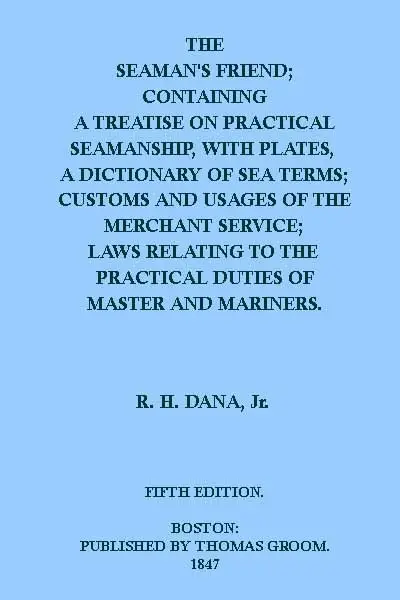
"The Seaman's Friend" by Richard Henry Dana is a comprehensive guide on practical seamanship written in the early 19th century. This work serves as a crucial resource for sailors, providing detailed information about ship construction, rigging, and the laws and customs governing maritime life. It is particularly aimed at those new to sea life and includes technical diagrams and practical advice for both novice and experienced mariners. The beginning of the book outlines its purpose and dedication to various stakeholders in the maritime industry, including sailors, ship owners, and legal authorities. It introduces the first section, which focuses on practical seamanship, including the construction of vessels and the management of sails and rigging. The text elaborates on the technical specifications and proportions vital for building and operating merchant vessels, offering insights into the various kinds of equipment and terminology pertinent to seamanship. This foundational content sets the stage for deeper explorations into the complexities of maritime duties and regulations as the book progresses.
Introduction adapted from the source catalogue; source summaries may be automatically generated.
Free to read · English · 87,833 words · No account needed
MAKE TIME FOR A GOOD BOOK
On by default. Untick to stop anonymous reading totals. Each page counts after 10 seconds in view. How this works.
Anonymous counting is on unless you have switched it off.
Rudder-chains lead from the outer and upper end of the rudder to the quarters. They are hung slack.
CHAIN-PLATES. Plates of iron bolted to the side of a ship, to which the chains and dead-eyes of the lower rigging are connected.
CHANNELS. Broad pieces of plank bolted edgewise to the outside of a vessel. Used for spreading the lower rigging. (See CHAINS.)
CHAPELLING. Wearing a ship round, when taken aback, without bracing the head yards. (See page 80.)
CHECK. A term sometimes used for slacking off a little on a brace, and
then belaying it.
CHEEKS. The projections on each side of a mast, upon which the trestle-trees rest. The sides of the shell of a block.
CHEERLY! Quickly, with a will.
CHESS-TREES. Pieces of oak, fitted to the sides of a vessel, abaft the fore chains, with a sheave in them, to board the main tack to. Now out of use.
CHIMES. The ends of the staves of a cask, where they come out beyond
the head of the cask.
CHINSE. To thrust oakum into seams with a small iron.
CHOCK. A wedge used to secure anything with, or for anything to rest upon. The long boat rests upon two large chocks, when it is stowed.
Chock-a-block. When the lower block of a tackle is run close up to the upper one, so that you can hoist no higher. This is also called hoisting up two-blocks.
CISTERN. An apartment in the hold of a vessel, having a pipe leading out through the side, with a cock, by which water may be let into her.
CLAMPS. Thick planks on the inside of vessels, to support the ends of beams. Also, crooked plates of iron fore-locked upon the trunnions of cannon. Any plate of iron made to turn, open, and shut so as to confine a spar or boom, as, a studdingsail boom, or a boat's mast.
CLASP-HOOK. (See CLOVE-HOOK.)
CLEAT. A piece of wood used in different parts of a vessel to belay
ropes to.
CLEW. The lower corner of square sails, and the after corner of a
fore-and-aft sail.
To clew up, is to haul up the clew of a sail.
CLEW-GARNET. A rope that hauls up the clew of a foresail or mainsail in
a square-rigged vessel.
CLEWLINE. A rope that hauls up the clew of a square sail. The clew-garnet is the clewline of a course.
CLINCH. A half-hitch, stopped to its own part.
CLOSE-HAULED. Applied to a vessel which is sailing with her yards braced up so as to get as much as possible to windward. The same as on a taut bowline, full and by, on the wind, &c.
Your reading position is saved on this browser. Take it to another device with a library code. Reading pages adapt to text, rather than matching a printed edition.
BEHIND THE BOOK
This eBook is for the use of anyone anywhere in the United States and most other parts of the world at no cost and with almost no restrictions whatsoever. You may copy it, give it away or re-use it under the terms of the Project Gutenberg License included with this eBook or online at www.gutenberg.org. If you are not located in the United States, you will have to check the laws of the country where you are located before using this eBook. Read the source licence.
The original source file, including credits and licence, is retained by this library. Request an original-format copy at no charge. Please include the book title and Project Gutenberg identifier #40958.
KEEP YOUR CURIOSITY GOING

John Muir

Asa Gray
Asa Gray

Florence Nightingale
Elizabeth Robins Pennell
Denison Olmsted