THE CLASSIC COLLECTION✦To Cuba and BackCLASSIC FREE BOOKS
To Cuba and Back
Richard Henry Dana
THE CLASSIC COLLECTION · 1851
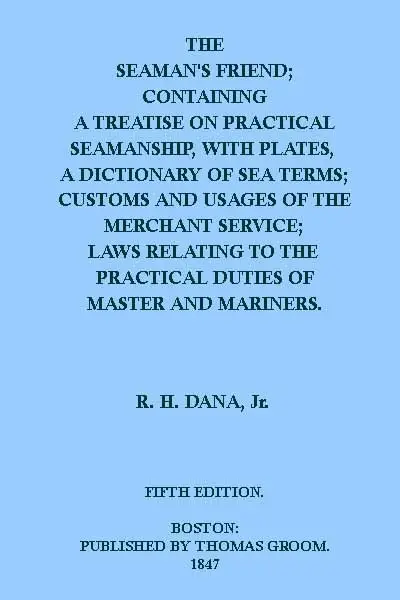
"The Seaman's Friend" by Richard Henry Dana is a comprehensive guide on practical seamanship written in the early 19th century. This work serves as a crucial resource for sailors, providing detailed information about ship construction, rigging, and the laws and customs governing maritime life. It is particularly aimed at those new to sea life and includes technical diagrams and practical advice for both novice and experienced mariners. The beginning of the book outlines its purpose and dedication to various stakeholders in the maritime industry, including sailors, ship owners, and legal authorities. It introduces the first section, which focuses on practical seamanship, including the construction of vessels and the management of sails and rigging. The text elaborates on the technical specifications and proportions vital for building and operating merchant vessels, offering insights into the various kinds of equipment and terminology pertinent to seamanship. This foundational content sets the stage for deeper explorations into the complexities of maritime duties and regulations as the book progresses.
Introduction adapted from the source catalogue; source summaries may be automatically generated.
Free to read · English · 87,833 words · No account needed
MAKE TIME FOR A GOOD BOOK
On by default. Untick to stop anonymous reading totals. Each page counts after 10 seconds in view. How this works.
Anonymous counting is on unless you have switched it off.
BEARING. The direction of an object from the person looking. The bearings of a vessel, are the widest part of her below the plank-shear. That part of her hull which is on the water-line when she is at anchor and in her proper trim.
BEATING. Going toward the direction of the wind, by alternate tacks.
BECALM. To intercept the wind. A vessel or highland to windward is said to becalm another. So one sail becalms another.
BECKET. A piece of rope placed so as to confine a spar or another rope. A handle made of rope, in the form of a circle, (as the handle of a chest,) is called a becket.
BEES. Pieces of plank bolted to the outer end of the bowsprit, to reeve the foretopmast stays through.
BELAY. To make a rope fast by turns round a pin or coil, without
hitching or seizing it.
BEND. To make fast.
To bend a sail, is to make it fast to the yard.
To bend a cable, is to make it fast to the anchor.
A bend, is a knot by which one rope is made fast to another.
BENDS. (See PLATE 3.) The strongest part of a vessel's side, to which the beams, knees, and foot-hooks are bolted. The part between the water's edge and the bulwarks.
BENEAPED. (See NEAPED.)
BENTICK SHROUDS. Formerly used, and extending from the futtock-staves
to the opposite channels.
BERTH. The place where a vessel lies. The place in which a man sleeps.
BETWEEN-DECKS. The space between any two decks of a ship.
BIBBS. Pieces of timber bolted to the hounds of a mast, to support the
trestle-trees.
BIGHT. The double part of a rope when it is folded; in contradistinction from the ends. Any part of a rope may be called the bight, except the ends. Also, a bend in the shore, making a small bay or inlet.
BILGE. That part of the floor of a ship upon which she would rest if aground; being the part near the keel which is more in a horizontal than a perpendicular line.
Bilge-ways. Pieces of timber bolted together and placed under the
bilge, in launching.
Bilged. When the bilge is broken in.
Bilge Water. Water which settles in the bilge.
Bilge. The largest circumference of a cask.
BILL. The point at the extremity of the fluke of an anchor.
BILLET-HEAD. (See HEAD.)
BINNACLE. A box near the helm, containing the compass.
BITTS. Perpendicular pieces of timber going through the deck, placed to secure anything to. The cables are fastened to them, if there is no windlass. There are also bitts to secure the windlass, and on each side of the heel of the bowsprit.
Your reading position is saved on this browser. Take it to another device with a library code. Reading pages adapt to text, rather than matching a printed edition.
BEHIND THE BOOK
This eBook is for the use of anyone anywhere in the United States and most other parts of the world at no cost and with almost no restrictions whatsoever. You may copy it, give it away or re-use it under the terms of the Project Gutenberg License included with this eBook or online at www.gutenberg.org. If you are not located in the United States, you will have to check the laws of the country where you are located before using this eBook. Read the source licence.
The original source file, including credits and licence, is retained by this library. Request an original-format copy at no charge. Please include the book title and Project Gutenberg identifier #40958.
KEEP YOUR CURIOSITY GOING

John Muir

Asa Gray
Asa Gray

Florence Nightingale
Elizabeth Robins Pennell
Denison Olmsted