THE CLASSIC COLLECTION✦To Cuba and BackCLASSIC FREE BOOKS
To Cuba and Back
Richard Henry Dana
THE CLASSIC COLLECTION · 1851
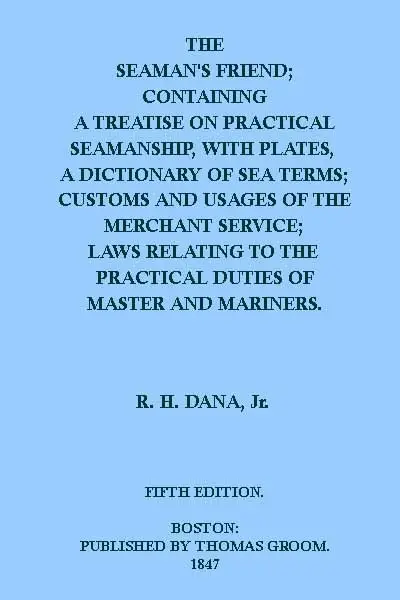
"The Seaman's Friend" by Richard Henry Dana is a comprehensive guide on practical seamanship written in the early 19th century. This work serves as a crucial resource for sailors, providing detailed information about ship construction, rigging, and the laws and customs governing maritime life. It is particularly aimed at those new to sea life and includes technical diagrams and practical advice for both novice and experienced mariners. The beginning of the book outlines its purpose and dedication to various stakeholders in the maritime industry, including sailors, ship owners, and legal authorities. It introduces the first section, which focuses on practical seamanship, including the construction of vessels and the management of sails and rigging. The text elaborates on the technical specifications and proportions vital for building and operating merchant vessels, offering insights into the various kinds of equipment and terminology pertinent to seamanship. This foundational content sets the stage for deeper explorations into the complexities of maritime duties and regulations as the book progresses.
Introduction adapted from the source catalogue; source summaries may be automatically generated.
Free to read · English · 87,833 words · No account needed
MAKE TIME FOR A GOOD BOOK
On by default. Untick to stop anonymous reading totals. Each page counts after 10 seconds in view. How this works.
Anonymous counting is on unless you have switched it off.
[96] 2 Sumner, 1. Ware, 219.
[97] Ware, 367. Gilpin, 31.
[98] 1 Pet. Ad. 168.
The practice of subjecting American seamen to foreign authority, or to persons whom they cannot well hold answerable,--like that of foreign imprisonment,--is an odious one, and must be justified by an overpowering necessity.
A recent statute[99] makes it the duty of consuls to exert themselves to reclaim deserters and discountenance insubordination, and authorizes them to employ the local authorities, where it can usefully be done, for those purposes. But this will unquestionably be restricted to the apprehension of the deserter, and the quelling of the revolt or mutiny; and as soon as these ends are attained, the sole responsibility of the master in dealing with the crew will re-attach.
[99] Act 1840, ch. 23, §1.
If the master is present while the mate, or any subordinate officer, inflicts punishment upon any of the crew, or if it is inflicted under such circumstances as would raise a presumption that the master was knowing of it, and he does not interfere, he will be held to have adopted it as his own act, and will be answerable accordingly.[100]
[100] 2 Sumner, 1.
In addition to the master's liability to the seamen in damages for abuse of power, he is also liable, as a criminal, to fine and imprisonment. A recent statute enacts, that "if any master, or other officer, of an American vessel, shall, from malice, hatred, or revenge, and without justifiable cause, beat, wound, or imprison any one or more of the crew of such vessel, or withhold from them suitable food or nourishment, or inflict on them any cruel or unusual punishment, every such person so offending shall, on conviction thereof, be punished by fine not exceeding one thousand dollars, or by imprisonment not exceeding five years, or by both, according to the nature and aggravation of the offence."[101] It is held that the word 'crew,' in this statute, includes officers; and accordingly a master was punished for unjustifiably confining and otherwise mal-treating his chief mate.[102]
[101] Act 1835, ch. 313, §3.
[102] 3 Sumner, 209.
To constitute 'malice' in the above statute, it is not necessary to show malignity as it is commonly understood, or brutality; but the term, in law, requires no more than a 'wilful intention to do a wrongful act.' An offence is punishable under this act, even although no bad passions came into play, (as hatred, or revenge,) for the term 'malice,' in law, covers all cases of intentional wrong, in their mildest form.[103]
[103] 2 Sumner, 584.
Your reading position is saved on this browser. Take it to another device with a library code. Reading pages adapt to text, rather than matching a printed edition.
BEHIND THE BOOK
This eBook is for the use of anyone anywhere in the United States and most other parts of the world at no cost and with almost no restrictions whatsoever. You may copy it, give it away or re-use it under the terms of the Project Gutenberg License included with this eBook or online at www.gutenberg.org. If you are not located in the United States, you will have to check the laws of the country where you are located before using this eBook. Read the source licence.
The original source file, including credits and licence, is retained by this library. Request an original-format copy at no charge. Please include the book title and Project Gutenberg identifier #40958.
KEEP YOUR CURIOSITY GOING

John Muir

Asa Gray
Asa Gray

Florence Nightingale
Elizabeth Robins Pennell
Denison Olmsted