THE CLASSIC COLLECTION✦To Cuba and BackCLASSIC FREE BOOKS
To Cuba and Back
Richard Henry Dana
THE CLASSIC COLLECTION · 1851
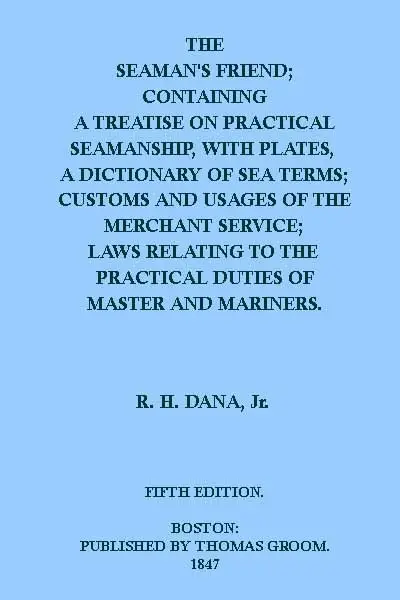
"The Seaman's Friend" by Richard Henry Dana is a comprehensive guide on practical seamanship written in the early 19th century. This work serves as a crucial resource for sailors, providing detailed information about ship construction, rigging, and the laws and customs governing maritime life. It is particularly aimed at those new to sea life and includes technical diagrams and practical advice for both novice and experienced mariners. The beginning of the book outlines its purpose and dedication to various stakeholders in the maritime industry, including sailors, ship owners, and legal authorities. It introduces the first section, which focuses on practical seamanship, including the construction of vessels and the management of sails and rigging. The text elaborates on the technical specifications and proportions vital for building and operating merchant vessels, offering insights into the various kinds of equipment and terminology pertinent to seamanship. This foundational content sets the stage for deeper explorations into the complexities of maritime duties and regulations as the book progresses.
Introduction adapted from the source catalogue; source summaries may be automatically generated.
Free to read · English · 87,833 words · No account needed
MAKE TIME FOR A GOOD BOOK
On by default. Untick to stop anonymous reading totals. Each page counts after 10 seconds in view. How this works.
Anonymous counting is on unless you have switched it off.
To spring a luff, is to force a vessel close to the wind, in sailing.
SPRING-STAY. A preventer-stay, to assist the regular one. (See STAY.)
SPRING TIDES. The highest and lowest course of tides, occurring every
new and full moon.
SPRIT. A small boom or gaff, used with some sails in small boats. The lower end rests in a becket or snotter by the foot of the mast, and the other end spreads and raises the outer upper corner of the sail, crossing it diagonally. A sail so rigged in a boat is called a sprit-sail.
SPRIT-SAIL-YARD. (See PLATE 1.) A yard lashed across the bowsprit or knight-heads, and used to spread the guys of the jib and flying jib-boom. There was formerly a sail bent to it called a sprit-sail.
SPUNYARN. (See page 44.) A cord formed by twisting together two or
three rope-yarns.
SPURLING LINE. A line communicating between the tiller and tell-tale.
SPURS. Pieces of timber fixed on the bilge-ways, their upper ends being bolted to the vessel's sides above the water. Also, curved pieces of timber, serving as half beams, to support the decks where whole beams cannot be placed.
SPUR-SHOES. Large pieces of timber that come abaft the pump-well.
SQUARE. Yards are squared when they are horizontal and at right angles with the keel. Squaring by the lifts makes them horizontal; and by the braces, makes them at right angles with the vessel's line. Also, the proper term for the length of yards. A vessel has square yards when her yards are unusually long. A sail is said to be very square on the head when it is long on the head.
To square a yard, in working ship, means to bring it in square by the
braces.
SQUARE-SAIL. A temporary sail, set at the fore-mast of a schooner or sloop when going before the wind. (See SAIL.)
STAFF. A pole or mast, used to hoist flags upon.
STANCHIONS. (See PLATE 3.) Upright posts of wood or iron, placed so as to support the beams of a vessel. Also, upright pieces of timber, placed at intervals along the sides of a vessel, to support the bulwarks and rail, and reaching down to the bends, by the side of the timbers, to which they are bolted. Also, any fixed, upright support; as to an awning, or for the man-ropes.
STAND BY! An order to be prepared.
STANDARD. An inverted knee, placed above the deck instead of beneath it; as, bitt-standard, &c.
STANDING. The standing part of a rope is that part which is fast, in opposition to the part that is hauled upon; or the main part, in opposition to the end.
Your reading position is saved on this browser. Take it to another device with a library code. Reading pages adapt to text, rather than matching a printed edition.
BEHIND THE BOOK
This eBook is for the use of anyone anywhere in the United States and most other parts of the world at no cost and with almost no restrictions whatsoever. You may copy it, give it away or re-use it under the terms of the Project Gutenberg License included with this eBook or online at www.gutenberg.org. If you are not located in the United States, you will have to check the laws of the country where you are located before using this eBook. Read the source licence.
The original source file, including credits and licence, is retained by this library. Request an original-format copy at no charge. Please include the book title and Project Gutenberg identifier #40958.
KEEP YOUR CURIOSITY GOING

John Muir

Asa Gray
Asa Gray

Florence Nightingale
Elizabeth Robins Pennell
Denison Olmsted