THE CLASSIC COLLECTION✦To Cuba and BackCLASSIC FREE BOOKS
To Cuba and Back
Richard Henry Dana
THE CLASSIC COLLECTION · 1851
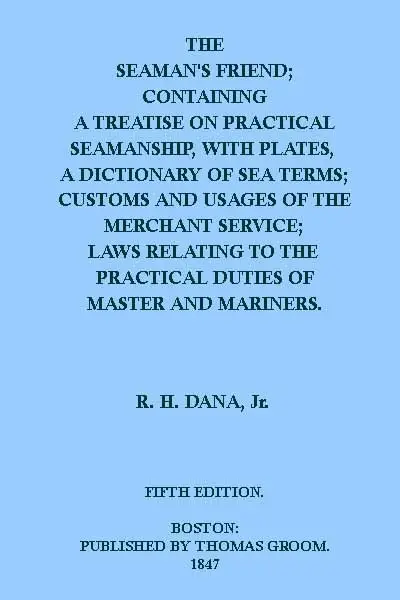
"The Seaman's Friend" by Richard Henry Dana is a comprehensive guide on practical seamanship written in the early 19th century. This work serves as a crucial resource for sailors, providing detailed information about ship construction, rigging, and the laws and customs governing maritime life. It is particularly aimed at those new to sea life and includes technical diagrams and practical advice for both novice and experienced mariners. The beginning of the book outlines its purpose and dedication to various stakeholders in the maritime industry, including sailors, ship owners, and legal authorities. It introduces the first section, which focuses on practical seamanship, including the construction of vessels and the management of sails and rigging. The text elaborates on the technical specifications and proportions vital for building and operating merchant vessels, offering insights into the various kinds of equipment and terminology pertinent to seamanship. This foundational content sets the stage for deeper explorations into the complexities of maritime duties and regulations as the book progresses.
Introduction adapted from the source catalogue; source summaries may be automatically generated.
Free to read · English · 87,833 words · No account needed
MAKE TIME FOR A GOOD BOOK
On by default. Untick to stop anonymous reading totals. Each page counts after 10 seconds in view. How this works.
Anonymous counting is on unless you have switched it off.
PAY-OFF. When a vessel's head falls off from the wind.
To pay. To cover over with tar or pitch.
To pay out. To slack up on a cable and let it run out.
PEAK. The upper outer corner of a gaff-sail.
PEAK. (See A-PEAK.)
A stay-peak is when the cable and fore stay form a line.
A short stay-peak is when the cable is too much in to form this line.
PENDANT, or PENNANT. A long narrow piece of bunting, carried at the
mast-head.
Broad pennant, is a square piece, carried in the same way, in a
commodore's vessel.
Pennant. A rope to which a purchase is hooked. A long strap fitted at one end to a yard or mast-head, with a hook or block at the other end, for a brace to reeve through, or to hook a tackle to.
PILLOW. A block which supports the inner end of the bowsprit.
PIN. The axis on which a sheave turns. Also, a short piece of wood or
iron to belay ropes to.
PINK-STERN. A high, narrow stern.
PINNACE. A boat, in size between the launch and a cutter.
PINTLE. A metal bolt, used for hanging a rudder.
PITCH. A resin taken from pine, and used for filling up the seams of a
vessel.
PLANKS. Thick, strong boards, used for covering the sides and decks of
vessels.
PLAT. A braid of foxes. (See FOX.)
PLATE. (See CHAIN-PLATE.)
PLUG. A piece of wood, fitted into a hole in a vessel or boat, so as to let in or keep out water.
POINT. To take the end of a rope and work it over with knittles. (See
page 51. See REEF-POINTS.)
POLE. Applied to the highest mast of a ship, usually painted; as,
skysail pole.
POOP. A deck raised over the after part of the spar deck. A vessel is pooped when the sea breaks over her stern.
POPPETS. Perpendicular pieces of timber fixed to the fore-and-aft part of the bilge-ways in launching.
PORT. Used instead of larboard.
To port the helm, is to put it to the larboard.
PORT, or PORT-HOLE. Holes in the side of a vessel, to point cannon out
of. (See BRIDLE.)
PORTOISE. The gunwale. The yards are a-portoise when they rest on the
gunwale.
PORT-SILLS. (See SILLS.)
PREVENTER. An additional rope or spar, used as a support.
PRICK. A quantity of spunyarn or rope laid close up together.
PRICKER. A small marlinspike, used in sail-making. It generally has a
wooden handle.
PUDDENING. A quantity of yarns, matting or oakum, used to prevent
chafing.
PUMP-BRAKE. The handle to the pump.
PURCHASE. A mechanical power which increases the force applied.
To purchase, is to raise by a purchase.
Your reading position is saved on this browser. Take it to another device with a library code. Reading pages adapt to text, rather than matching a printed edition.
BEHIND THE BOOK
This eBook is for the use of anyone anywhere in the United States and most other parts of the world at no cost and with almost no restrictions whatsoever. You may copy it, give it away or re-use it under the terms of the Project Gutenberg License included with this eBook or online at www.gutenberg.org. If you are not located in the United States, you will have to check the laws of the country where you are located before using this eBook. Read the source licence.
The original source file, including credits and licence, is retained by this library. Request an original-format copy at no charge. Please include the book title and Project Gutenberg identifier #40958.
KEEP YOUR CURIOSITY GOING

John Muir

Asa Gray
Asa Gray

Florence Nightingale
Elizabeth Robins Pennell
Denison Olmsted