THE CLASSIC COLLECTION✦To Cuba and BackCLASSIC FREE BOOKS
To Cuba and Back
Richard Henry Dana
THE CLASSIC COLLECTION · 1851
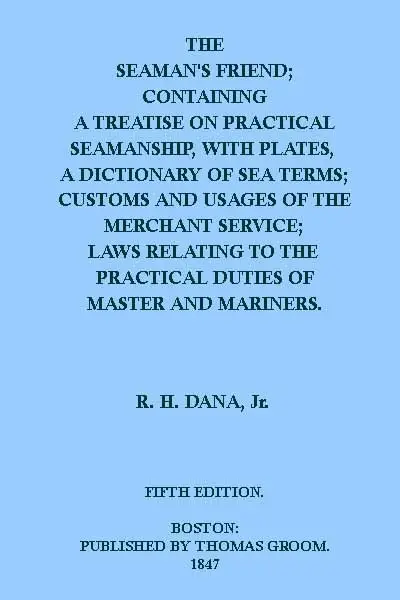
"The Seaman's Friend" by Richard Henry Dana is a comprehensive guide on practical seamanship written in the early 19th century. This work serves as a crucial resource for sailors, providing detailed information about ship construction, rigging, and the laws and customs governing maritime life. It is particularly aimed at those new to sea life and includes technical diagrams and practical advice for both novice and experienced mariners. The beginning of the book outlines its purpose and dedication to various stakeholders in the maritime industry, including sailors, ship owners, and legal authorities. It introduces the first section, which focuses on practical seamanship, including the construction of vessels and the management of sails and rigging. The text elaborates on the technical specifications and proportions vital for building and operating merchant vessels, offering insights into the various kinds of equipment and terminology pertinent to seamanship. This foundational content sets the stage for deeper explorations into the complexities of maritime duties and regulations as the book progresses.
Introduction adapted from the source catalogue; source summaries may be automatically generated.
Free to read · English · 87,833 words · No account needed
MAKE TIME FOR A GOOD BOOK
On by default. Untick to stop anonymous reading totals. Each page counts after 10 seconds in view. How this works.
Anonymous counting is on unless you have switched it off.
FASHION-PIECES. The aftermost timbers, terminating the breadth and forming the shape of the stern.
FAST. A rope by which a vessel is secured to a wharf. There are bow or head, breast, quarter, and stern fasts.
FATHOM. Six feet.
FEATHER. To feather an oar in rowing, is to turn the blade horizontally with the top aft as it comes out of the water.
FEATHER-EDGED. Planks which have one side thicker than another.
FENDERS. Pieces of rope or wood hung over the side of a vessel or boat, to protect it from chafing. The fenders of a neat boat are usually made of canvass and stuffed.
FID. A block of wood or iron, placed through the hole in the heel of a mast, and resting on the trestle-trees of the mast below. This supports the mast. Also, a wooden pin, tapered, used in splicing large ropes, in opening eyes, &c.
FIDDLE-BLOCK. A long shell, having one sheave over the other, and the lower smaller than the upper.
FIDDLE-HEAD. (See HEAD.)
FIFE-RAIL. The rail going round a mast.
FIGURE-HEAD. A carved head or full-length figure, over the cut-water.
FILLINGS. Pieces of timber used to make the curve fair for the
mouldings, between the edges of the fish-front and the sides of the
mast.
FILLER. (See MADE MAST.)
FINISHING. Carved ornaments of the quarter-galley, below the second counter, and above the upper lights.
FISH. To raise the flukes of an anchor upon the gunwale. Also, to strengthen a spar when sprung or weakened, by putting in or fastening on another piece.
Fish-front, Fishes-sides. (See MADE MAST.)
FISH-DAVIT. The davit used for fishing an anchor.
FISH-HOOK. A hook with a pennant, to the end of which the fish-tackle
is hooked.
FISH-TACKLE. The tackle used for fishing an anchor.
FLARE. When the vessel's sides go out from the perpendicular. In opposition to falling-home or tumbling-in.
FLAT. A sheet is said to be hauled flat, when it is hauled down
close.
Flat-aback, when a sail is blown with its after surface against the
mast.
FLEET. To come up a tackle and draw the blocks apart, for another pull, after they have been hauled two-blocks.
Fleet ho! The order given at such times. Also, to shift the position of a block or fall, so as to haul to more advantage.
FLEMISH COIL. (See FRENCH-FAKE.)
FLEMISH-EYE. A kind of eye-splice. (See PLATE 5 and page 45.)
FLEMISH-HORSE. An additional foot-rope at the ends of topsail yards.
FLOOR. The bottom of a vessel, on each side of the keelson.
FLOOR TIMBERS. Those timbers of a vessel which are placed across the
keel. (See PLATE 3.)
FLOWING SHEET. When a vessel has the wind free, and the lee clews eased
off.
Your reading position is saved on this browser. Take it to another device with a library code. Reading pages adapt to text, rather than matching a printed edition.
BEHIND THE BOOK
This eBook is for the use of anyone anywhere in the United States and most other parts of the world at no cost and with almost no restrictions whatsoever. You may copy it, give it away or re-use it under the terms of the Project Gutenberg License included with this eBook or online at www.gutenberg.org. If you are not located in the United States, you will have to check the laws of the country where you are located before using this eBook. Read the source licence.
The original source file, including credits and licence, is retained by this library. Request an original-format copy at no charge. Please include the book title and Project Gutenberg identifier #40958.
KEEP YOUR CURIOSITY GOING

John Muir

Asa Gray
Asa Gray

Florence Nightingale
Elizabeth Robins Pennell
Denison Olmsted