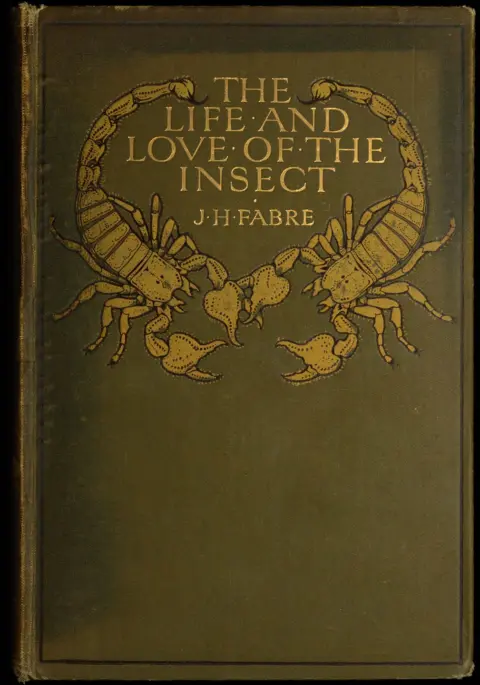
The Life and Love of the Insect
Jean-Henri Fabre
THE CLASSIC COLLECTION · 1918
"The Sacred Beetle and Others" by Jean-Henri Fabre is a collection of essays on beetles, particularly focusing on the Sacred Beetle, which is likely written in the late 19th century. The work delves into the unique behaviors and instincts of various beetle species, exploring their nesting and reproductive habits, as well as their ecological significance. Fabre’s inquiry is steeped in detailed observation and scientific inquiry, revealing not only the complexity of these insects but also the fascinating interplay of nature and instinct. At the start of the work, Fabre introduces the Sacred Beetle and his companions as they embark on a quest to observe this peculiar insect. He describes the beetle's task of rolling dung into spherical balls, which serve as food, and elaborates on the intricate methods it employs to navigate its environment and construct its nest. Through vibrant depictions of their behaviors and interactions, the author invites readers into the rich and often overlooked world of insects, emphasizing both their industriousness and the wonder of their instinctual drives. This opening sets the stage for deeper explorations into entomology and invites readers to appreciate the complexity of life from a small but significant perspective.
Introduction adapted from the source catalogue; source summaries may be automatically generated.
Free to read · English · 90,848 words · No account needed
MAKE TIME FOR A GOOD BOOK
On by default. Untick to stop anonymous reading totals. Each page counts after 10 seconds in view. How this works.
Anonymous counting is on unless you have switched it off.
[42] Or imperial mushroom. For this and the purple boletus, cf. The Life of the Fly, by J. Henri Fabre, translated by Alexander Teixeira de Mattos: chap. xviii.—Translator’s Note.
[43] .546 × .273 inch.—Translator’s Note.
[44] .585 × .39 inch.—Translator’s Note.
[45] Pantagruel: chap. i.; Sir Thomas Urquhart’s
translation.—Translator’s Note.
[46] Minotaurus typhœus. Cf. The Life and Love of the Insect: chap.
x.—Translator’s Note.
[47] A genus of Longicorns, or Long-horned Beetles.—Translator’s Note.
[48] Cf. The Life of the Grasshopper, by J. Henri Fabre, translated by Alexander Teixeira de Mattos: chaps, i. to v.—Translator’s Note.
[49] .273 to .312 × .156 inch.—Translator’s Note.
[50] Johann Leonhard Frisch (1666–1743), a Lutheran clergyman, lexicologist and natural historian and member of the Berlin Academy. His Beschreibung von allerlei Insecten in Deutschland was published in 1720 to 1738.—Translator’s Note.
[51] Martial Étienne Mulsant (1797–1880), professor of natural history at the Lycée de Lyon; author of Histoire naturelle des coléoptères de France (1839–1846) and other entomological works.—Translator’s Note.
[52] Cf. The Life of the Grasshopper: chaps. vi. to ix.—Translator’s
Note.
[53] Cf. Bramble-bees and Others: chaps. ix. and x.—Translator’s Note.
[54] The Rose-chafer, whose grub forms the prey of the Scolia-wasp. Cf. The Life and Love of the Insect: chap. xi.—Translator’s Note.
[55] Cf. Fabre’s own youthful experiences, in The Life of the Fly: chap. vii.—Translator’s Note.
[56] For the author’s stay at Ajaccio, where he was a schoolmaster in his youth, cf. The Life of the Fly: chap. vi.—Translator’s Note.
[57] Chapter XI. of the present book appeared in the fifth volume of the Souvenirs entomologiques; this and the following chapter formed part of the tenth and last volume.—Translator’s Note.
[58] Cf. The Life and Love of the Insect: chap. x.—Translator’s Note.
[59] For the Epeiræ, or Garden Spiders, the Lycosa, or Black-bellied Tarantula, and the Labyrinth and Clotho Spiders, cf. The Life of the Spider, by J. Henri Fabre, translated by Alexander Teixeira de Mattos: passim.—Translator’s Note.
[60] Cf. The Life of the Grasshopper: chaps. viii., ix., xvi. and
xvii.—Translator’s Note.
[61] Cf. The Life of the Fly and The Life of the Caterpillar:
passim.—Translator’s Note.
[62] .039 inch.—Translator’s Note.
[63] Cf. The Life and Love of the Insect: chaps. xvii. and xviii. The seven essays on the Languedocian Scorpion will be included in the last volume of this complete edition of Fabre’s entomological works.—Translator’s Note.
[64] Cf. The Life of the Grasshopper: chap. xix.—Translator’s Note.
[65] Chapter XI. of the present volume.—Translator’s Note.
Your reading position is saved on this browser. Take it to another device with a library code. Reading pages adapt to text, rather than matching a printed edition.
Jean-Henri Fabre
Jean-Henri Fabre
Jean-Henri Fabre
Jean-Henri Fabre
BEHIND THE BOOK
This eBook is for the use of anyone anywhere in the United States and most other parts of the world at no cost and with almost no restrictions whatsoever. You may copy it, give it away or re-use it under the terms of the Project Gutenberg License included with this eBook or online at www.gutenberg.org. If you are not located in the United States, you will have to check the laws of the country where you are located before using this eBook. Read the source licence.
The original source file, including credits and licence, is retained by this library. Request an original-format copy at no charge. Please include the book title and Project Gutenberg identifier #66743.
KEEP YOUR CURIOSITY GOING

David Patterson (Spirit) Hatch

David Patterson (Spirit) Hatch

David Patterson (Spirit) Hatch

Ralph Waldo Emerson

Maurice Baring

Oscar Wilde & James McNeill Whistler