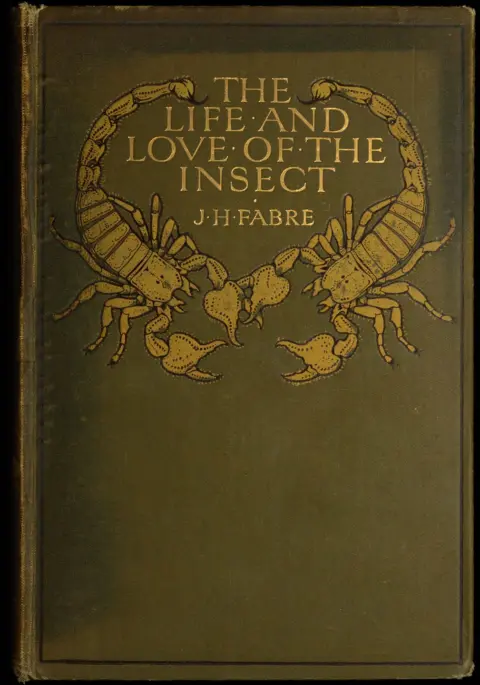
The Life and Love of the Insect
Jean-Henri Fabre
THE CLASSIC COLLECTION · 1918
"The Sacred Beetle and Others" by Jean-Henri Fabre is a collection of essays on beetles, particularly focusing on the Sacred Beetle, which is likely written in the late 19th century. The work delves into the unique behaviors and instincts of various beetle species, exploring their nesting and reproductive habits, as well as their ecological significance. Fabre’s inquiry is steeped in detailed observation and scientific inquiry, revealing not only the complexity of these insects but also the fascinating interplay of nature and instinct. At the start of the work, Fabre introduces the Sacred Beetle and his companions as they embark on a quest to observe this peculiar insect. He describes the beetle's task of rolling dung into spherical balls, which serve as food, and elaborates on the intricate methods it employs to navigate its environment and construct its nest. Through vibrant depictions of their behaviors and interactions, the author invites readers into the rich and often overlooked world of insects, emphasizing both their industriousness and the wonder of their instinctual drives. This opening sets the stage for deeper explorations into entomology and invites readers to appreciate the complexity of life from a small but significant perspective.
Introduction adapted from the source catalogue; source summaries may be automatically generated.
Free to read · English · 90,848 words · No account needed
MAKE TIME FOR A GOOD BOOK
On by default. Untick to stop anonymous reading totals. Each page counts after 10 seconds in view. How this works.
Anonymous counting is on unless you have switched it off.
[11] Cf. The Life of the Grasshopper, by J. Henri Fabre, translated by Alexander Teixeira de Mattos: chaps. i. to v.—Translator’s Note.
[12] The weekly holiday in the French schools.—Translator’s Note.
[13] This seems the place in which to remind the reader that the first two chapters of the present volume correspond with Chapters I. and II. of the first volume of the Souvenirs entomologiques in their original form. Chapters III. to VII. of the present volume are translations of Chapters I. to V. of the fifth volume of the Souvenirs, published many years later, at a time when Fabre had completed his study of the Sacred Beetle.—Translator’s Note.
[14] Cf. Mulsant’s Coléoptères de France: Lamellicornes.—Author’s Note.
[15] Jean de La Fontaine (1621–1695), author of the famous
Fables.—Translator’s Note.
[16] ‘... a double chance of gain: First, one’s own profit; next, another’s loss.’
[17] .11 to .15 inch.—Translator’s Note.
[18] Close upon 9½ feet.—Translator’s Note.
[19] 1.75 × 1.17 inches.—Translator’s Note.
[20] 1.36 × 1.09 inches.—Translator’s Note.
[21] .39 × .19 inch.—Translator’s Note.
[22] Cf. The Life and Love of the Insect, by J. Henri Fabre, translated by Alexander Teixeira de Mattos: chap. xi.—Translator’s Note.
[23] Cf. The Hunting Wasps, by J. Henri Fabre, translated by Alexander Teixeira de Mattos: chaps, iv. to x.—Translator’s Note.
[24] .19 inch.—Translator’s Note.
[25] The last ventral segment of the abdomen.—Translator’s Note.
[26] Cf. Bramble-bees and Others, by J. Henri Fabre, translated by Alexander Teixeira de Mattos: chap. ix.—Translator’s Note.
[27] Pierre André Latreille (1762–1833), one of the founders of entomological science, a professor at the Muséum d’histoire naturelle and member of the Académie des sciences.—Translator’s Note.
[28] Cf. Mémoires du Muséum d’histoire naturelle: vol. v., p.
249.—Author’s Note.
[29] Horapollo Nilous, Orus Apollo, or Horos Apollo (fl. circa 400), author of the Hieroglyphica.—Translator’s Note.
[30] Etienne Marcel Mulsant (1797–1880), author of the Histoire naturelle des coléoptères en France (1839–1874) mentioned on page 94.—Translator’s Note.
[31] Hieroglyphics: Book 1., x.; Cory’s translation.—Translator’s Note.
[32] 1.28 × .93 inch.—Translator’s Note.
[33] Cf. inter alia the author’s Some Reflections upon Insect Psychology, in The Mason-Bees, by J. Henri Fabre, translated by Alexander Teixeira de Mattos: chap. vii.—Translator’s Note.
[34] Mites or Ticks.—Translator’s Note.
[35] Rove-beetles.—Translator’s Note.
[36] A genus of Dung-beetles.—Translator’s Note.
[37] Cf. Chapters XI., XVII. and XVIII. of the present
volume.—Translator’s Note.
[38] 1.56 × 1.32 inches.—Translator’s Note.
[39] Cf. Chapters XII. to XIV. of the present volume.—Translator’s
Note.
[40] Cf. The Mason-bees and Bramble-bees and Others:
passim.—Translator’s Note.
[41] Rose-chafers.—Translator’s Note.
Your reading position is saved on this browser. Take it to another device with a library code. Reading pages adapt to text, rather than matching a printed edition.
Jean-Henri Fabre
Jean-Henri Fabre
Jean-Henri Fabre
Jean-Henri Fabre
BEHIND THE BOOK
This eBook is for the use of anyone anywhere in the United States and most other parts of the world at no cost and with almost no restrictions whatsoever. You may copy it, give it away or re-use it under the terms of the Project Gutenberg License included with this eBook or online at www.gutenberg.org. If you are not located in the United States, you will have to check the laws of the country where you are located before using this eBook. Read the source licence.
The original source file, including credits and licence, is retained by this library. Request an original-format copy at no charge. Please include the book title and Project Gutenberg identifier #66743.
KEEP YOUR CURIOSITY GOING

David Patterson (Spirit) Hatch

David Patterson (Spirit) Hatch

David Patterson (Spirit) Hatch

Ralph Waldo Emerson

Maurice Baring

Oscar Wilde & James McNeill Whistler