
Last letters from the living dead man
David Patterson (Spirit) Hatch
THE CLASSIC COLLECTION · 1853
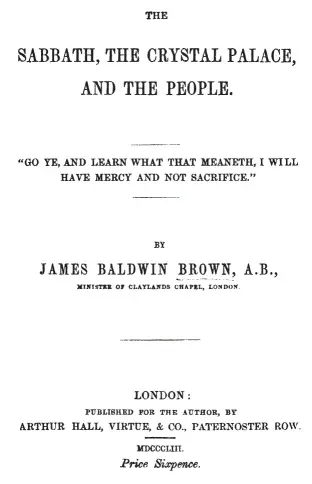
"The Sabbath, the Crystal Palace, and the People" by James Baldwin Brown is a theological discourse written during the mid-19th century. This publication examines the relationship between the Church and society, particularly addressing the contentious issue of opening the Crystal Palace on Sundays. The book reflects on the spiritual significance of the Sabbath and explores how it intersects with social progress, demonstrating a deep concern for the moral responsibilities of Christians in the context of a rapidly changing society. In this work, Brown articulates the necessity of maintaining the sanctity of the Sabbath while also recognizing the evolving needs of the working class in Victorian England. He argues against rigid opposition to the Crystal Palace's Sunday opening, positing that engagement with cultural institutions can elevate public morals and serve as a stepping stone towards a deeper appreciation of spiritual observances. Through thoughtful analysis and passionate rhetoric, Brown advocates for a balanced approach that honors both the tradition of the Sabbath and the contemporary needs of the populace, emphasizing the potential for cultural endeavors to fulfill the spiritual aspirations of the community.
Introduction adapted from the source catalogue; source summaries may be automatically generated.
Free to read · English · 10,143 words · No account needed
MAKE TIME FOR A GOOD BOOK
On by default. Untick to stop anonymous reading totals. Each page counts after 10 seconds in view. How this works.
Anonymous counting is on unless you have switched it off.
Having laid down these principles with regard to the Christian Sabbath, in refutation of the rationalistic argument, let us proceed to the practical application of them to the matter in hand. The case is just this. An institution is about to be formed and an exhibition opened, which must be regarded as the legitimate fruit of the forty years’ peace which that stern warrior conquered for us, whom we have just attended with befitting splendour to his burial, whose mourners were a million and a half of men. The Crystal Palace of last year was its direct result—the World’s Great Show—the Jubilee of Commerce, celebrated with festal pomp in London—the heart of the body commercial—whence also had gone forth, forty years ago, the head and the hands which had torn the troubler of the world’s peace from his throne, and inaugurated the new era. England gained the victory, and at the end of a long generation, unparalleled for activity and enterprise in the history of man, she called the world to her capital to see and to taste the fruits. Her grey old warrior was spared to see it. The peaceful pageant of commerce passed by him and did him homage, and then he was taken to his rest. It is surely remarkable, that Wellington was spared to see the crown of his labours—the fruit of generations of peaceful activities, which will be marked in history by his name—and then was removed before the event was consummated which may cost the world another struggle, and the blood of her bravest men. Such was the Crystal Palace of 1851.
The Crystal Palace of 1853 will have another and profounder character. It is an attempt to consecrate these fruits of the world’s strivings to the education and elevation of the great masses, whom commerce has too long used up, and then flung aside to perish. It is a deliberate effort to gather all the ripest fruit of the world’s most earnest strivings, most glorious victories, and present them, in order to minister to the development of the men, women, and children of the present generation. It is no mere exhibition, except in the sense in which the whole world is an exhibition. It is the grandest conception of a hitherto mechanical and money-loving generation, and has its root far deeper than in a desire for 5 per cent. returns. It grows up through the force of a conviction, which is now wrought into the mind of the community, that the intellect and wealth which commerce has developed, owe a ministry to the people of the land; and that while the merchant princes can pillage the Continent, Egypt, Palestine, India, and China, of their treasures, to minister to their own vanity, amusement, or instruction, the united strength of the intellect and wealth of the country should build a Palace, far transcending all private palaces, for the great people whose industry has made our England the queen of the kingdoms of the earth. It is emphatically a People’s Palace, and the organization of it on this gigantic scale, by men of shrewd understanding, is certainly a sign that the tide of public feeling has turned towards higher, more intellectual, more elevating pursuits and recreations, than it affected some fifteen years ago. The fact that the keenest speculators are now ransacking our world for the treasures of art, science, and the early history of our race, wherewith to adorn this Palace, is a proof that the very class which has been most prone to renounce all the higher attributes of humanity, and to make its life like that of the brutes that perish, is beginning to resume the exercise of those higher attributes, and to waken to a sense of what a man’s life includes. It is possible that many may regard this view of the New Exhibition as overstrained. Many expect that people will go to the Crystal Palace to see the sight, and, when they have seen it, will go to the public-houses and finish there. Such a view is both shallow and faithless. No doubt, those who like to think so will find plenty which will appear to sustain their views. “The people” is a vague term. It needs patient and intelligent observation, not on the outskirts, but in the centre of a great popular movement, to discern its character. The experience of the last few years does not confirm such anticipations. The working classes, who visit the Museum in Great Russell Street, the Zoological Gardens on Monday, Hampton Court, and Kew, add nothing to the disorder and drunkenness of the metropolis. It is wonderfully rare, even in the more distant exhibitions and places of intelligent enjoyment which have been mentioned, to meet with disorder. Certainly, the drunkenness and disorder of London have been greatly diminished by the opening of places of resort for the working classes where mind as well as body may be fed. Every thing in the past justifies the extension of the experiment, and on the grandest scale. To the poor man, these things are not so much exhibitions as they are to us who can more frequent them. They partake of the dignity of events, stir up the fountains of manhood, perhaps long stagnant, and make him feel life’s meaning and life’s worth, and thus they expand his soul. Now, it is worth while seriously to consider—Is this different from the object which God proposed in the institution of the Sabbath day? It stops far short of that object; but, as far as it goes, does it not travel in the same direction, and aim at the lifting man up from the brutish condition into which a too slavish daily toil would plunge him, to feel how much a man is better than a brute? God, in the Sabbath institution, seeks to make him feel that man is so much better than a brute, that he can talk to God as a Friend, and love Him as a Father. No human effort can teach man that;—no Sabbath observance, even of the strictest sort, can make man observe the Lord’s day, as the Lord counts observance; but when men, in the mass, are gone so far from the Sabbath that they systematically prostitute and pollute it, does God frown on human institutions, which work, however slowly and dimly, towards the realization of the benefit? Does He not say of all such, “Forbid them not, for he that is not against us is on our side?” If through the unconscious influence of Christianity, which has leavened even our speculating fraternities, “the earth is helping” the Kingdom; if the back-water of the mill-wheel of the Church has come round, and is adding its strength to the current; let us look on it lovingly and hopefully, as a state of things to be fostered and led onward to what is better, in no wise to be resisted and banned. And if men want to see this thing which is to elevate and educate them on the Lord’s day—the great mass of the people being notoriously averse to the Sabbath of the Church—we should not say, roughly and fiercely, “You shall not,” but recognize it, as far as it goes, as a sign of progress, hoping that, by all the humanizing influences which are brought to bear on them, we may regain a hold on them, and lead them on to a true appreciation of the Christian idea of the Sabbath. The gist of the matter seems to lie here:—at present, we have but slight hold on the working classes; they care not for our Sabbaths, and find no pleasure in our worship. Is it right, on the ground that it would be a formal breach of that Sabbath which is now really and flagrantly violated, to refuse our consent to a movement which will secure for them some portion, at any rate, of benefit on the Lord’s day?
Your reading position is saved on this browser. Take it to another device with a library code. Reading pages adapt to text, rather than matching a printed edition.
BEHIND THE BOOK
This eBook is for the use of anyone anywhere in the United States and most other parts of the world at no cost and with almost no restrictions whatsoever. You may copy it, give it away or re-use it under the terms of the Project Gutenberg License included with this eBook or online at www.gutenberg.org. If you are not located in the United States, you will have to check the laws of the country where you are located before using this eBook. Read the source licence.
The original source file, including credits and licence, is retained by this library. Request an original-format copy at no charge. Please include the book title and Project Gutenberg identifier #62202.
KEEP YOUR CURIOSITY GOING
David Patterson (Spirit) Hatch

David Patterson (Spirit) Hatch

David Patterson (Spirit) Hatch
Cécile Tormay

Moritz Busch
Coulson Kernahan