
Last letters from the living dead man
David Patterson (Spirit) Hatch
THE CLASSIC COLLECTION · 1853
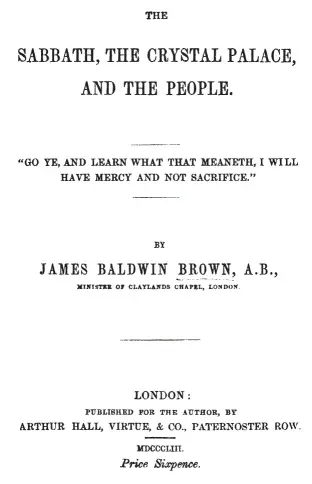
"The Sabbath, the Crystal Palace, and the People" by James Baldwin Brown is a theological discourse written during the mid-19th century. This publication examines the relationship between the Church and society, particularly addressing the contentious issue of opening the Crystal Palace on Sundays. The book reflects on the spiritual significance of the Sabbath and explores how it intersects with social progress, demonstrating a deep concern for the moral responsibilities of Christians in the context of a rapidly changing society. In this work, Brown articulates the necessity of maintaining the sanctity of the Sabbath while also recognizing the evolving needs of the working class in Victorian England. He argues against rigid opposition to the Crystal Palace's Sunday opening, positing that engagement with cultural institutions can elevate public morals and serve as a stepping stone towards a deeper appreciation of spiritual observances. Through thoughtful analysis and passionate rhetoric, Brown advocates for a balanced approach that honors both the tradition of the Sabbath and the contemporary needs of the populace, emphasizing the potential for cultural endeavors to fulfill the spiritual aspirations of the community.
Introduction adapted from the source catalogue; source summaries may be automatically generated.
Free to read · English · 10,143 words · No account needed
MAKE TIME FOR A GOOD BOOK
On by default. Untick to stop anonymous reading totals. Each page counts after 10 seconds in view. How this works.
Anonymous counting is on unless you have switched it off.
With many, much of the argument turns on this word “formal” breach. It is worth while to consider more fully its meaning, and to inquire into the real notions of Sabbath observance which prevail in the Christian church. We are all agreed, that the highest kind of good was contemplated by God in the institution of the Sabbath; we are not all agreed that, failing the highest good, a lesser good which is within our reach may lawfully be secured. Many good people reason thus:—“The Sabbath is God’s day. It is the portion of man’s time which He has cut off and consecrated to himself; the mere time is His, as well as the spirit of the worshipper; to recognize any secular employment of such time, is to recognize a robbery of God.” “Remember thou keep holy the Sabbath day.”
To this view of Sabbath observance it may be objected—1. It recognizes a distinction in kind between the common day and the sacred day, which has no warrant in the New Testament Scripture. Is not “work” a command, as well as “worship?” And is not every commandment holy, and obedience holy? Is it only on the first day that we are to be fervent in spirit? Are we not to be serving the Lord by diligence in business, with fervent spirit, every day in the week, in our places of business, and the haunts of men? The idea that the Sabbath is a kind of tribute paid to God, to allow us to go free to work on week-days—a sort of composition—is foreign both to the spirit and the letter of the teaching of the New Testament. The Lord’s day is to be a day of refreshing, of renewing of soul, that every day may be a day of Divine service, and have more, not less, of the sacred element infused into it. The idea of a tribute of one day out of seven, false as it is, rules very much of the feeling of the religious public on this question, and perhaps in a measure affects all our hearts. But a second objection, and a plainer one, to this view of the law of Sabbath observance, is this:—there is hardly a Christian to be found who professes practically to carry it out. How much of our Sabbath is literally spent in devotion, how much in cheerful converse with the family circle, how much in meals, how much in criticism of the sermon, not always of a highly spiritual cast, how much in passing references to the leading topics of the day? Let us be honest and single-minded, and answer from our consciences these questions. If we were to try our Sabbath observance by that law which did consecrate the time in its unity and completeness, which of us could stand? Do we regard this as a sin? By no means; because we feel that Christian Sabbath observance is in the spirit, and not in the letter; in the direction of our thoughts and desires without hindrance from the work-day world to God; in the feeling of rest—of Sabbath calm—of holy peace and joy—which has possessed us, and made our Sabbath more a thing to be measured by the Spirit’s instruments, and registered in the Spirit’s record, than by the clock. And if a man has no homage to render, no spiritual good to gain, because he desires none, what does he gain, what does the Church gain, what does the world gain, if he be compelled in some sort to recognize it, by being debarred from a pursuit which would at any other time be beneficial to him; provided always that his liberty be no detriment to those who have better ways of spending the day? Bring him to church to hear the Gospel! By all means. I would that all places of pleasure were shut up on Sabbaths, because men felt that they had better work on hand than to visit them. But if the man says, “I will not enter your churches—I hate them;”—we ask, where is the gain to him, to any one, in saying, “There are the ale-houses, there are the tea-gardens—you are a sinner for going, but there they are; there is, moreover, a train specially provided by Government for you to travel; but this Crystal Palace, so grand and beautiful, we can and will debar you from. Whatever good it has to offer you, you shall not get it on Sabbath days!” It seems very foolish to confess that all attempts to make the masses devote the hours of the Sabbath to devotion are futile—that no serious limit can be set successfully to the efforts of private speculators to tempt men to demoralizing Sabbath desecration—and yet, when a scheme is set on foot which aims at remedying in some sort the mischief, by elevating instead of degrading men, because it is so good and so complete as to be of national importance, its progress is barred at once.
Your reading position is saved on this browser. Take it to another device with a library code. Reading pages adapt to text, rather than matching a printed edition.
BEHIND THE BOOK
This eBook is for the use of anyone anywhere in the United States and most other parts of the world at no cost and with almost no restrictions whatsoever. You may copy it, give it away or re-use it under the terms of the Project Gutenberg License included with this eBook or online at www.gutenberg.org. If you are not located in the United States, you will have to check the laws of the country where you are located before using this eBook. Read the source licence.
The original source file, including credits and licence, is retained by this library. Request an original-format copy at no charge. Please include the book title and Project Gutenberg identifier #62202.
KEEP YOUR CURIOSITY GOING
David Patterson (Spirit) Hatch

David Patterson (Spirit) Hatch

David Patterson (Spirit) Hatch
Cécile Tormay

Moritz Busch
Coulson Kernahan