
Last letters from the living dead man
David Patterson (Spirit) Hatch
THE CLASSIC COLLECTION · 1853
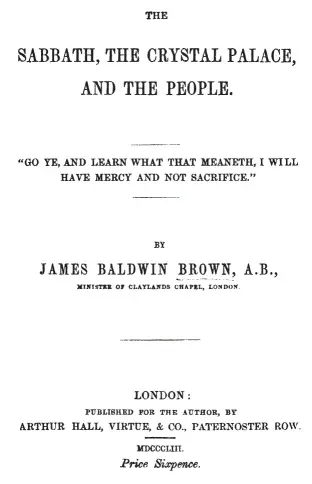
"The Sabbath, the Crystal Palace, and the People" by James Baldwin Brown is a theological discourse written during the mid-19th century. This publication examines the relationship between the Church and society, particularly addressing the contentious issue of opening the Crystal Palace on Sundays. The book reflects on the spiritual significance of the Sabbath and explores how it intersects with social progress, demonstrating a deep concern for the moral responsibilities of Christians in the context of a rapidly changing society. In this work, Brown articulates the necessity of maintaining the sanctity of the Sabbath while also recognizing the evolving needs of the working class in Victorian England. He argues against rigid opposition to the Crystal Palace's Sunday opening, positing that engagement with cultural institutions can elevate public morals and serve as a stepping stone towards a deeper appreciation of spiritual observances. Through thoughtful analysis and passionate rhetoric, Brown advocates for a balanced approach that honors both the tradition of the Sabbath and the contemporary needs of the populace, emphasizing the potential for cultural endeavors to fulfill the spiritual aspirations of the community.
Introduction adapted from the source catalogue; source summaries may be automatically generated.
Free to read · English · 10,143 words · No account needed
MAKE TIME FOR A GOOD BOOK
On by default. Untick to stop anonymous reading totals. Each page counts after 10 seconds in view. How this works.
Anonymous counting is on unless you have switched it off.
It seems very strange to some that a feature of Judaism so strongly marked, has so little formal recognition and reinforcement in the New Testament. What is the foundation of the Christian Sabbath? On what ground of reason or of law does it rest? Of law, none whatever. To the Pharisees, the men who sat in Moses’ seat, Christ appeared to be a Sabbath breaker. Whatever His estimation of it, His conduct with regard to it was such, that it could at any rate be said, with a colour of truth, “This man is not of God, because he keepeth not the Sabbath day.” On every occasion on which there is a question on the subject, Christ appears in strong antagonism to the Churchmen of his time; and on one occasion he defends himself by an appeal to an irregularity of David, which he justified on the ground of necessity; a mode of defence which must have greatly surprised them, which surprise he takes no pains to mitigate. And yet, mark you, he never allowed that he violated the spirit of the Sabbath institution; nay, he charged the rigid Sabbatarians with the violation, giving them a new lesson to learn—“Go ye, and learn what that meaneth, I will have mercy and not sacrifice.” For the rest, we have to gather the Sabbath law out of the New Testament in the following fashion:—
On the first day of the week, the Saviour arose from the dead, and laid the foundation of a new creation. On the first day of the week, Jesus appeared to his disciples, (John xx. 19 and 26.) On the first day of the week, the Apostles were baptized with tongues of fire. On the first day of the week, the disciples came together to break bread at Troas, (Acts xx. 7.) On this day Paul thinks a work of charity specially graceful and appropriate, (1 Cor. xvi. 2.) There is little doubt, but no decisive evidence, that the assemblies of Christians alluded to “passim” in the Epistles, are to be referred to this day; and John, in Patmos, “was in the Spirit on the Lord’s day.” As far as the New Testament is concerned, we believe that this is all. Some, then, might say that it is simply by implication and inference, and not by distinct commandment, that the Church keeps a Sabbath. The Jewish Sabbath, with all its awful sanctions, vanishes, and no one can quote any law of the New Testament which sets up anything in its place. No one can show by what authority the day was altered, nor tell how far the authority, which changed the day, could transfer the sanctions and penalties from the old day to the new. In mere word, this is true enough. It is untrue enough, at heart. How does the Sabbath come down to us? As a day set apart, through all Christian ages, by the deliberate consecration of the whole Catholic church from apostolic times. We must not rail too much at tradition. The Lord’s day is certainly more a tradition than a commandment. And what, in the Christian church, is the office of the Spirit in relation to Divine things, and, among them, Divine laws? Is it not the office of the Spirit to lead men to see from within the wisdom and goodness of the commandment, and lovingly to adopt it; showing to the soul of man the wisdom of the Divine constitution in everything, and securing, not a formal, but a loving adhesion to it; abandoning entirely the system of formal prohibitions and penalties, as inconsistent with the method of grace and of love? Does the absence of a Divine testimony against theft or adultery, in Christ’s epitome of the commandments, legalize theft or adultery? And does the absence of a renewed formal announcement of the original Divine provision for man—the Sabbath-day—mean that God ceases to care for it, that He annuls the first constitution, and leaves man to work on till death like a brute? On the contrary, it means that the Spirit of God, and not the law, has taken charge of the institution, and that He will make its power felt and its worth acknowledged, wherever He bears witness within human souls. But it is a very terrible sin to take it out of His charge, and make it law again, by presenting it in any other way than He presented it to the early Christian world. Has not the Lord’s day come down to us just as we should have anticipated—through the Spirit? Was there not a deep reason beneath the old institution, Exodus xxxi. 17—“It is a sign between me and the children of Israel for ever: for in six days the Lord made heaven and earth, and on the seventh day He rested, and was refreshed.” Is there not as deep a reason underneath the new? Is it not the Lord’s day? The Jewish day commemorated a creation complete; the Christian Sabbath, a creation begun. The one a last day—the finishing of a work—looking backwards to the original condition and constitution; the other a first day, with the week days, the ages, the eternities before it, commemorating a new condition and constitution, or the old one transfigured, to bear fruit through a future eternity. For myself, I would handle as reverently the Lord’s day which the Spirit has delivered to us through the Church, as the Jew his Sabbath, protected by the penalties of the law. Only, as Christians, we are bound to go further back than the Jew could go, dared go, even beneath and behind the commandment, and enter into the counsels of Him who gave to us the Sabbath day. We are to regard the purpose and spirit of the Sabbath. A man who goes to church twice and worships, and thinks that therein he has fulfilled the law of the Sabbath, and brands him as a law-breaker ipso facto who has never been to church at all, fearfully misunderstands the matter. The thing is good; its goodness is now its argument; and that observance which is not in full tune with its goodness, may be worth much before men, but is worth nothing before God. A father who has children at home, in early years compels them by law to join the family circle, and observe the laws and orders of the house. When they are full grown, he tries to make the home attractive, and leaves it to the sense of duty, love, and pleasure, to work conformity. This Christian view of the Sabbath is the very opposite of that which makes every day a Sabbath, and dishonours the one. The endeavour to realize every day a Sabbath feeling, if genuine and constant, will add fresh value to the Sabbath of refreshment and repose; while a disposition to slight the Lord’s day, on the pretext of keeping all days holy, will end in exhausting life of its spiritual element, and destroying the very soul of man’s work.
Your reading position is saved on this browser. Take it to another device with a library code. Reading pages adapt to text, rather than matching a printed edition.
BEHIND THE BOOK
This eBook is for the use of anyone anywhere in the United States and most other parts of the world at no cost and with almost no restrictions whatsoever. You may copy it, give it away or re-use it under the terms of the Project Gutenberg License included with this eBook or online at www.gutenberg.org. If you are not located in the United States, you will have to check the laws of the country where you are located before using this eBook. Read the source licence.
The original source file, including credits and licence, is retained by this library. Request an original-format copy at no charge. Please include the book title and Project Gutenberg identifier #62202.
KEEP YOUR CURIOSITY GOING
David Patterson (Spirit) Hatch

David Patterson (Spirit) Hatch

David Patterson (Spirit) Hatch
Cécile Tormay

Moritz Busch
Coulson Kernahan