THE CLASSIC COLLECTION✦An outlaw’s diary: the CommuneCLASSIC FREE BOOKS
An outlaw’s diary: the Commune
Cécile Tormay
THE CLASSIC COLLECTION · 1900
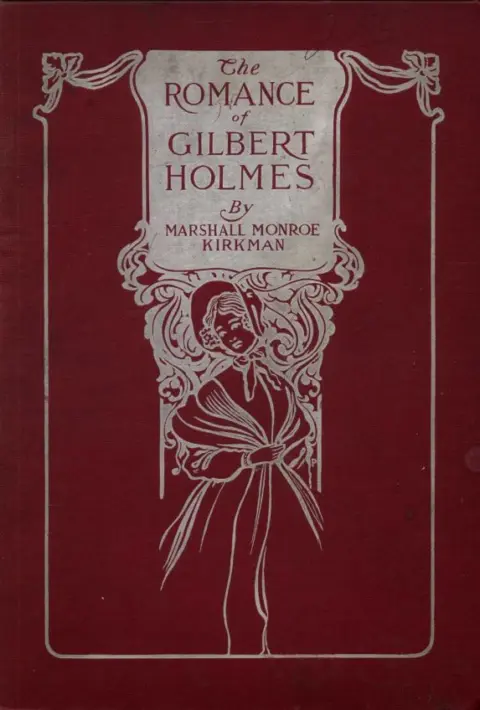
"The Romance of Gilbert Holmes: An Historical Novel" by Marshall M. Kirkman is a historical novel written in the late 19th century. The story centers on the life of Gilbert Holmes, exploring themes of love, loss, and adventure set against the backdrop of early American history. The narrative begins with a tragic event involving Gilbert's parents, setting the tone for his journey and the connections he forms. The opening of the novel introduces a melancholic scene at a New Orleans wharf, where the protagonist reflects on the changing world around him. He encounters a beautiful lady, whose compassion for the convicts marching past captivates him. We soon meet Gilbert, who reminisces about his early life and the deep bond shared with his loving parents. As the narrative unfolds, readers witness Gilbert's early experiences, including a near-fatal ferry accident, the struggles of frontier life, and the kindness of a Native American woman. The stage is set for exploration of Gilbert's adventures and romantic pursuits in a developing America amidst personal and external turmoil.
Introduction adapted from the source catalogue; source summaries may be automatically generated.
Free to read · English · 140,288 words · No account needed
MAKE TIME FOR A GOOD BOOK
On by default. Untick to stop anonymous reading totals. Each page counts after 10 seconds in view. How this works.
Anonymous counting is on unless you have switched it off.
At the time of which I speak steam was only just coming into use on the Mississippi, and men went far out of their way to see the great boats that plied back and forth, and seeing them, stood spellbound, as did I. Nor have change and lengthening years served in any way to dull the recollection of that far-off day. Every detail comes back to me now; the clanging bell, the hoarse whistle sounding croupily across the water, the great boat coming buoyantly on, its busy decks, the passengers standing by, the gurgling water, the swash of the wheels, the rhythmic music of the exhaust, the black smoke trailing on behind, and, most striking of all--so simple are the impressions of youth--the letters painted in vivid plainness on the surface of the rounded wheelhouse. Naught is wanting to complete the picture, and if by chance some sound like the deep bell or croaking whistle strikes on my listening ear, it awakens afresh the scenes of that far-off time as if they were but yesterday. Not, however, as then, to thrill with ecstasy, but rather with pleasurable melancholy, like an echo from the past, so sad it is.
While the boat was making its way to the channel of the river, our little party ascended the stairs which led to the saloon above. Reaching the quarter-deck, what was our surprise to find Blott facing us, and unconcernedly, as if knowing us but casually, if at all. At sight of him, Uncle Job stopped abruptly, and after regarding him a moment, angrily inquired:
"What are you doing here, constable?"
"I'm holdin' down this mattin', an' as you've got feet, s'pose you come an' help me," Blott answered, moving about uneasily on the piece of carpet whereon he stood.
"You are following this lad," Uncle Job answered, paying no attention to
what he said.
"Now, don't lose yourself, old man; I'm no trailer. Moth done you dirt, mebbe, but I never did nothin' to you, have I?" he asked, facing us and striving to appear calm.
"Perhaps not, but you are here to spy on us now."
"Not on your life; an' let me advise you, my friend," he answered, opening and shutting his hands nervously, "not to use that word too much in this country, or it'll git you into trouble. I'm no spy, least of all for Pickle."
"Then what are you doing on this boat?" Uncle Job inquired, by no means convinced of the other's good intention.
"Mebbe I'm toorin', but I ain't," he answered, more quietly. "I'm doin' the disappearin' act, though, an' to-morrow they'll be draggin' the river, I 'spect, thinkin' I'm drowned."
"Where are you going?"
Your reading position is saved on this browser. Take it to another device with a library code. Reading pages adapt to text, rather than matching a printed edition.
BEHIND THE BOOK
This eBook is for the use of anyone anywhere in the United States and most other parts of the world at no cost and with almost no restrictions whatsoever. You may copy it, give it away or re-use it under the terms of the Project Gutenberg License included with this eBook or online at www.gutenberg.org. If you are not located in the United States, you will have to check the laws of the country where you are located before using this eBook. Read the source licence.
The original source file, including credits and licence, is retained by this library. Request an original-format copy at no charge. Please include the book title and Project Gutenberg identifier #53006.
KEEP YOUR CURIOSITY GOING
Cécile Tormay

Moritz Busch
Coulson Kernahan
John L. Ransom

Maurice Baring
Frances Wright