THE CLASSIC COLLECTION✦An outlaw’s diary: the CommuneCLASSIC FREE BOOKS
An outlaw’s diary: the Commune
Cécile Tormay
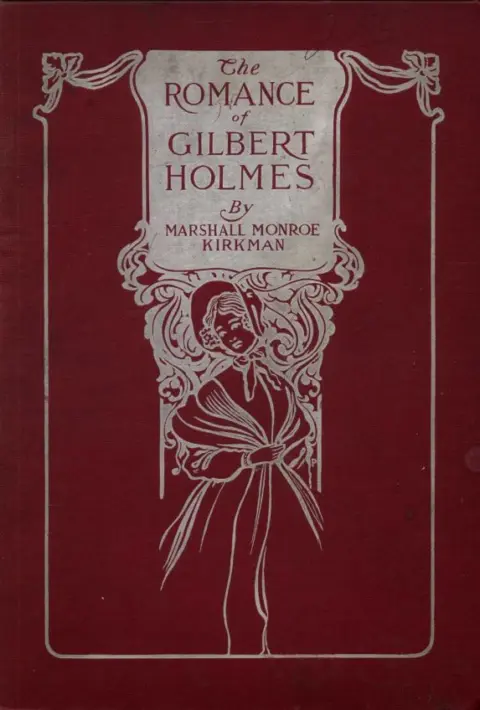
THE CLASSIC COLLECTION · 1900
"The Romance of Gilbert Holmes: An Historical Novel" by Marshall M. Kirkman is a historical novel written in the late 19th century. The story centers on the life of Gilbert Holmes, exploring themes of love, loss, and adventure set against the backdrop of early American history. The narrative begins with a tragic event involving Gilbert's parents, setting the tone for his journey and the connections he forms. The opening of the novel introduces a melancholic scene at a New Orleans wharf, where the protagonist reflects on the changing world around him. He encounters a beautiful lady, whose compassion for the convicts marching past captivates him. We soon meet Gilbert, who reminisces about his early life and the deep bond shared with his loving parents. As the narrative unfolds, readers witness Gilbert's early experiences, including a near-fatal ferry accident, the struggles of frontier life, and the kindness of a Native American woman. The stage is set for exploration of Gilbert's adventures and romantic pursuits in a developing America amidst personal and external turmoil.
Introduction adapted from the source catalogue; source summaries may be automatically generated.
Free to read · English · 140,288 words · No account needed
MAKE TIME FOR A GOOD BOOK
On by default. Untick to stop anonymous reading totals. Each page counts after 10 seconds in view. How this works.
Anonymous counting is on unless you have switched it off.
When we had examined all the beautiful things the room contained, or made pretense of doing so--for I was ever interested in Constance to the exclusion of other matters--she pointed with a show of pride to the battered head of an animal fastened above the door by which we had entered, exclaiming:
"See, Gilbert, where papa's put the horrid thing! I can never look at
it without a shudder."
"It's ugly enough, I'm sure," I answered; "but what is it?"
"Surely you ought to know, if any one," she answered, taking hold of my hand and leading me close to the object.
"It's so cut up one can't tell whether it's the head of a pig or a
panther," I answered.
"It's neither; but you're only making believe, Gilbert?"
"No; but I never saw anything half so ugly."
"Oh, fie! how stupid you are, or make out to be."
"Well, what is it? I can't guess," I answered, but in no hurry to have her tell me, so sweet was her voice and so entrancing her contention.
"Well, I've a good mind not to tell you, but it's the head of the wolf you killed. Papa had it mounted just as it was brought from Wild Plum; and it grows more ugly every day, I think," she answered, scowling at the hideous thing.
"I'd never have known it, it's so shrunken and wrinkled," I answered, gazing at the object with new interest.
"Then you remember, do you?" she asked, coming close to my side, as if
it were still alive.
Yes, I remembered the wolf well enough, but most because it concerned Constance, and had, besides, so much to do with her father's kindness to me then and always. On this account it is proper I should tell you the story; and though it may seem out of the ordinary and improbable now, it was not so regarded at the time. For you must know that in the early days the panther and bear and many other savage animals made their homes undisturbed in the depths of the great forests of Illinois, and among the first recollections of my childhood were the cries, sometimes fierce, but more often doleful, of the wolves about our home. Our situation indeed in respect to such visits was peculiar, for from the plain that lay on one side there came the gray or prairie wolf, and from the forest opposite, his fierce brother, the black or timber wolf. The first was a cowardly brute, hardly above a chicken in courage, and given to pilfering about the stables and hen-houses, though sometimes venturing as far as the kitchen if there was anything it could steal. The timber-wolf was larger, and when hungry would attack animals ten times its size. Indeed, when famished, it did not fear man, and in this way numbers of the early settlers lost their lives. In the summer and fall, when food was plentiful, it rarely visited us, but in the late winter its cries at night were so common as hardly to attract attention.
Your reading position is saved on this browser. Take it to another device with a library code. Reading pages adapt to text, rather than matching a printed edition.
BEHIND THE BOOK
This eBook is for the use of anyone anywhere in the United States and most other parts of the world at no cost and with almost no restrictions whatsoever. You may copy it, give it away or re-use it under the terms of the Project Gutenberg License included with this eBook or online at www.gutenberg.org. If you are not located in the United States, you will have to check the laws of the country where you are located before using this eBook. Read the source licence.
The original source file, including credits and licence, is retained by this library. Request an original-format copy at no charge. Please include the book title and Project Gutenberg identifier #53006.
KEEP YOUR CURIOSITY GOING
Cécile Tormay

Moritz Busch
Coulson Kernahan
John L. Ransom

Maurice Baring
Frances Wright