THE CLASSIC COLLECTION✦An outlaw’s diary: the CommuneCLASSIC FREE BOOKS
An outlaw’s diary: the Commune
Cécile Tormay
THE CLASSIC COLLECTION · 1900
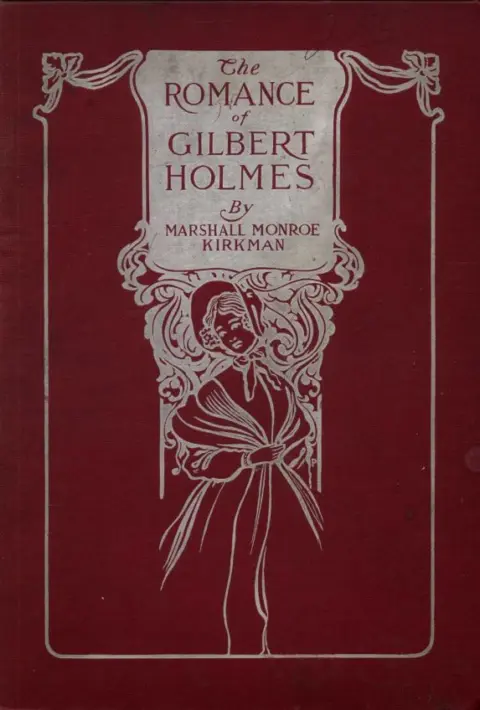
"The Romance of Gilbert Holmes: An Historical Novel" by Marshall M. Kirkman is a historical novel written in the late 19th century. The story centers on the life of Gilbert Holmes, exploring themes of love, loss, and adventure set against the backdrop of early American history. The narrative begins with a tragic event involving Gilbert's parents, setting the tone for his journey and the connections he forms. The opening of the novel introduces a melancholic scene at a New Orleans wharf, where the protagonist reflects on the changing world around him. He encounters a beautiful lady, whose compassion for the convicts marching past captivates him. We soon meet Gilbert, who reminisces about his early life and the deep bond shared with his loving parents. As the narrative unfolds, readers witness Gilbert's early experiences, including a near-fatal ferry accident, the struggles of frontier life, and the kindness of a Native American woman. The stage is set for exploration of Gilbert's adventures and romantic pursuits in a developing America amidst personal and external turmoil.
Introduction adapted from the source catalogue; source summaries may be automatically generated.
Free to read · English · 140,288 words · No account needed
MAKE TIME FOR A GOOD BOOK
On by default. Untick to stop anonymous reading totals. Each page counts after 10 seconds in view. How this works.
Anonymous counting is on unless you have switched it off.
"A week ago, and nobody has told me! Oh, Uncle Job, you haven't a friend in the world, and will surely be lost!" I cried. "Why did I come here, anyway, and leave you! I was a coward to fear Moth, when you were in greater danger than I."
"There! don't take on so, my dear. I'm sure it will all come out right in the end," Mrs. Blake interposed, hopefully.
"No; and I'm going to him, and to-day--and now," I cried, taking up my
hat.
This Mr. and Mrs. Blake, however, would not permit, saying it was foolish, and that Moth was in Appletop and would give me trouble, while I could do nothing. This only made me the more determined, for I thought there was something back that had not been disclosed, but of what nature I could form no idea. Nor did it matter, for nothing could be worse than Uncle Job's plight and the crime he was accused of. That he had done any wrong I did not for a moment believe. He who was incapable of even a bad thought! Thus the day wore itself out amid my entreaties, the night closing in somber and gray, with a light fall of snow. My determination in nowise changed, I excused myself when supper was over, and going to my room, slipped on a heavy jacket, and opening the window jumped to the ground. Hastening, I reached the old abandoned road, sure my absence would not be discovered until morning; but in any event, I would not return, for they had no claim on me, and as for Moth, I no longer cared for him, so great was my distress over Uncle Job's unhappy plight.
The storm in which I now found myself was mild to a degree, and such as country people like to face. Coming on lightly from the south, with scarce any wind, the snow did not fly here and there as we sometimes see it, but came in great wavering flakes, each lying where it fell, and softly, as if the particles followed some order of things laid down from the beginning, so deft were they and free from bustle or any show of activity. Walking and partly running, the soft flakes falling on my face cooled my blood and stimulated my strength, so that I looked forward to my journey with something akin to pleasure. A moon half full lessened the somber gray of the sky, bringing out in glad relief the myriad forms built up by the snow on either side of the half-hidden path. The stillness of the night and the seclusion of the forest soothed and rested my mind, worn with the events of the day, and in that mood I hurried on, refreshed and comforted by the contrast. All my life I had been thus abroad, and the breaking of a twig or creaking of a limb under the piled-up snow did not startle me as it would some, but came like the welcome of a friend. In this way I ran on, elated, sometimes singing lightly, but observing all that came within my view, and more particularly the curious forms built up by the fast-falling shower. Of these, some appeared to welcome the storm, while others stood aloof in gloomy reproof. Thus the staring, upright limbs of the maple would have none of it, but spurned the gentle drops as a woman might a soft caress, neither seeking nor accepting grace of any kind. The hickory and wild crab, too, looked black and sour in the twilight, as if viewing what was going on with no kindly spirit. Drooping and in loving embrace, in reproof of the others, the elms caught up great armfuls of the falling flakes and held them tenderly, as a mother might an ailing child. The oaks, too, like sturdy, brown-headed men--for so their clinging leaves made them appear in the uncertain light--held their burden as if in some way the foliage of other months would the sooner return to bless them because of it. Underneath and diminutive, like waiting children, the elders stood waist-deep, canopies of snow forming above them like umbrellas uplifted against the storm. Other and lesser shrubs crouched down, or bending forward had the look of wearing collars turned up about their ears, so sturdy did they appear. Still smaller plants, growing on the margin of the path, no bigger than your hand, stood up for a while like mice or foxes perched on end, but only to sink down one by one and disappear, as the snow piled higher and higher about them.
Your reading position is saved on this browser. Take it to another device with a library code. Reading pages adapt to text, rather than matching a printed edition.
BEHIND THE BOOK
This eBook is for the use of anyone anywhere in the United States and most other parts of the world at no cost and with almost no restrictions whatsoever. You may copy it, give it away or re-use it under the terms of the Project Gutenberg License included with this eBook or online at www.gutenberg.org. If you are not located in the United States, you will have to check the laws of the country where you are located before using this eBook. Read the source licence.
The original source file, including credits and licence, is retained by this library. Request an original-format copy at no charge. Please include the book title and Project Gutenberg identifier #53006.
KEEP YOUR CURIOSITY GOING
Cécile Tormay

Moritz Busch
Coulson Kernahan
John L. Ransom

Maurice Baring
Frances Wright