THE CLASSIC COLLECTION✦Frank Merriwell’s dangerCLASSIC FREE BOOKS
Frank Merriwell’s danger
Burt L. Standish
THE CLASSIC COLLECTION · 1900
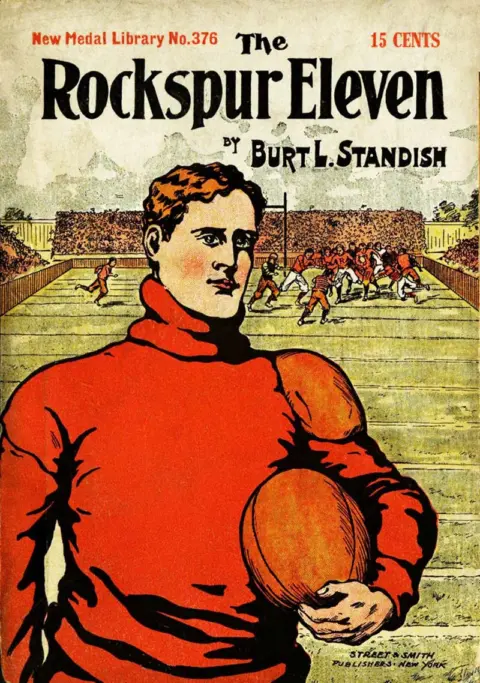
"The Rockspur Eleven: A Fine Football Story for Boys" by Burt L. Standish is a fictional novel written in the late 19th century. The story revolves around young boys passionate about football, particularly focusing on Don Scott, a boy struggling with his temper and the challenges of teamwork, as well as his interactions with his teammates and a new, cocky coach named Dolph Renwood. The narrative promises themes of friendship, rivalry, and the importance of self-control in the face of adversity. The opening of the novel introduces Don Scott, who is in a foul mood as he sulks beneath an apple tree, having been frustrated with Renwood, the new football coach, and the pressure to perform on the team. Danny Chatterton, Don's lively friend, tries to coax him into practicing, but Don's pride and anger lead to a confrontation where he expresses his distaste for Renwood’s coaching style. Following an encounter with his father, who advises him to control his temper, Don grapples with his emotions amidst the dynamics of his friendships and the football team. The scene sets the tone for a young boy navigating the intense feelings of youth in the world of competitive sports.
Introduction adapted from the source catalogue; source summaries may be automatically generated.
Free to read · English · 68,600 words · No account needed
MAKE TIME FOR A GOOD BOOK
On by default. Untick to stop anonymous reading totals. Each page counts after 10 seconds in view. How this works.
Anonymous counting is on unless you have switched it off.
Don could scarcely fail to observe his companion’s strange agitation
and pallor.
“Well, what’s the matter with you?” he exclaimed, wonderingly.
“That knife!” gasped Leon. “Where did you get it?”
He snatched it from Don’s hand and examined it closely, his fingers trembling a little, while his whole manner betrayed both astonishment and dismay.
“Have you ever seen that knife before?” questioned the dark-haired boy.
“I--I--why, I believe I have.”
“When? Where?”
“Why, I--er--saw it last night.”
“You did? Where?”
“In the club-room.”
“Who had it?” cried Don, clutching Bentley fiercely by the shoulder.
“Don’t!” begged the other lad, squirming and dropping his cigarette. “Great Cæsar! you hurt! Your fingers feel like iron!”
“Who had that knife?” Don again demanded. “If you saw it in the club-room, you must have seen it in the possession of some one. Who had it?”
“Why, it--it’s Renwood’s knife.”
“How do you know? Did you see it in his possession?”
“Yes.”
“Are you sure? Are you sure?”
“Yes, I’m sure, for I took it from him and examined it before all the other fellows. I told him I’d like to have a knife like that, and then I passed it back to him, and he took it. All the fellows saw me give it back to him,” Leon concluded, impressively.
“That settles it!” grated the doctor’s son, his eyes flashing and his face betraying triumphant satisfaction. “I’m glad they all saw this knife in that fellow’s possession and that he claimed it as his own. Even though I cannot understand his motive for doing the dirty job in the dressing-room, there is no longer a doubt in my mind but he did it.”
Bentley drew a long breath, looked wonderfully relieved, and a bit of color returned to his sallow cheeks. Had Don Scott been watching his visitor closely, he must have wondered somewhat at his manner.
“But how that knife came into your possession is more than I can understand,” said Leon, picking up his half-smoked cigarette and looking at Don askance.
Then Scott told him the whole story of his adventure in the dressing-room the night before, and the other listened attentively, but with his eyes downcast, at times gnawing at his lips in a nervous manner.
“That beats the world!” he muttered, when the story was finished. “But I think it’s a mighty unlucky thing that you turned up there last night, old man.”
“Unlucky?” cried Don. “How is that? Didn’t I catch the fellow right in
the act?”
“Yes; but it might have been better if you had not caught him.”
Your reading position is saved on this browser. Take it to another device with a library code. Reading pages adapt to text, rather than matching a printed edition.
Burt L. Standish
Burt L. Standish

Burt L. Standish

Burt L. Standish
BEHIND THE BOOK
This eBook is for the use of anyone anywhere in the United States and most other parts of the world at no cost and with almost no restrictions whatsoever. You may copy it, give it away or re-use it under the terms of the Project Gutenberg License included with this eBook or online at www.gutenberg.org. If you are not located in the United States, you will have to check the laws of the country where you are located before using this eBook. Read the source licence.
The original source file, including credits and licence, is retained by this library. Request an original-format copy at no charge. Please include the book title and Project Gutenberg identifier #67397.
KEEP YOUR CURIOSITY GOING
Coulson Kernahan

Maurice Baring
Frances Wright
Cécile Tormay

Frederic Jesup Stimson

W. H. P. (William Henry Pope) Jarvis