THE CLASSIC COLLECTION✦Frank Merriwell’s dangerCLASSIC FREE BOOKS
Frank Merriwell’s danger
Burt L. Standish
THE CLASSIC COLLECTION · 1900
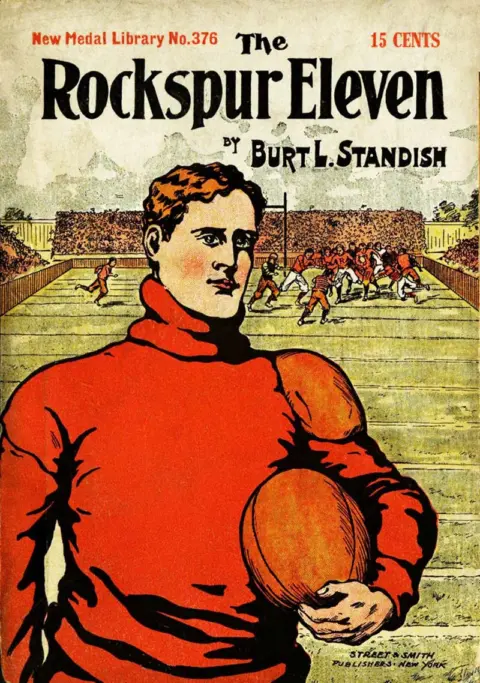
"The Rockspur Eleven: A Fine Football Story for Boys" by Burt L. Standish is a fictional novel written in the late 19th century. The story revolves around young boys passionate about football, particularly focusing on Don Scott, a boy struggling with his temper and the challenges of teamwork, as well as his interactions with his teammates and a new, cocky coach named Dolph Renwood. The narrative promises themes of friendship, rivalry, and the importance of self-control in the face of adversity. The opening of the novel introduces Don Scott, who is in a foul mood as he sulks beneath an apple tree, having been frustrated with Renwood, the new football coach, and the pressure to perform on the team. Danny Chatterton, Don's lively friend, tries to coax him into practicing, but Don's pride and anger lead to a confrontation where he expresses his distaste for Renwood’s coaching style. Following an encounter with his father, who advises him to control his temper, Don grapples with his emotions amidst the dynamics of his friendships and the football team. The scene sets the tone for a young boy navigating the intense feelings of youth in the world of competitive sports.
Introduction adapted from the source catalogue; source summaries may be automatically generated.
Free to read · English · 68,600 words · No account needed
MAKE TIME FOR A GOOD BOOK
On by default. Untick to stop anonymous reading totals. Each page counts after 10 seconds in view. How this works.
Anonymous counting is on unless you have switched it off.
Under the grand-stand the perspiring, blood-stained, dirt-bedaubed young heroes were being rubbed down by their admiring friends, while outside the Highland crowd sang pæans of victory.
“We’ll win this game, fellows, just as true as we play the next half to win,” said Sterndale, undaunted.
He never seemed to lose courage, but some of those tired fellows hung
their heads.
“They can out-kick us,” muttered Rob Linton.
“Well, if we’ve found our weakness there, we must avoid kicking,” said the captain, guarding his words so none of the Highlanders would hear. “Perhaps they don’t know how weak we are.”
“Don’t fool yourself,” grated Scott, flashing a look in the direction of Renwood. “They were informed of all our weak points before they came to Rockspur to-day.”
“How do you know that?” demanded Dick, putting peculiar emphasis on the
“you.”
Don realized that this was something he could not explain, and so he
muttered:
“Never mind. I know a thing or two, and I’ve caught on to some things in this game that ought to be plain enough to you, Sterndale, if you are not stone-blind.”
“You’re all wrong, Scott, and you’ll find it out,” said Dick, positively. “The sooner you get over that feeling the better it will be for you and the team.”
Scott flushed. “Do you mean to hint that I haven’t done my level best?” he harshly demanded.
“Not a bit of it,” Dick instantly answered. “I don’t know where we would have been without you. And I’ve given you chances enough, too.”
“But you gave the ball to Renwood on the third try when the touchdown was made--and that after my run.”
“It was a trick to bother Highland some. Besides that, you were tired, and I had sent you against them twice.”
“Tired! Bah! I was over the line ahead of Renwood, and----”
“I don’t believe I’d got over at all if you hadn’t yanked me across,” broke in the voice of Renwood himself, who had overheard Don’s words by accident. “I was stuck fast when you gave that surge and seemed to pull me right through Hartford. The entire credit of that touchdown belongs to you, Scott.”
This was so frank and honest that Don was silenced for a moment, but he
finally muttered:
“Well, I didn’t get it.”
There the matter dropped for a time, the men receiving notice to get onto the field again, the ten minutes of rest being over; but Don had not changed his mind in the least.
Your reading position is saved on this browser. Take it to another device with a library code. Reading pages adapt to text, rather than matching a printed edition.
Burt L. Standish
Burt L. Standish

Burt L. Standish

Burt L. Standish
BEHIND THE BOOK
This eBook is for the use of anyone anywhere in the United States and most other parts of the world at no cost and with almost no restrictions whatsoever. You may copy it, give it away or re-use it under the terms of the Project Gutenberg License included with this eBook or online at www.gutenberg.org. If you are not located in the United States, you will have to check the laws of the country where you are located before using this eBook. Read the source licence.
The original source file, including credits and licence, is retained by this library. Request an original-format copy at no charge. Please include the book title and Project Gutenberg identifier #67397.
KEEP YOUR CURIOSITY GOING
Coulson Kernahan

Maurice Baring
Frances Wright
Cécile Tormay

Frederic Jesup Stimson

W. H. P. (William Henry Pope) Jarvis