THE CLASSIC COLLECTION✦Frank Merriwell’s dangerCLASSIC FREE BOOKS
Frank Merriwell’s danger
Burt L. Standish
THE CLASSIC COLLECTION · 1900
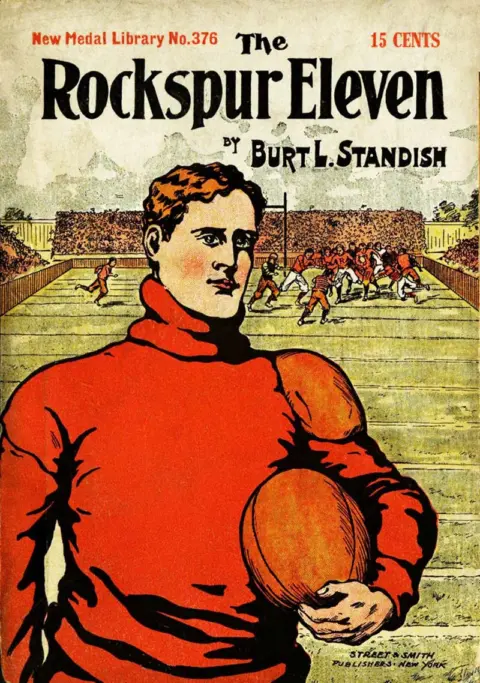
"The Rockspur Eleven: A Fine Football Story for Boys" by Burt L. Standish is a fictional novel written in the late 19th century. The story revolves around young boys passionate about football, particularly focusing on Don Scott, a boy struggling with his temper and the challenges of teamwork, as well as his interactions with his teammates and a new, cocky coach named Dolph Renwood. The narrative promises themes of friendship, rivalry, and the importance of self-control in the face of adversity. The opening of the novel introduces Don Scott, who is in a foul mood as he sulks beneath an apple tree, having been frustrated with Renwood, the new football coach, and the pressure to perform on the team. Danny Chatterton, Don's lively friend, tries to coax him into practicing, but Don's pride and anger lead to a confrontation where he expresses his distaste for Renwood’s coaching style. Following an encounter with his father, who advises him to control his temper, Don grapples with his emotions amidst the dynamics of his friendships and the football team. The scene sets the tone for a young boy navigating the intense feelings of youth in the world of competitive sports.
Introduction adapted from the source catalogue; source summaries may be automatically generated.
Free to read · English · 68,600 words · No account needed
MAKE TIME FOR A GOOD BOOK
On by default. Untick to stop anonymous reading totals. Each page counts after 10 seconds in view. How this works.
Anonymous counting is on unless you have switched it off.
“You better go along about your business, Chatterton!” he grated. “I won’t take that kind of talk from you, either! You can run your old football team without me, and you’re all a lot of soft-headed chumps to let Renwood lord it over you. Now, don’t make any back talk to me! Go on and tell them what I think of them.”
Danny backed away from the fence and sidled off, as Don came forward
threateningly.
“I don’t know but we’ll get along bub-bub-better without ye,” he declared, with a taunting grin. “You’re always rah-rah-raising a rah-rah-row.”
Don had reached the fence, and, in a sudden burst of rage, he tore off a broken picket and flung it after Danny, who skillfully dodged the missile and then hastily scudded away, still laughing.
“That’s right--run!” snarled Don, glaring after the little fellow. “If I had hold of you, I’d make ye laugh out of the other corner of your mouth!”
He kicked the fence savagely, and then retreated to the apple-tree once more, in anything but an agreeable humor.
Pat, the Irish hostler and man about the place, came round to the front of the house, leading Dr. Scott’s horse, attached to a light driving carriage. The doctor, medicine-case in hand, appeared at the front door; but, instead of descending the walk and entering the carriage at once, he came down the steps and turned into the orchard back of the house, where his son was still sulking under the sweet apple-tree.
“My boy,” said the doctor, a gravely handsome man with iron-gray beard and dark eyes, which now seemed strangely sad, “sitting there at my window just now, I happened to overhear your conversation with that other lad.”
Don flushed a little, but continued to scowl, though he had risen to his feet and was standing in a respectful attitude of attention before his father.
“I noted,” said the gentleman, “that you were in a very bad humor, and your words told me why you were angry. I also observed that you flew into an unreasonable passion at the close of your talk. Now I am not going to lecture you, Don, but I wish to warn you. You must learn to govern your temper, my son, or it will control you, to your sorrow and everlasting regret.”
“But, father, there are times when it’s impossible not to become angry,” protested the boy.
“Perhaps it may seem so, but every time a person gives way to a fit of anger he weakens his self-control and makes himself less capable of successfully coping with the trials and emergencies of life.”
Your reading position is saved on this browser. Take it to another device with a library code. Reading pages adapt to text, rather than matching a printed edition.
Burt L. Standish
Burt L. Standish

Burt L. Standish

Burt L. Standish
BEHIND THE BOOK
This eBook is for the use of anyone anywhere in the United States and most other parts of the world at no cost and with almost no restrictions whatsoever. You may copy it, give it away or re-use it under the terms of the Project Gutenberg License included with this eBook or online at www.gutenberg.org. If you are not located in the United States, you will have to check the laws of the country where you are located before using this eBook. Read the source licence.
The original source file, including credits and licence, is retained by this library. Request an original-format copy at no charge. Please include the book title and Project Gutenberg identifier #67397.
KEEP YOUR CURIOSITY GOING
Coulson Kernahan

Maurice Baring
Frances Wright
Cécile Tormay

Frederic Jesup Stimson

W. H. P. (William Henry Pope) Jarvis