THE CLASSIC COLLECTION✦Frank Merriwell’s dangerCLASSIC FREE BOOKS
Frank Merriwell’s danger
Burt L. Standish
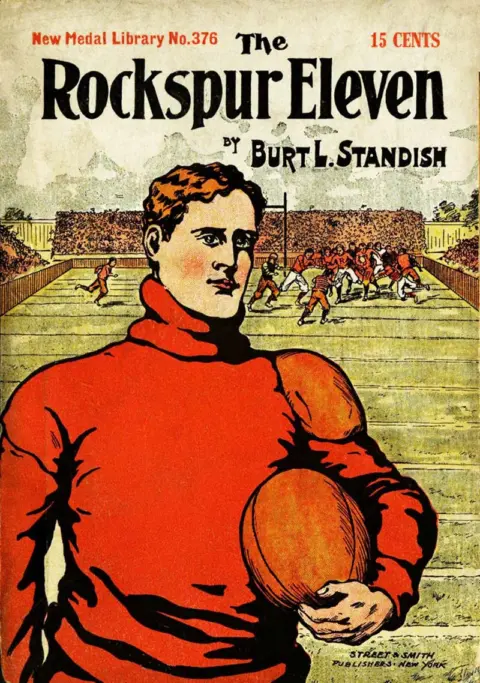
THE CLASSIC COLLECTION · 1900
"The Rockspur Eleven: A Fine Football Story for Boys" by Burt L. Standish is a fictional novel written in the late 19th century. The story revolves around young boys passionate about football, particularly focusing on Don Scott, a boy struggling with his temper and the challenges of teamwork, as well as his interactions with his teammates and a new, cocky coach named Dolph Renwood. The narrative promises themes of friendship, rivalry, and the importance of self-control in the face of adversity. The opening of the novel introduces Don Scott, who is in a foul mood as he sulks beneath an apple tree, having been frustrated with Renwood, the new football coach, and the pressure to perform on the team. Danny Chatterton, Don's lively friend, tries to coax him into practicing, but Don's pride and anger lead to a confrontation where he expresses his distaste for Renwood’s coaching style. Following an encounter with his father, who advises him to control his temper, Don grapples with his emotions amidst the dynamics of his friendships and the football team. The scene sets the tone for a young boy navigating the intense feelings of youth in the world of competitive sports.
Introduction adapted from the source catalogue; source summaries may be automatically generated.
Free to read · English · 68,600 words · No account needed
MAKE TIME FOR A GOOD BOOK
On by default. Untick to stop anonymous reading totals. Each page counts after 10 seconds in view. How this works.
Anonymous counting is on unless you have switched it off.
“That’s right, Sterndale,” agreed Dolph Renwood. “Smith was a perfect whirlwind. Several times he did great work at interference, even though he was playing back of the line. If he’d been in his old position----”
Renwood stopped, and Harry Carter spoke up at once:
“I did the best I could, fellows. I know I made some bad blunders, but I didn’t shirk, and----”
“You’re all right,” Dolph interrupted; “but you haven’t had the practice, and you were given a hard position in the line. Now, if you had been placed next to the end, with Smith on the end----”
“Are you digging at me?” asked Bentley, snappily. “I was playing next
to the end.”
“I am not digging at anybody,” calmly answered the quarter-back of the team; “but I know we should have had Smith on that end.”
“There’s been too much shifting about,” said Leon. “You fellows took in Boland and Carter, and then you tried Linton at right tackle till you found Ford wouldn’t work beside Old Lightning. That made you shift back, and finally you decided you couldn’t get along without me, after all, which caused another change.”
“We’ve not had enough time for practice,” Sterndale asserted.
“You’ve had as much as Highland,” grinned Leon, lighting another
cigarette.
“No, not by a whole week.”
“That’s a lot!”
“It counts when all the practice a team gets is secured in two or three weeks. College teams begin to practice months ahead.”
“And sometimes there are changes in the make-up of a college team one day before a great game,” put in Renwood.
“I presume you know all about it,” purred Leon, with a sneer.
“Well, I know something about it. I’ve had a chance to see considerable of Harvard’s training work, and some of the Harvard men are my friends.”
“For instance, Phil Winston, who is the Highland coach. I suppose he is one of your friends.”
“I happen to know Winston,” confessed Dolph, “but that is all. We are
not friends.”
“Oh,” said Bentley, queerly, “I didn’t know but you were.” And the tone and manner in which the words were spoken attracted attention.
Renwood gave Leon no further notice, but turned to the others, saying:
“I tell you what it is, fellows, we met with a big loss when Scott got his back up and left the eleven. With that fellow in his old position and Smith back on the end, I believe we might give Highland a hot game a week from to-day.”
“It’s no use to talk about that,” said Sterndale, gloomily. “Scott
won’t come back.”
Your reading position is saved on this browser. Take it to another device with a library code. Reading pages adapt to text, rather than matching a printed edition.
Burt L. Standish
Burt L. Standish
Burt L. Standish
Burt L. Standish
BEHIND THE BOOK
This eBook is for the use of anyone anywhere in the United States and most other parts of the world at no cost and with almost no restrictions whatsoever. You may copy it, give it away or re-use it under the terms of the Project Gutenberg License included with this eBook or online at www.gutenberg.org. If you are not located in the United States, you will have to check the laws of the country where you are located before using this eBook. Read the source licence.
The original source file, including credits and licence, is retained by this library. Request an original-format copy at no charge. Please include the book title and Project Gutenberg identifier #67397.
KEEP YOUR CURIOSITY GOING
Coulson Kernahan

Maurice Baring
Frances Wright
Cécile Tormay

Frederic Jesup Stimson

W. H. P. (William Henry Pope) Jarvis