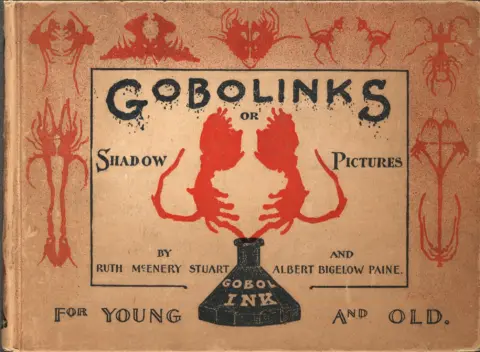
Gobolinks; or, Shadow Pictures for Young and Old
Ruth McEnery Stuart & Albert Bigelow Paine

THE CLASSIC COLLECTION · 1904
"The River's Children: An Idyl of the Mississippi" by Ruth McEnery Stuart is a novel written in the early 20th century. Set against the backdrop of the Mississippi River, the story unfolds during a time of strife and natural disaster, reflecting on themes of love, loss, and resilience through the lives of its characters. The narrative primarily revolves around the relationships and struggles of both the black and white populations living along the river during a period riddled with tension and hardship. At the start of the book, the reader is introduced to the powerful and tumultuous Mississippi River, which is causing havoc and threatening communities and plantations in the area. Amid this turmoil, groups of laborers, primarily African American men, work tirelessly to shore up the riverbanks against flooding, showcasing their resilience and camaraderie through song. The interactions between characters such as Felix and Adolphe highlight not only the immediate dangers they face from the rampaging waters but also the deeper emotional struggles and community bonds formed in times of duress. The novel's opening sets the stage for these intertwined lives, hinting at a weaving of personal and collective stories that reflect a rich tapestry of life along the Mississippi.
Introduction adapted from the source catalogue; source summaries may be automatically generated.
Free to read · English · 26,292 words · No account needed
MAKE TIME FOR A GOOD BOOK
On by default. Untick to stop anonymous reading totals. Each page counts after 10 seconds in view. How this works.
Anonymous counting is on unless you have switched it off.
"T'ink of coming home from de war, already robbed, to find all gone--home, wife, child, family, servants, all obliterate', an' only de river's mark, green mold an' mildew, on de walls above de mantel in de house; an' outside her still face under de sky to answer, an' she heed no questions. She is called de father of waters? In a sense, yas, maybe. Mais, no. She is, I tell you, de mother of trouble--an' pleasure, too.
"She is, after all, de queen of dis valley, an' no mistake--dat river. When she need fresh ermine for her robe, she throw it over our cotton fields--"
"Yas, an' de black spots, dey are our sorrows. Dat's not a bad
resemblance, no."
The speaker looked at his watch.
"Pas' eleven," he said. "Da' 's good luck w'en she start to fall befo' midnight. Oh-h-h! Mais she is one great coquette, yas. She keep you crazy until she get tired wid you, an' den she slip away an' steal her beauty-sleep befo' de clock strike twelve."
"You t'ink she is going to sleep now? Maybe she fool us yet, Adolphe."
"Well, maybe. Mais I have great hope. She begin to nod, and w'en dat happen to a woman or a riv--"
Conversation was suddenly interrupted here by a great crash. The two men started, and, turning, saw an entire section of the improvised embankment fall landward.
Had the stress of the moment been less, they would involuntarily have hastened to the spot, but terror fixed them where they stood. There was but a moment of suspense,--of almost despair,--but it seemed an eternity, before relief came in a great shout which sent vibrations of joy far along the bank, even to those who watched and worked on the right bank of the stream.
It had been only a "dry break." The weights thrown in upon the cotton had been out of plumb, and had pitched the whole structure inward.
The uproar following this accident was long and loud, and had not subsided when the bell rang again, and, with tense nerves strained to listen, the line of men dropped speech. Instead of calling out the decreasing depth, as usual, the crier this time shouted:
"Two inches down, thank God!"
Screams of joy, not unmixed with tears, greeted this announcement. The strain was virtually over.
The two rich men who had stood and talked together mopped their foreheads and shook hands in silence.
Finally it was the older, whom we have called Adolphe,--which was not his name any more than was his companion's Felix,--finally, then, Adolphe remarked quite calmly, as he looked at his watch:
Your reading position is saved on this browser. Take it to another device with a library code. Reading pages adapt to text, rather than matching a printed edition.
Ruth McEnery Stuart & Albert Bigelow Paine
Ruth McEnery Stuart
Ruth McEnery Stuart
Ruth McEnery Stuart
BEHIND THE BOOK
This eBook is for the use of anyone anywhere in the United States and most other parts of the world at no cost and with almost no restrictions whatsoever. You may copy it, give it away or re-use it under the terms of the Project Gutenberg License included with this eBook or online at www.gutenberg.org. If you are not located in the United States, you will have to check the laws of the country where you are located before using this eBook. Read the source licence.
The original source file, including credits and licence, is retained by this library. Request an original-format copy at no charge. Please include the book title and Project Gutenberg identifier #34416.
KEEP YOUR CURIOSITY GOING
Coulson Kernahan

Maurice Baring
Frances Wright
Cécile Tormay

Frederic Jesup Stimson

W. H. P. (William Henry Pope) Jarvis