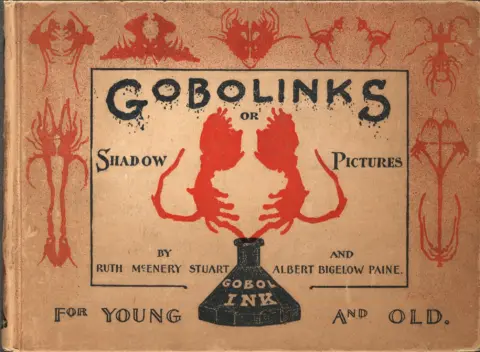
Gobolinks; or, Shadow Pictures for Young and Old
Ruth McEnery Stuart & Albert Bigelow Paine

THE CLASSIC COLLECTION · 1904
"The River's Children: An Idyl of the Mississippi" by Ruth McEnery Stuart is a novel written in the early 20th century. Set against the backdrop of the Mississippi River, the story unfolds during a time of strife and natural disaster, reflecting on themes of love, loss, and resilience through the lives of its characters. The narrative primarily revolves around the relationships and struggles of both the black and white populations living along the river during a period riddled with tension and hardship. At the start of the book, the reader is introduced to the powerful and tumultuous Mississippi River, which is causing havoc and threatening communities and plantations in the area. Amid this turmoil, groups of laborers, primarily African American men, work tirelessly to shore up the riverbanks against flooding, showcasing their resilience and camaraderie through song. The interactions between characters such as Felix and Adolphe highlight not only the immediate dangers they face from the rampaging waters but also the deeper emotional struggles and community bonds formed in times of duress. The novel's opening sets the stage for these intertwined lives, hinting at a weaving of personal and collective stories that reflect a rich tapestry of life along the Mississippi.
Introduction adapted from the source catalogue; source summaries may be automatically generated.
Free to read · English · 26,292 words · No account needed
MAKE TIME FOR A GOOD BOOK
On by default. Untick to stop anonymous reading totals. Each page counts after 10 seconds in view. How this works.
Anonymous counting is on unless you have switched it off.
"Oh, it 's windy,
Sweet Lucindy,
On de river-bank to-night,
An' de moontime
Beats de noontime,
When de trimblin' water 's white."
So runs the plantation love-song, and so sang a great brown fellow as, with oars over his shoulder, he strolled down "Lovers' Lane," between the bois d'arcs, toward the Mississippi levee.
He repeated it correctly until he neared the gourd-vine which marked the home of his lady, when he dropped his voice a bit and, eschewing rhyme for the greater value, sang:
"Oh, it 's windy,
Sweet Maria,
On de river-bank to-night--"
And slackening his pace until he heard footsteps behind him, he stopped and waited while a lithe yellow girl overtook him languidly.
"Heah, you take yo' sheer o' de load!" he laughed as he handed her one of the oars. "Better begin right. You tote half an' me half." And as she took the oar he added, "How is you to-night, anyhow, sugar-gal?"
While he put his right arm around her waist, having shifted the remaining oar to his left side, the girl instinctively bestowed the one she carried over her right shoulder, so that her left arm was free for reciprocity, to which it naively devoted itself.
"I tell yer, hit 's fine an' windy to-night, sho' enough," he said. "De breeze on de levee is fresh an' cool, an' de skift she's got a new yaller-buff frock, an' she--"
"Which skift? De Malviny? Is you give her a fresh coat o' paint? An' dat's my favoryte color--yaller-buff!" This with a chuckle.
"No; dey ain't no Malviny skift no mo'--not on dis plantation. I done
changed her name."
"You is, is yer? What is you named her dis time?"
She was preparing to express surprise in the surely expected. Of course the boat was renamed the Maria. What else, in the circumstances?
"I painted her after a lady-frien's complexion, a bright, clair yaller; but as to de name--guess!" said the man, with a lunge toward the girl, as the oar he carried struck a tree--a lunge which brought him into position to touch her ear with his lips while he repeated: "What you reckon I named her, sweetenin'?"
"How should I know? I ain't in yo' heart!"
"You ain't, ain't yer? Ef you ain't, I'd like mighty well to know who is. You's a reg'lar risidenter, you is--an' you knows it, too! Guess along, gal. What you think de boat's named?"
"Well, ef you persises for me to guess, I'll say Silv' Ann. Dat 's a
purty title for a skift."
Your reading position is saved on this browser. Take it to another device with a library code. Reading pages adapt to text, rather than matching a printed edition.
Ruth McEnery Stuart & Albert Bigelow Paine
Ruth McEnery Stuart
Ruth McEnery Stuart
Ruth McEnery Stuart
BEHIND THE BOOK
This eBook is for the use of anyone anywhere in the United States and most other parts of the world at no cost and with almost no restrictions whatsoever. You may copy it, give it away or re-use it under the terms of the Project Gutenberg License included with this eBook or online at www.gutenberg.org. If you are not located in the United States, you will have to check the laws of the country where you are located before using this eBook. Read the source licence.
The original source file, including credits and licence, is retained by this library. Request an original-format copy at no charge. Please include the book title and Project Gutenberg identifier #34416.
KEEP YOUR CURIOSITY GOING
Coulson Kernahan

Maurice Baring
Frances Wright
Cécile Tormay

Frederic Jesup Stimson

W. H. P. (William Henry Pope) Jarvis