The Westminster Alice
Saki
THE CLASSIC COLLECTION · 1900
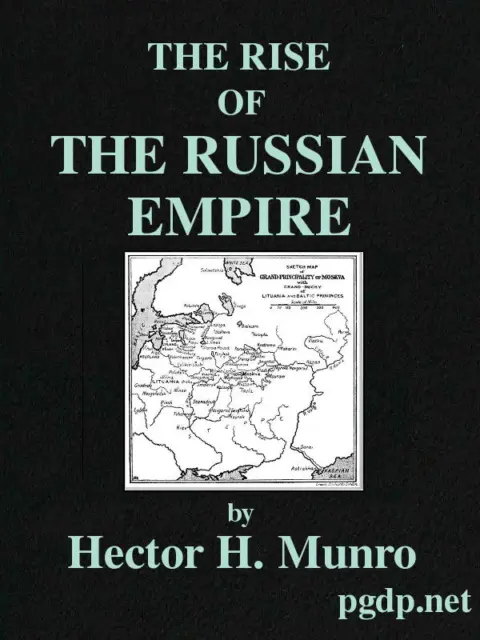
"The Rise of the Russian Empire" by Hector H. Munro is a historical account written in the late 19th century. This work aims to provide a detailed presentation of Russian history, exploring the nation’s evolution from its early beginnings, focusing particularly on the reigns of significant figures like Rurik and Oleg. It seeks to fill the gaps in English-language literature on Russian history, offering insights into the cultural, political, and geographical context of early Russia. The opening of the book introduces the landscape and geographical features of Russia, establishing a foundation for understanding its historical development. It paints a vivid picture of the diverse tribes inhabiting the region and highlights the unique challenges posed by the country's vast geography. As it delves into the early Slavic peoples, the narrative discusses their societal structures and interactions with neighboring tribes. This sets the stage for the arrival of the Varangians, who would significantly influence the formation of the Russian state, marking the beginning of a pivotal era in the nation's history.
Introduction adapted from the source catalogue; source summaries may be automatically generated.
Free to read · English · 115,731 words · No account needed
MAKE TIME FOR A GOOD BOOK
On by default. Untick to stop anonymous reading totals. Each page counts after 10 seconds in view. How this works.
Anonymous counting is on unless you have switched it off.
The peace of Stolbova was as favourable an accommodation as the Tzar could reasonably have expected to secure. The surrender of a hopeless pretension to the last shred of Baltic coast still further checked the struggle for an outlet seawards which had been pursued for the last half-hundred years with such discouraging result; but Moskovy got back some of the places which had been wrung from her weakness, and above all gained breathing time to concentrate her energies on the strife with the arch-enemy Poland.
Both parties had made preparation for pushing the quarrel to the uttermost. The Korolovitch[200] Vladislav had, with the insistence of youth, induced the Poles to support him in enforcing his election to the throne of all the Russias, a sovereignty stretching away over a vast expanse of tributary lands till it was almost lost on the horizon of western politics. On the other hand, Mikhail and the Moskovites were braced to fight for their faith, their fatherland, for very existence. [Sidenote: 1616] Vladislav’s enterprise had received the cautious sanction of the Senate and the more unrestrained blessing of the Archbishop of Warszawa, and in a schismatic-Greek church in the old Volhynian capital, Vladimir, a standard bearing the arms of Moskva had been consecrated; a standard which would, it was hoped, draw the Russians over to the cause of the Polish pretender. In the autumn of 1616 a detachment under the hetman Gonsievskie, consisting of a small but capable force, moved out of Smolensk towards Dorogoboujh and camped at the gorodok of Tverdilitz. Instantly the Tzar ordered his voevodas to make a dash upon Smolensk, thus cutting off Gonsievskie’s line of communication and striking at the enemy on their own ground. The move was well conceived and swiftly executed, but its success stopped short at the outworks of Smolensk. The Russians were not well versed in the art of taking a city by sudden assault, and their leader, Boutourlin, remained helpless in his intrenchments for the rest of the year, his troops exposed to attacks from the besieged on one side and Gonsievskie’s skirmishers on the other, and reduced to feed on horse-flesh for want of other provisions. [Sidenote: 1617] The new year witnessed vigorous action on both sides; a Polish force was routed by a Russian detachment near Dorogoboujh, an event which caused much rejoicing at Moskva, while in May Gonsievskie drove Boutourlin from before the walls of Smolensk. The same month another Polish attack on Dorogoboujh was repulsed, and the Russians hoped at least to maintain an effective defensive resistance to the invaders, but the turn of the year brought with it worse tidings. In July the hetman’s troops made themselves masters of Staritza, Torjhok, and other places, and pushed their advance guard into the Bielozero district, and at the same time came news that the Korolovitch himself was marching with a fresh army upon Moskva. At the end of August Vladislav effected a junction with the Malo-Russian hetman Khodkievitch, and two months later Dorogoboujh and Viasma had both been occupied by the conquering Vasa. Mikhail saw the fate of his forerunners looming large upon him, and already perhaps heard the bells of Moskva knelling his overthrow or the crowds of Krakow jeering at his misfortunes. But the winter season brought with it a respite; the Poles were beaten back from attacks on Tver and Mojhaysk, and in December Vladislav retreated to quarters in Viasma. From here he put forward proposals for peace negotiations, hoping perhaps to gain over the boyarins and people to his side without recourse to further fighting. The Moskovites, however, answered the Korolovitch boldly, and seemed as little disposed to yield an inch of territory as he was to abate a jot of his pretensions. [Sidenote: 1618] The first six months of the ensuing year were spent in fruitless discussions, during which time hostilities were as far as possible suspended. On the 29th of June the Poles resumed the offensive by an assault on Mojhaysk, which was defended with spirit against this and several subsequent attacks. Seeing, however, the hopelessness of prolonging the defence of this place against the determined efforts of the Korolovitch’s army, the Russian voevodas withdrew their force on the dark and wet night of the first of August, and retired upon Moskva. Masters of Mojhaysk, the Poles now prepared to clinch their successes by an attack on the capital itself, and Mikhail saw himself threatened in his last stronghold. With the memory of Vasili Shouyskie and Thedor Godounov before his mind the young Tzar may well have distrusted the loyalty which was nevertheless all that remained for him to trust to, and it was not without reason that he sought, by a solemn assembly of the sobor, to confirm and invigorate the staunchness of his subjects. To all appearance the city was lost. On one side advanced the Korolovitch with his victorious army as far as the village of Toushin, of evil memory; on the other, by way of Kolomna, bore down the Malo-Russian hetman, Sagaydatchnuiy,[201] with 20,000 Kozaks. The Moskovite voevodas stood by in helpless inactivity while the hetman joined his forces with those of Vladislav, and terror settled down on the capital. The religious fanaticism of the people was countered by their superstition-soaked imaginings, and the appearance of a comet some millions of miles above them in the skies, “over against the town,” intensified the alarm felt at the more immediate neighbourhood of the Polish armies. A demand for submission sent in by the Korolovitch restored the defiant humour of the Moskvitchi; this overture was more or less a blind, as the Poles were meditating a sudden assault, but their designs became known by some means to the citizens, and when, on the night of the 1st of October, the attack was made, the Russians were ready for it. The Arbatskie gate was stoutly defended, and at red dawn the Poles were driven back from that point; along the wall from thence to the Nikitskie gate the efforts of the assailants were directed with no better result, and at the Tverskie gate the onslaught failed by reason of the scaling ladders being too short for their purpose. Nowhere could the enemy force an entrance, and the Polish hetmans had to draw off their discomfited troops from the neighbourhood of the capital. The spell which had hung round the Korolovitch’s advance was broken, and he found himself at the commencement of winter in the heart of a hostile country, whose inhabitants only needed the heartening effect of a success to rouse them on all sides against him. Under these circumstances Vladislav gave permission to his advisers to open fresh negotiations with the Moskovite boyarins of state, and Lev Sapieha, Adam Novodvorskie (Bishop of Kaminiec), and three other notables were empowered to treat for the arrangement of a peace. But notwithstanding the difficulty of keeping together a discouraged and ill-paid army and the instructions which came from Sigismund to bring the war to a speedy conclusion, the Polish prince was loth to relinquish the sovereignty which had seemed so nearly within his grasp, and placed the terms of compensation too high for Russian acceptance. The negotiations which had been opened near Moskva on the bank of the Priesna were broken off, and the Korolovitch once more assumed the offensive. Neither the capital nor the walls of the Troitza offered a very promising point of attack, and a retreating detachment of Poles was overtaken and defeated near Bielozero, but the ravages of the Dniepr Kozaks, who were undeterred in their rangings by the bitter winter weather, disposed the Moskovites to renew the proposals for a peaceable settlement. At length, in the village of Deoulino, three verstas from the Troitza monastery, a truce of fourteen years and six months was agreed upon. Vladislav left Mikhail in possession of the throne of Moskva, but retained the empty consolation of styling himself Tzar; on the other hand Russia yielded up to Poland a long list of towns, most of which had been snatched from her during the fatal “Time of the Troubles,” and which she was now too weak to recover. Smolensk, Tchernigov, Roslavl, Novgorod-Sieverskie and district, Starodoub, Dorogoboujh, Serpeysk, Nevl, and some lesser places were the price the gosoudarstvo had to pay for the peace which had been so long absent from the land; Viasma, Mojhaysk, and some other Pole-held towns were given back to the tzarstvo, and an exchange of prisoners was concerted, by virtue of which Filarete Romanov and the voevoda Shein were restored to their country. (Vasili Shouyskie had died in captivity at Warszawa some years previously.) The ikon of S. Nikolai of Mojhaysk, venerated by the Russians as a living being, and seized by the Poles as a spoil of war, was also included in the stipulated restitutions.[202] On the 1st of December 1618 the Truce of Deoulino was signed, and with the opening of the new year Mikhail saw the waters of destruction recede from around his long-menaced throne. As the Polish eagles went winging homeward the land settled down, almost for the first time in the century, to a period of peace and security, and the figurative “voice of the turtle” arose once more in the forests and fields of Moskovy. In June 1619 the inhabitants of the capital went out with their ubiquitous ikons and crosses to receive the restored Filarete, who had been elected to the vacant Patriarchate, and as the bells rang out their welcome to the returning Vladuika Mikhail hailed with joy a father and a counsellor, the Church obtained a head, and the gosoudarstvo an able administrator. State and Church emerged together from the maelstrom which had swept over them both, and in the persons of Thedor and Mikhail Romanov the Russian Empire had found the dynasty which was to nurture it to a giant growth and guide it forward on the path of power. The conclusion of the treaties of Stolbova and Deoulino drove deep wedges into the territory of the tzarstvo and thrust Moskovy back yet farther from the Baltic and from Western Europe; but all the elements of survival and absorption were present in the momentarily weakened state. While Sweden, devoid of natural resources, was manuring a fitful crop of laurels and grafted possessions with the blood of magnificently disciplined armies, the wealth of Perm and Sibiria and the trade of Makar’ev and Azov was pouring into Russia the life-spring of recuperation, the wherewithal to wring victory from defeat, and weary down less enduring opponents. And while the Poles were opening wider and wider the doors of their Constitution to every species of privileged obstruction and respectable anarchy, the Moskovites, warned by past experiences, and constrained by the grim spectre of the scaffold on the Red Place--which was not always a mere spectre--were “beating the forehead” to the sovereign authority as unreservedly as they had done in the days of the fearsome Ivan. With the firm establishment of the first Romanov on the throne the Russian Empire became an accomplished fact, and the ground was prepared for the work of his famous grandson. This was the turning-point of the long struggle for existence, and from thenceforth the two-headed eagle, blazoned with S. George the Conqueror, soars ever more prominently in the eastern heavens. With the consecration of the Patriarch Filarete in the Ouspienskie Cathedral, in the presence of the Tzar and the high boyarins, prelates, and councillors, nobles, clergy, and people, with the historic jewel-wrought Bogoroditza of Vladimir shedding its sacred lustre on the assembled throng, and the crown of Monomachus sparkling in the light of the illuminating tapers, closes the last scene of the grounding of the Russian Empire; and here may be fitly quoted, from the old Slavonic saga, “Oh, men of the Russian land, already are you this side the hill.”
Your reading position is saved on this browser. Take it to another device with a library code. Reading pages adapt to text, rather than matching a printed edition.
Saki
Saki
Saki
Saki
BEHIND THE BOOK
This eBook is for the use of anyone anywhere in the United States and most other parts of the world at no cost and with almost no restrictions whatsoever. You may copy it, give it away or re-use it under the terms of the Project Gutenberg License included with this eBook or online at www.gutenberg.org. If you are not located in the United States, you will have to check the laws of the country where you are located before using this eBook. Read the source licence.
The original source file, including credits and licence, is retained by this library. Request an original-format copy at no charge. Please include the book title and Project Gutenberg identifier #45099.
KEEP YOUR CURIOSITY GOING
Cécile Tormay

Moritz Busch
John L. Ransom
Frances Wright
Cécile Tormay

Mabel Potter Daggett