The Westminster Alice
Saki
THE CLASSIC COLLECTION · 1900
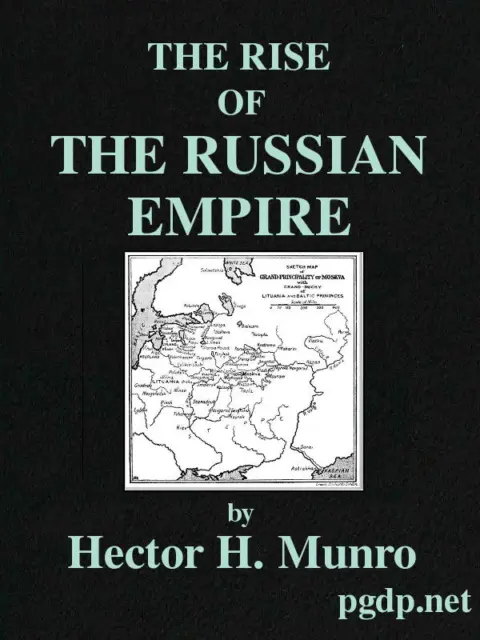
"The Rise of the Russian Empire" by Hector H. Munro is a historical account written in the late 19th century. This work aims to provide a detailed presentation of Russian history, exploring the nation’s evolution from its early beginnings, focusing particularly on the reigns of significant figures like Rurik and Oleg. It seeks to fill the gaps in English-language literature on Russian history, offering insights into the cultural, political, and geographical context of early Russia. The opening of the book introduces the landscape and geographical features of Russia, establishing a foundation for understanding its historical development. It paints a vivid picture of the diverse tribes inhabiting the region and highlights the unique challenges posed by the country's vast geography. As it delves into the early Slavic peoples, the narrative discusses their societal structures and interactions with neighboring tribes. This sets the stage for the arrival of the Varangians, who would significantly influence the formation of the Russian state, marking the beginning of a pivotal era in the nation's history.
Introduction adapted from the source catalogue; source summaries may be automatically generated.
Free to read · English · 115,731 words · No account needed
MAKE TIME FOR A GOOD BOOK
On by default. Untick to stop anonymous reading totals. Each page counts after 10 seconds in view. How this works.
Anonymous counting is on unless you have switched it off.
Whatever the nature of the causes that led up to this irruption of stranger folk, the fact and, to a certain extent, the manner of their coming is substantially set forth in the old chronicles. Like ocean demi-gods riding out from the sea into the ken of mortal men came three Russ-Varangian brothers, Rurik, Sineus, and Truvor, with a mighty host of kinsfolk and followers, steering eastward in their long, narrow-beaked boats through the waterways that lead from the Finnish Gulf into the lake-land of the Slavs. Separating their forces, Rurik established himself at--according to some accounts, built--the town of Ladoga, on the banks of the Volkhov, twelve miles from its entrance into the Lake Ladoga, thus interposing himself between Novgorod and the sea. His brothers settled at Bielozersk and Izborsk respectively, the latter occupying an important position near Lake Peipus and the Liv border, the former pushing a Varangian outpost among the Finnish tribes to the east; all three, whether from accident or design, choosing the vicinity of an open stretch of water. The date of this immigration is fixed by the chronicler at 862, which is regarded as the starting-point of the Russian State. Two years later Rurik, by the death of both his brothers, was left in sole chieftaincy of the adventurers. From his first stronghold he soon shifted his headquarters to a point farther up the Volkhov’s course, over against Novgorod, where he built himself a citadel; from thence he eventually made himself master of the town, not apparently without some opposition from the inhabitants. Henceforward the Skandinavian chief was undisputed prince of the Slavonic people who had invited him into their country; the neighbouring districts of Rostov and Polotzk were brought under his authority, and Novgorod became the capital and centre of a state which reached from Lake Peipus to the Upper Volga, and from Ladoga to the watershed of the Dvina and Dniepr. In thus extending and consolidating his power and welding his Skandinavian following and the discordant Slavic elements into one smoothly-working organisation, Rurik evinced qualities of statesmanship equal in their way to those displayed by William the Norman in his conquest and administration of England. The absence of any national cohesion among the Slavs, while facilitating the Norse intrusion and settlement, increased the difficulty of binding them in allegiance to a central authority; yet within the space of a few crowded years the Varangian ruler enjoyed an undisputed sway in the lands of his mastery such as few princes could in those unordered times rely on. Not the least difficult part of Rurik’s task must have been the control of his own wanderlusting countrymen, turned loose in an extensive and vaguely-defined region, with rumours of wealth and plunder and fighting beckoning them to the south. In the nature of things such temptation would not be long resisted, especially as the Dniepr offered a convenient if insecure passage to the desired lands, and a short time after the first Norse settlement two Skandinavian adventurers, named Askold and Dir, broke away from the main body with a small following, possibly with the idea of enlisting themselves in the Varangian Guard at Byzantium. They did not immediately pursue their journey, however, farther than Kiev, a townstead of the Polian Slavs,[8] standing on a low bluff above the west bank of the Dniepr. Here they established themselves as Rurik had done at Novgorod, and, reinforced perhaps by roving bodies of their countrymen, set up a second Russian State, without losing sight, however, of the original object which had drawn them southwards. Consequently in the summer of 865 an expedition of from ten to fifteen thousand men, presumably recruited from both Slavs and Norsemen, embarked in their long, narrow war-boats and sailed for Byzantium, plundering and burning along the coast of the Black Sea, and finally riding into the harbour. The audacity of the attack, or perhaps the warlike reputation of the invading host, seems to have paralysed the inhabitants of the city, and the authorities had recourse to supernatural invocation to deliver them from this new danger. The robe of the Virgin was removed from its venerated shrine in the Blacherne Chapel, escorted in solemn procession to the shores of the harbour, and dipped in the water, whereupon arose a tempest that drove the heathen fleet in disorder out to sea. That, at least, is the account of the transaction given by the Byzantine chroniclers.
Your reading position is saved on this browser. Take it to another device with a library code. Reading pages adapt to text, rather than matching a printed edition.
Saki
Saki
Saki
Saki
BEHIND THE BOOK
This eBook is for the use of anyone anywhere in the United States and most other parts of the world at no cost and with almost no restrictions whatsoever. You may copy it, give it away or re-use it under the terms of the Project Gutenberg License included with this eBook or online at www.gutenberg.org. If you are not located in the United States, you will have to check the laws of the country where you are located before using this eBook. Read the source licence.
The original source file, including credits and licence, is retained by this library. Request an original-format copy at no charge. Please include the book title and Project Gutenberg identifier #45099.
KEEP YOUR CURIOSITY GOING
Cécile Tormay

Moritz Busch
John L. Ransom
Frances Wright
Cécile Tormay

Mabel Potter Daggett