READ · DISCOVER · ENJOYClassic literature · Always free
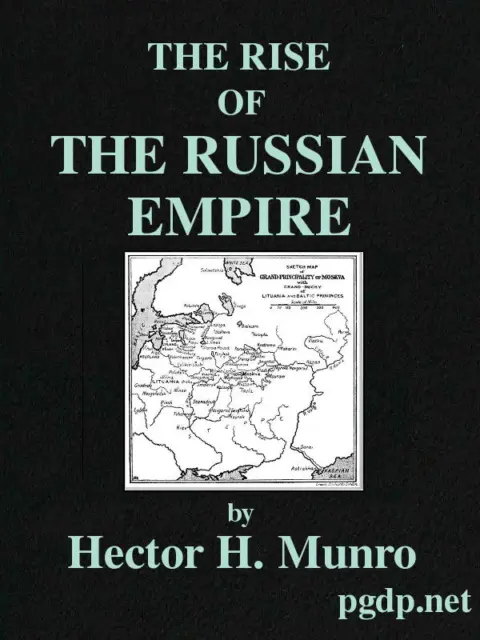
The Rise of the Russian Empire — digital edition cover

THE CLASSIC COLLECTION · 1900

The Rise of the Russian Empire

"The Rise of the Russian Empire" by Hector H. Munro is a historical account written in the late 19th century. This work aims to provide a detailed presentation of Russian history, exploring the nation’s evolution from its early beginnings, focusing particularly on the reigns of significant figures like Rurik and Oleg. It seeks to fill the gaps in English-language literature on Russian history, offering insights into the cultural, political, and geographical context of early Russia. The opening of the book introduces the landscape and geographical features of Russia, establishing a foundation for understanding its historical development. It paints a vivid picture of the diverse tribes inhabiting the region and highlights the unique challenges posed by the country's vast geography. As it delves into the early Slavic peoples, the narrative discusses their societal structures and interactions with neighboring tribes. This sets the stage for the arrival of the Varangians, who would significantly influence the formation of the Russian state, marking the beginning of a pivotal era in the nation's history.

Introduction adapted from the source catalogue; source summaries may be automatically generated.

Start reading ↓

Free to read · English · 115,731 words · No account needed

MAKE TIME FOR A GOOD BOOK

The Rise of the Russian Empire

On by default. Untick to stop anonymous reading totals. Each page counts after 10 seconds in view. How this works.

Anonymous counting is on unless you have switched it off.

The Rise of the Russian Empire

Dark and anxious for the Moskvitchi was the winter following the tzarskie election; sullen and ill-fed troops quartered within the capital, and without bands of Kozaks prowling like wolves about the country; no supplies coming into Moskva, only rumours of warlike invasion from Lit’uania. The thaws of spring might bring with them Sigismund and his hetmans, and the swallow tribes returning to their nests on the Kreml ramparts might once again be greeted with the singing of the Latins in the holy places of Orthodoxy. The forebodings of Polish invasion passed away, however, with the winter snows, and the Tzar’s counsellors were able to devote their attention to a campaign of extermination against Zaroutzkie and his wild horsemen. [Sidenote: 1614] The kniaz Ivan Odoevskie was dispatched with a Moskovite army in search of the Kozak chief, and after a series of marchings and counter-marchings fell in with him not far from Toula; according to the voevoda’s report, Zaroutzkie was completely defeated after two days’ continuous fighting, and forced to fly across the Don to Medvieditz with a few followers, leaving his baggage train, standards, and many prisoners in the victor’s hands. The chronicles give a somewhat different account of the matter, and relate that the rebel leader repulsed the tzarskie troops and retired in good order to Astrakhan, leaving a devastated country behind him. Whatever the actual result of the fighting, the disturbing element was at least removed from the heart of the empire, and the authorities at Moskva were able to open up negotiations with the Kozaks of the Don and Volga for the purpose of detaching them from the cause of Zaroutzkie and Marina and enlisting their services against the Lit’uanian enemy. The Tzar sent them messengers with his flag and exhortations to withdraw their allegiance from heretics and traitors; more to the purpose, he was able to send them supplies of cloth, provisions, saltpetre, and lead. The Kozaks greeted the Tzar’s name with a display of loyalty, and accepted his presents, but they did not show a readiness to enroll themselves under his flag; there seemed indeed a possibility that Zaroutzkie would succeed in gathering under his leadership the Volga and Don freebooters and the Tartars of Kazan, and thus shut in the struggling tzarstvo between his forces on the east and those of Poland on the west. Letter after letter was sent from Moskva to the men of the steppe, and appeals were made to their patriotism, their religion, and their cupidity. The downfall of Zaroutzkie and his party was brought about, however, by other agency; in dusty Astrakhan, where Marina and her third consort held their rebel Court, the townsfolk, resentful of the violence of the Volga Kozaks who were quartered on them, rose in rebellion. Zaroutzkie was driven into the stone town, and, on the approach of a body of Moskovite strielitz, the Astrakhanese kissed the cross and beat the forehead to the Tzar Mikhail. The desperate adventurers escaped from the toils which were gathering round them, and fled with a small number of adherents along the wooded banks of the Volga. Odoevskie had arrived on the scene with fresh forces, and a hot pursuit was kept up on the track of the fugitives. At the end of June the enemies of Russia’s peace--Zaroutzkie, the ambition-borne Marina, and her four-year-old son--fell into the hands of their pursuers, and were brought back in triumph to Astrakhan. The bold and stubborn Kozak kniaz ended his wild career by the horrible death of impalement, and the Polish ex-Tzaritza was torn from her child and sent in chains to Moskva, closing her chequered course in a dungeon of the city which she had entered as a monarch’s bride. Her luckless infant, the last and fittest victim of the catastrophe of Ouglitch, swung on a gibbet on the road that runs towards Serpoukhov, a tender and pitiful morsel of gallows-fruit for the Volga daws to peck at. The fate of Zaroutzkie and the extinction of the last pale ghostling of a race of spectres did not immediately deter the wild spirits of the steppes from struggling against the elements of order, so long absent from the land. Bands of Kozaks, swelled into an army by drafts of Russian freebooters and fugitive serfs, border raiders and Tcherkesses, raised anew the flag of rebellion and discord, and were not dispersed till an over-bold rush towards Moskva brought upon them a decisive defeat on the banks of the Loujha (September 1614). At the same time Lisovskie kept alive the cause of the Polish prince and made the Sieverskie land the base of operations for his light and seasoned troops. Nor was the outlook more hopeful in the north; besides Great Novgorod and the Water-ward (one of the five districts appertaining to that city), the Swedes held Keksholm, Ivangorod, Yam, Kopor’e, Ladoga, and Staraia Rousa. The Novgorodskie, who had handed themselves over to the Swedish prince on the supposition that he would be chosen Tzar of Russia, found themselves, by the election of Mikhail, confronted with the alternative of revolt against their accepted sovereign or separation from Moskovy. The citizens would willingly have chosen the former course, but the Swedes were in forcible possession, and, like the porcupine of the fable, were in no way disposed to quit the quarters into which they had been admitted. Faced with the necessity of increasing their field forces to cope with the enemies who threatened them on every side, the Russian executive were obliged to make further calls upon the resources of the gosoudarstvo; the north-eastern province, the youngest of all the Russian territories, responded manfully to the Tzar’s requisitions, but for the most part the other taxing grounds yielded poor returns. Equally unproductive was the experiment in liquor dealing, by which the Government sought to augment their revenue by monopolising the distilling and sale of wines and spirits. In another direction they were more successful in seeking for assistance; shortly after Mikhail’s coronation the young Tzar’s counsellors, recalling the terms of friendship which had existed aforetime between the rulers of Moskovy and the Tudor sovereigns of England, dispatched an embassy to the Stewart prince who had stepped into the inheritance of the latter dynasty. King James was appealed to by his brother monarch for urgently needed supplies of gunpowder, money, lead, sulphur, and other munitions with which to carry on the war of self-defence, and also for the exertion of his good services for the arrangement of an accommodation with Sweden. It was characteristic of the British negotiators that they instinctively sought to obtain concessions for their merchants to trade through Russian waterways direct with Persia, India, and China, characteristic perhaps of the Moskovites that they temporised, raised obstacles, and finally granted nothing. It was also an honourable episode in the not too satisfactory foreign dealings of the Stewarts that the refusal did not alienate the good offices which were put forward on behalf of the Tzar. In August 1614 John Merrick, a recently knighted merchant who was well acquainted with Moskva, came to that city with full powers from the King of Great Britain for opening negotiations between Sweden and Russia. Holland had also been approached on the same subject, and Merrick was joined at Novgorod by the Dutch ambassador van Brederode. At the same time that the Russian Government was seeking the intervention and aid of the northern sea powers, its agents were casting about among the military states of south-eastern Europe with a similar object. So far had the dream of a crusade against the Crescent faded away from Moskovite imagination before the nightmare of present woes, that the young Tzar and his counsellors were anxious to league their forces with those of the Sultan and the Tartar Khan against the King of Poland, and negotiations were set on foot at Constantinople for that purpose. [Sidenote: 1615] The Emperor, who was appealed to with the view of obtaining by diplomacy what the Turks did not seem likely to effect by war, accepted the post of mediator, and a meeting of the Russian and Polish ambassadors was held at Smolensk, under the presidency of the imperial representative, Erasmus Handelius. As the Poles began by demanding that Vladislav should be recognised as Tzar of Russia, the negotiations did not proceed very far, and the German returned to his master with the report that “you might so well try to reconcile fire and water.” An irregular warfare of an extraordinary character preluded the opening of a more serious campaign between the two hate-hounded States. The firebrand Lisovskie kindled the blaze of strife and devastation once more in the Sieverskie country, and with his light horsemen, innured to fatigue and rapid marches, flitted like a will-o’-the-wisp before the pursuing troops of Dimitri Pojharskie. Hunted out of the Sieverski border, he passed swiftly northward by Smolensk and Viasma, harried the slobodas of Rjhev, turned towards Ouglitch, and subsequently burst through between Yaroslavl and Kostroma and laid Souzdal in ashes; from thence he hied into the Riazan province, beat off the attacks of the Moskovite voevodas, and dashed back into Lit’uania by way of Toula and Serpoukhov. In the north meanwhile the walls of Pskov had once more proved a bulwark against the tide of Russia’s misfortunes, and the military talents which the young Gustav-Adolf had already commenced to display were unable to bring about the reduction of that stronghold. This check, together with the Polish and Danish wars in which Sweden was involved, inclined the King to be more favourably disposed towards a reasonable accommodation than his cousin of Poland had shown himself, and the peace negotiations which the English and Dutch representatives set afoot were more hopeful of result than those of Smolensk. The foreign envoys saw in the miserable desolation of the border districts through which they travelled evidence of the distress with which Moskovy was still afflicted. Save bands of Kozaks skulking in the woods, the country-side was devoid of human habitants; of the native population only unburied corpses remained, and at night the howling of congregated wolves and other beasts of prey resounded on all sides. The once thriving town of Staraia Rousa was a heap of ruined houses and churches, haunted by an under-fed remnant of scarcely 100 men. Such were the scenes amid which the ambassadors of the two contending nations and their mediators commenced their attempts at mutual accommodation. The cool-headed and business-like qualities of the British representative were perhaps the deciding factor in the protracted negotiations, and towards the end of 1616 Merrick was able to bring the opposing elements together in the village of Stolbova to discuss the final terms of peace. [Sidenote: 1617] In February the following year the treaty of Stolbova was signed, its principal provisions being: that Sweden yielded back to Russia Great Novgorod and district, Ladoga, Staraia Rousa, and some smaller places, but retained Ivangorod, Yam, Kopor’e, Keksholm and the province of Korelia, and in addition received a sum of 20,000 roubles; that free commercial intercourse should obtain between the two reconciled countries; and that immigrants from the west should have free access to the Tzar’s dominions through Swedish territory.[199] Merrick, who had done his utmost to secure tolerable terms for the Russians, further assisted them by paying down the money demanded by Sweden.

Your reading position is saved on this browser. Take it to another device with a library code. Reading pages adapt to text, rather than matching a printed edition.

More from this author

BEHIND THE WORDS

About Saki

Saki (1870–1916). Explore The Westminster Alice, The Rise of the Russian Empire, When William Came and other works in this collection. These books span adventure, classic fiction, drama & theatre.

Explore this author’s books →

THE READERS’ VERDICT

How did this story stay with you?

Not rated yet
Your rating for The Rise of the Russian Empire

Be the first to share your verdict.

One rating per browser, which you can change or remove. A necessary browser identifier remembers your vote. How ratings work

A GOOD STORY DESERVES COMPANY

Pass this book along.

A great read is even better when it’s shared.

SEND A LITTLE INSPIRATION

Share this book

BEHIND THE BOOK

Edition & source details.

Title
The Rise of the Russian Empire
Author
Saki
First publication (Open Library catalogue match)
1900
Digital edition publisher
Project Gutenberg
Gutenberg release date
2014-03-09
Language
English
Source edition imprint
Not stated in source catalogue
Source identifier
Project Gutenberg #45099
Contributors
No additional named contributors in source metadata

Public-domain source & licence

This eBook is for the use of anyone anywhere in the United States and most other parts of the world at no cost and with almost no restrictions whatsoever. You may copy it, give it away or re-use it under the terms of the Project Gutenberg License included with this eBook or online at www.gutenberg.org. If you are not located in the United States, you will have to check the laws of the country where you are located before using this eBook. Read the source licence.

Full source licence and obtaining an original copy

The original source file, including credits and licence, is retained by this library. Request an original-format copy at no charge. Please include the book title and Project Gutenberg identifier #45099.

the full Project Gutenberg License must appear
prominently whenever any copy of a Project Gutenberg work (any work
on which the phrase “Project Gutenberg” appears, or with which the
phrase “Project Gutenberg” is associated) is accessed, displayed,
performed, viewed, copied or distributed:

This eBook is for the use of anyone anywhere in the United States and most
other parts of the world at no cost and with almost no restrictions
whatsoever. You may copy it, give it away or re-use it under the terms
of the Project Gutenberg™ License included with this eBook or online
at www.gutenberg.org. If you
are not located in the United States, you will have to check the laws
of the country where you are located before using this eBook.

1.E.2. If an individual Project Gutenberg electronic work is
derived from texts not protected by U.S. copyright law (does not
contain a notice indicating that it is posted with permission of the
copyright holder), the work can be copied and distributed to anyone in
the United States without paying any fees or charges. If you are
redistributing or providing access to a work with the phrase “Project
Gutenberg” associated with or appearing on the work, you must comply
either with the requirements of paragraphs 1.E.1 through 1.E.7 or
obtain permission for the use of the work and the Project Gutenberg
trademark as set forth in paragraphs 1.E.8 or 1.E.9.

1.E.3. If an individual Project Gutenberg electronic work is posted
with the permission of the copyright holder, your use and distribution
must comply with both paragraphs 1.E.1 through 1.E.7 and any
additional terms imposed by the copyright holder. Additional terms
will be linked to the Project Gutenberg License for all works
posted with the permission of the copyright holder found at the
beginning of this work.

1.E.4. Do not unlink or detach or remove the full Project Gutenberg
License terms from this work, or any files containing a part of this
work or any other work associated with Project Gutenberg.

1.E.5. Do not copy, display, perform, distribute or redistribute this
electronic work, or any part of this electronic work, without
prominently displaying the sentence set forth in paragraph 1.E.1 with
active links or immediate access to the full terms of the Project
Gutenberg License.

1.E.6. You may convert to and distribute this work in any binary,
compressed, marked up, nonproprietary or proprietary form, including
any word processing or hypertext form. However, if you provide access
to or distribute copies of a Project Gutenberg work in a format
other than “Plain Vanilla ASCII” or other format used in the official
version posted on the official Project Gutenberg website
(www.gutenberg.org), you must, at no additional cost, fee or expense
to the user, provide a copy, a means of exporting a copy, or a means
of obtaining a copy upon request, of the work in its original “Plain
Vanilla ASCII” or other form. Any alternate format must include the
full Project Gutenberg License as specified in paragraph 1.E.1.

1.E.7. Do not charge a fee for access to, viewing, displaying,
performing, copying or distributing any Project Gutenberg works
unless you comply with paragraph 1.E.8 or 1.E.9.

1.E.8. You may charge a reasonable fee for copies of or providing
access to or distributing Project Gutenberg electronic works
provided that:

• You pay a royalty fee of 20% of the gross profits you derive from
the use of Project Gutenberg works calculated using the method
you already use to calculate your applicable taxes. The fee is owed
to the owner of the Project Gutenberg trademark, but he has
agreed to donate royalties under this paragraph to the Project
Gutenberg Literary Archive Foundation. Royalty payments must be paid
within 60 days following each date on which you prepare (or are
legally required to prepare) your periodic tax returns. Royalty
payments should be clearly marked as such and sent to the Project
Gutenberg Literary Archive Foundation at the address specified in
Section 4, “Information about donations to the Project Gutenberg
Literary Archive Foundation.”

• You provide a full refund of any money paid by a user who notifies
you in writing (or by e-mail) within 30 days of receipt that s/he
does not agree to the terms of the full Project Gutenberg™
License. You must require such a user to return or destroy all
copies of the works possessed in a physical medium and discontinue
all use of and all access to other copies of Project Gutenberg™
works.

• You provide, in accordance with paragraph 1.F.3, a full refund of
any money paid for a work or a replacement copy, if a defect in the
electronic work is discovered and reported to you within 90 days of
receipt of the work.

• You comply with all other terms of this agreement for free
distribution of Project Gutenberg™ works.


1.E.9. If you wish to charge a fee or distribute a Project
Gutenberg™ electronic work or group of works on different terms than
are set forth in this agreement, you must obtain permission in writing
from the Project Gutenberg Literary Archive Foundation, the manager of
the Project Gutenberg™ trademark. Contact the Foundation as set
forth in Section 3 below.

1.F.

1.F.1. Project Gutenberg volunteers and employees expend considerable
effort to identify, do copyright research on, transcribe and proofread
works not protected by U.S. copyright law in creating the Project
Gutenberg™ collection. Despite these efforts, Project Gutenberg™
electronic works, and the medium on which they may be stored, may
contain “Defects,” such as, but not limited to, incomplete, inaccurate
or corrupt data, transcription errors, a copyright or other
intellectual property infringement, a defective or damaged disk or
other medium, a computer virus, or computer codes that damage or
cannot be read by your equipment.

1.F.2. LIMITED WARRANTY, DISCLAIMER OF DAMAGES - Except for the “Right
of Replacement or Refund” described in paragraph 1.F.3, the Project
Gutenberg Literary Archive Foundation, the owner of the Project
Gutenberg™ trademark, and any other party distributing a Project
Gutenberg™ electronic work under this agreement, disclaim all
liability to you for damages, costs and expenses, including legal
fees. YOU AGREE THAT YOU HAVE NO REMEDIES FOR NEGLIGENCE, STRICT
LIABILITY, BREACH OF WARRANTY OR BREACH OF CONTRACT EXCEPT THOSE
PROVIDED IN PARAGRAPH 1.F.3. YOU AGREE THAT THE FOUNDATION, THE
TRADEMARK OWNER, AND ANY DISTRIBUTOR UNDER THIS AGREEMENT WILL NOT BE
LIABLE TO YOU FOR ACTUAL, DIRECT, INDIRECT, CONSEQUENTIAL, PUNITIVE OR
INCIDENTAL DAMAGES EVEN IF YOU GIVE NOTICE OF THE POSSIBILITY OF SUCH
DAMAGE.

1.F.3. LIMITED RIGHT OF REPLACEMENT OR REFUND - If you discover a
defect in this electronic work within 90 days of receiving it, you can
receive a refund of the money (if any) you paid for it by sending a
written explanation to the person you received the work from. If you
received the work on a physical medium, you must return the medium
with your written explanation. The person or entity that provided you
with the defective work may elect to provide a replacement copy in
lieu of a refund. If you received the work electronically, the person
or entity providing it to you may choose to give you a second
opportunity to receive the work electronically in lieu of a refund. If
the second copy is also defective, you may demand a refund in writing
without further opportunities to fix the problem.

1.F.4. Except for the limited right of replacement or refund set forth
in paragraph 1.F.3, this work is provided to you ‘AS-IS’, WITH NO
OTHER WARRANTIES OF ANY KIND, EXPRESS OR IMPLIED, INCLUDING BUT NOT
LIMITED TO WARRANTIES OF MERCHANTABILITY OR FITNESS FOR ANY PURPOSE.

1.F.5. Some states do not allow disclaimers of certain implied
warranties or the exclusion or limitation of certain types of
damages. If any disclaimer or limitation set forth in this agreement
violates the law of the state applicable to this agreement, the
agreement shall be interpreted to make the maximum disclaimer or
limitation permitted by the applicable state law. The invalidity or
unenforceability of any provision of this agreement shall not void the
remaining provisions.

1.F.6. INDEMNITY - You agree to indemnify and hold the Foundation, the
trademark owner, any agent or employee of the Foundation, anyone
providing copies of Project Gutenberg™ electronic works in
accordance with this agreement, and any volunteers associated with the
production, promotion and distribution of Project Gutenberg™
electronic works, harmless from all liability, costs and expenses,
including legal fees, that arise directly or indirectly from any of
the following which you do or cause to occur: (a) distribution of this
or any Project Gutenberg work, (b) alteration, modification, or
additions or deletions to any Project Gutenberg work, and (c) any
Defect you cause.

Section 2. Information about the Mission of Project Gutenberg

Project Gutenberg is synonymous with the free distribution of
electronic works in formats readable by the widest variety of
computers including obsolete, old, middle-aged and new computers. It
exists because of the efforts of hundreds of volunteers and donations
from people in all walks of life.

Volunteers and financial support to provide volunteers with the
assistance they need are critical to reaching Project Gutenberg’s
goals and ensuring that the Project Gutenberg collection will
remain freely available for generations to come. In 2001, the Project
Gutenberg Literary Archive Foundation was created to provide a secure
and permanent future for Project Gutenberg and future
generations. To learn more about the Project Gutenberg Literary
Archive Foundation and how your efforts and donations can help, see
Sections 3 and 4 and the Foundation information page at www.gutenberg.org.

Section 3. Information about the Project Gutenberg Literary Archive Foundation

The Project Gutenberg Literary Archive Foundation is a non-profit
501(c)(3) educational corporation organized under the laws of the
state of Mississippi and granted tax exempt status by the Internal
Revenue Service. The Foundation’s EIN or federal tax identification
number is 64-6221541. Contributions to the Project Gutenberg Literary
Archive Foundation are tax deductible to the full extent permitted by
U.S. federal laws and your state’s laws.

The Foundation’s business office is located at 41 Watchung Plaza #516,
Montclair NJ 07042, USA, +1 (862) 621-9288. Email contact links and up
to date contact information can be found at the Foundation’s website
and official page at www.gutenberg.org/contact

Section 4. Information about Donations to the Project Gutenberg
Literary Archive Foundation

Project Gutenberg™ depends upon and cannot survive without widespread
public support and donations to carry out its mission of
increasing the number of public domain and licensed works that can be
freely distributed in machine-readable form accessible by the widest
array of equipment including outdated equipment. Many small donations
($1 to $5,000) are particularly important to maintaining tax exempt
status with the IRS.

The Foundation is committed to complying with the laws regulating
charities and charitable donations in all 50 states of the United
States. Compliance requirements are not uniform and it takes a
considerable effort, much paperwork and many fees to meet and keep up
with these requirements. We do not solicit donations in locations
where we have not received written confirmation of compliance. To SEND
DONATIONS or determine the status of compliance for any particular state
visit www.gutenberg.org/donate.

While we cannot and do not solicit contributions from states where we
have not met the solicitation requirements, we know of no prohibition
against accepting unsolicited donations from donors in such states who
approach us with offers to donate.

International donations are gratefully accepted, but we cannot make
any statements concerning tax treatment of donations received from
outside the United States. U.S. laws alone swamp our small staff.

Please check the Project Gutenberg web pages for current donation
methods and addresses. Donations are accepted in a number of other
ways including checks, online payments and credit card donations. To
donate, please visit: www.gutenberg.org/donate.

Section 5. General Information About Project Gutenberg electronic works

Professor Michael S. Hart was the originator of the Project
Gutenberg concept of a library of electronic works that could be
freely shared with anyone. For forty years, he produced and
distributed Project Gutenberg eBooks with only a loose network of
volunteer support.

Project Gutenberg eBooks are often created from several printed
editions, all of which are confirmed as not protected by copyright in
the U.S. unless a copyright notice is included. Thus, we do not
necessarily keep eBooks in compliance with any particular paper
edition.

Most people start at our website which has the main PG search
facility: www.gutenberg.org.

This website includes information about Project Gutenberg,
including how to make donations to the Project Gutenberg Literary
Archive Foundation, how to help produce our new eBooks, and how to
subscribe to our email newsletter to hear about new eBooks.


KEEP YOUR CURIOSITY GOING

Your next chapter awaits.

Your privacy choices

Reading is always free. You can change these settings at any time.

Book banners link to our books on simonward.net. They do not use advertising cookies or tracking.

Privacy & cookie policy · Reading data and privacy controls