The Westminster Alice
Saki
THE CLASSIC COLLECTION · 1900
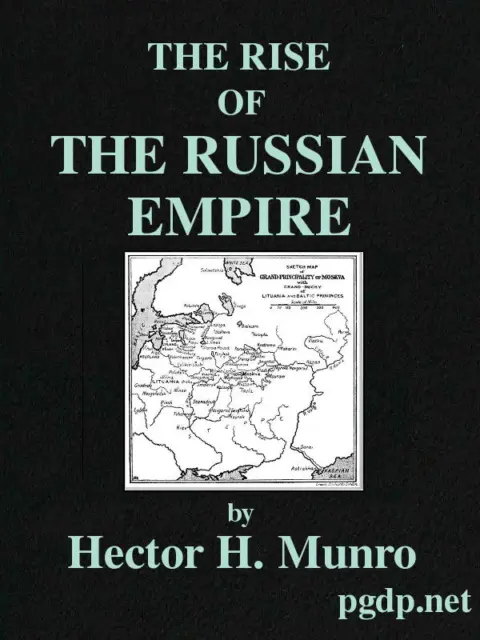
"The Rise of the Russian Empire" by Hector H. Munro is a historical account written in the late 19th century. This work aims to provide a detailed presentation of Russian history, exploring the nation’s evolution from its early beginnings, focusing particularly on the reigns of significant figures like Rurik and Oleg. It seeks to fill the gaps in English-language literature on Russian history, offering insights into the cultural, political, and geographical context of early Russia. The opening of the book introduces the landscape and geographical features of Russia, establishing a foundation for understanding its historical development. It paints a vivid picture of the diverse tribes inhabiting the region and highlights the unique challenges posed by the country's vast geography. As it delves into the early Slavic peoples, the narrative discusses their societal structures and interactions with neighboring tribes. This sets the stage for the arrival of the Varangians, who would significantly influence the formation of the Russian state, marking the beginning of a pivotal era in the nation's history.
Introduction adapted from the source catalogue; source summaries may be automatically generated.
Free to read · English · 115,731 words · No account needed
MAKE TIME FOR A GOOD BOOK
On by default. Untick to stop anonymous reading totals. Each page counts after 10 seconds in view. How this works.
Anonymous counting is on unless you have switched it off.
Whether this sanguinary example had the effect of encouraging “les autres,” or whether the damage sustained by Moskva from the Tartar brands stung the Russians to exceptional effort, a renewal of the invasion by the Khan met with a determined and successful opposition. [Sidenote: Aug. 1572] An enormous army of Krim and Nogai Tartars, reinforced by troops of Yeni-Tscheri and other Turkish soldiers, pushed across the Oka, but was encountered and decisively defeated by a Moskovite force of inferior numbers, under the command of Kniaz Vorotinski and Ivan Sheremetiev. The slaughter was heavy and the issue of the day swept away all question of withdrawal from Astrakhan, and gave Moskovy a long immunity from trouble with the steppe-folk. Ivan, who, while the attack threatened, had been seized with a desire to visit the northern districts of his dominions, returned from Novgorod to share in the general rejoicing. In the early part of the year he had scandalised and embarrassed the heads of the Church by taking unto himself a fourth wife, Anna Koltovskoi; after having accomplished this breach of the Church’s law he still further disturbed the spiritual fathers by announcing his sin to the Synod then sitting for the election of a Metropolitan in the place of Kirill, deceased, and demanding absolution. The Vladuikas, torn between love for their precious dogmas and a natural and earnest desire to fall in with the Tzar’s wishes, yielded finally to the stronger sentiment and hallowed the union. In order to prevent other less privileged persons from imitating the Tzar’s example, they hastened to “menace with a fulminating anathema those who should dare to enter into a fourth marriage.” Antonie, Archbishop of Polotzk, was elected Metropolitan.
While Moskva was yet quaking in anticipation of another visit from Devlet-Girei, an anxiously awaited event had taken place in the grand-duchy of Lit’uania. [Sidenote: 1570] At Knyszyn, near Grodno, on the 7th July, had passed away the amiable Sigismund-August, “last of the Yagiellos.” Instantly the states composing the Polish kingdom were plunged into the modified anarchy of an interregnum, and various aspirants to the kingly title, starting suddenly into the foreground, added to the general confusion. The internal differences which complicated the election of a successor to the defunct monarch were succinctly stated in the correspondence of a French diplomat, who informed his Court “there are four sorts of discords and different principles which greatly retard the election, which are: of the Lit’uanians with the Poles, of Great Poland with Little Poland, of the barons with the rest of the nobility, and of the Catholics with the Protestants.”[166] The faction of the Szlachta, or small landowners, was more or less identical with the Great-Poland party, while Little Poland was the stronghold of the higher magnates; this line of demarcation was further accentuated by the personal rivalry of Uchanski, Archbishop of Gniezno, who led the former party, and Firley, Grand Marshal of the realm, who headed the other. Add to this the fact that the Protestants were divided into more or less hostile camps of Lutherans, Calvinists, and Anabaptists, and a fair idea will be gathered of the field wherein the agents of the several candidates were to ply their arts. Of the princes who placed themselves, or were placed, in competition for the throne of the Yagiellos, the one whose claims stood forth most prominently was the Austrian Archduke Ernst, second son of the Emperor (Maximilian II.). The Habsburgs, who had already absorbed Bohemia and were almost as firmly established in that part of Hungary which was not occupied by the Turks, had on every possible occasion contracted matrimonial alliances with the Polish royal House, and hoped to add the Lekh kingdom to their family dominions. The candidature of the Archduke was backed by the imperial influence and had, moreover, the support of the Papacy, whose agent, Cardinal Commendone, was working to secure his election. On the other hand there were considerations which made his success by no means a foregone conclusion; the great body of the Protestants would unite in objecting to a monarch whose family traditions were bound up with Roman Catholic supremacy, and many of the Poles were apprehensive that an Austrian connection would involve them in a war with Turkey, a thing they were particularly anxious to avoid. Above all, he personified German intrusion, an element naturally distasteful to the Polish national spirit. The same dread of a foreign war which weakened the chances of the Archduke was the strongest factor, especially with the Lit’uanians, in advancing the Moskovite candidature. The term of truce had nearly run out and Ivan had clearly let it be understood that an unfriendly election would mean renewal of war. That the Tzar, as sovereign, might be a worse affliction than as a hostile neighbour was a contingency partly provided for by the jealous restrictions of the Pacta conventa, which he would be required to sign preliminary to his coronation. The idea of the Moskovite party in Lit’uania was, however, to elect the weak and more easily handled Thedor, Ivan’s second son, rather than the father. None of the Protestant princes who put themselves forward--John, King of Sweden (brother-in-law of the late Sigismund-August), Stefan Batory, Voevoda of Transylvania, and the young Duke Albrecht-Freidrich of Prussia--were strong enough to command the confidence even of their co-religionists. A further candidate there was, however, from an unexpected quarter. Henri de Valois, Duke of Anjou, brother to his Most Christian Majesty of France, and favourite son of Catherine de Medici, was a young gentleman who was casting about in various directions for an opening suitable for the development of his ambitions, and whose relations and acquaintances were exceedingly desirous to see him settled. Charles IX. was anxious to have this too brilliant brother removed to any sphere other than the kingdom of France, already in a sufficiently electric condition, a wish which was shared by Coligny and the Huguenots; while Catherine nursed the proud hope of seeing all her sons decorated with the kingly title. Monsieur himself was least enamoured of the project. From the Polish point of view he made an ideal candidate; belonging to a powerful House, which was neither German nor Moskovite, he was strong without being dangerous, and the good understanding which existed between the Louvre and the Porte would be an excellent guarantee for immunity from Turkish aggression. Nor was the Catholic bias of the Valois an insuperable obstacle to his election. The Prince who hunted Huguenots with such apparent zeal had in his boyhood dallied with the principles of the Reformation, and in later life seriously considered the project of placing himself at the head of the Protestants of the Low Countries.[167] He was in fact a thorough opportunist, and would probably hold, like his namesake of Navarre, in similar though reversed circumstances, that a kingdom outweighed the significance of a mass. His interests were actively pushed by the ambassador dispatched from France for that purpose, Jean de Montluc, Bishop of Valence, and the hesitancy of the Emperor and uncompromising attitude of the Tzar smoothed the way for his election. The news of the “happy and holy enterprise,” which had been carried to a successful conclusion in the streets of Paris in the small hours of the 24th August, was not received in Poland with the same complacency with which it was hailed at Rome, and the French candidature received a severe check. For months the name of the Duke of Anjou was in evil odour among the electors, and the sleepless efforts of Montluc were directed to the task of whitewashing his employer from the red stain of S. Bartholomew. The long-drawn-out proceedings which delayed the Diet of election, and which gave Poland an entirely new constitution, altering the whole course of her history, also gave time for the feeling against the Valois to die down; the French agents made good use of the respite and the Anjou cause steadily gained fresh adherents, till on the eve of the election scarcely any other candidate was seriously considered. [Sidenote: 1573] Thus it came to pass that, by an irony of fate, the stormy sittings of the Diet of Warszawa, which lasted for the greater part of April and May, resulted in bestowing the Polish crown on the prince who, of all the competitors, least coveted it. And in fact the hotly-contested prize, as it came out of the long interregnum, was scarcely a brilliant possession; “it was not the heritage of the Yagellos intact that the Bishop of Valence would have to take back to the brother of Charles IX., but a crown despoiled of a part of its privileges, and, under the title of king, nothing in truth more than the life-presidency of a republic.”[168] The terms of the celebrated Pacta conventa, to which every succeeding king would be required to give his adhesion, were, among others, that the king should have no voice in the election of a successor; must respect the religious liberty of the Dissidents; must neither undertake a war nor impose taxes without consent of Diet; nor marry nor divorce a wife without the same sanction; and that no foreigners should hold any public office.
Your reading position is saved on this browser. Take it to another device with a library code. Reading pages adapt to text, rather than matching a printed edition.
Saki
Saki
Saki
Saki
BEHIND THE BOOK
This eBook is for the use of anyone anywhere in the United States and most other parts of the world at no cost and with almost no restrictions whatsoever. You may copy it, give it away or re-use it under the terms of the Project Gutenberg License included with this eBook or online at www.gutenberg.org. If you are not located in the United States, you will have to check the laws of the country where you are located before using this eBook. Read the source licence.
The original source file, including credits and licence, is retained by this library. Request an original-format copy at no charge. Please include the book title and Project Gutenberg identifier #45099.
KEEP YOUR CURIOSITY GOING
Cécile Tormay

Moritz Busch
John L. Ransom
Frances Wright
Cécile Tormay

Mabel Potter Daggett