READ · DISCOVER · ENJOYClassic literature · Always free
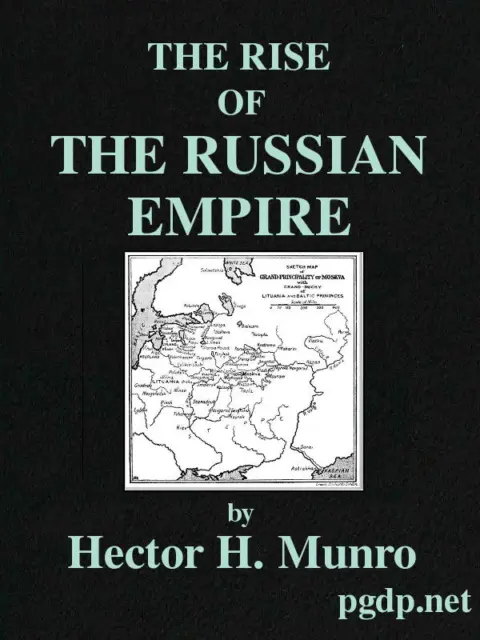
The Rise of the Russian Empire — digital edition cover

THE CLASSIC COLLECTION · 1900

The Rise of the Russian Empire

"The Rise of the Russian Empire" by Hector H. Munro is a historical account written in the late 19th century. This work aims to provide a detailed presentation of Russian history, exploring the nation’s evolution from its early beginnings, focusing particularly on the reigns of significant figures like Rurik and Oleg. It seeks to fill the gaps in English-language literature on Russian history, offering insights into the cultural, political, and geographical context of early Russia. The opening of the book introduces the landscape and geographical features of Russia, establishing a foundation for understanding its historical development. It paints a vivid picture of the diverse tribes inhabiting the region and highlights the unique challenges posed by the country's vast geography. As it delves into the early Slavic peoples, the narrative discusses their societal structures and interactions with neighboring tribes. This sets the stage for the arrival of the Varangians, who would significantly influence the formation of the Russian state, marking the beginning of a pivotal era in the nation's history.

Introduction adapted from the source catalogue; source summaries may be automatically generated.

Start reading ↓

Free to read · English · 115,731 words · No account needed

MAKE TIME FOR A GOOD BOOK

The Rise of the Russian Empire

On by default. Untick to stop anonymous reading totals. Each page counts after 10 seconds in view. How this works.

Anonymous counting is on unless you have switched it off.

The Rise of the Russian Empire

Amid the seemingly indiscriminating severities with which Ivan cowed the inhabitants of his principal cities, his mind was engaged in the conduct of a dexterous and well-thought-out foreign policy. The same year that witnessed the episode of Novgorod and the butchery in the Kitai-gorod was signalised by a long-laboured truce (to run for three years) between Moskovy and Poland. [Sidenote: 1570] The growing expectancy of a vacancy of the Polish-Lit’uanian throne had no doubt something to do with this reconciliation. That Ivan seriously put himself forward as a candidate for that extremely limited and curtailed monarchy seems to be the case, judging from the significant instructions which his ambassadors received, to keep strict silence, when in Poland, on the subject of the Tzar’s domestic tyrannies.[163] Equally surprising, but nevertheless credit-worthy, the Tzar was not without a party among the liberty and license-loving Polish nobles, many of whom, particularly at Warszawa, were said to be adopting Moskovite costume in view of a coming dynastic displacement. His adherents were chiefly among the szlachta, or small nobility, who numbered in their ranks many of the Reformed persuasion. At this period Protestants and Orthodox were lumped together in Poland, under the common designation of Dissidents, and suffered equally at the hands of the dominant Catholics. Hence many members of the Diet were more alarmed at the prospect of an Austrian, or other Jesuit-ridden king, than at the possible unmanageability of the Moskovite Tzar. While awaiting the drift of events in Poland, Ivan set in motion a course of action by which he hoped to drive the Swedes out of the Baltic provinces. His idea was to enlist the sympathy and support of the long-suffering Livlanders and Estlanders by setting up a puppet king who should govern the old lands of the Bund, under the suzerainty of Moskva. The title of King of Livland, offered, according to contemporary report, successively to ex-Master von Fürstenberg and the Duke of Kourland (by both of whom it was declined), was eventually accepted by the ambitious but effete Magnus of Holstein, Duke of Oesel and Wiek. [Sidenote: (1570)] Magnus paid a visit to Moskva--in some trepidation, for the city was getting an unhealthy reputation--and returned with the Tzar’s proclamation of his new dignity, backed up by five-and-twenty thousand Russian troops. With this force and his own German guards, the Holsteiner advanced upon Revel, which, however, held out against both his wiles and his assaults; the latter he discontinued after a siege of thirty weeks’ duration (16th March 1571), burning his camp-works and withdrawing his army into quarters. This rebuff settled the fate of the vassal “kingdom.” In another direction Ivan’s foreign policy had been equally unsuccessful--in an attempt, namely, to cultivate friendly relations with the Ottoman power. The embassy which he sent in 1570 to Constantinople, to congratulate Sultan Selim on his accession, was coldly received, and a demand put forward for the relinquishing of the Russian sovereignty over Kazan and Astrakhan. The uneasiness which the Tzar felt with regard to the possibility of a forward Mussulman movement was increased by news which was brought to Moskva in the spring of 1571 of a warlike activity among the Krimskie Tartars. Whether instigated by Turkish influences, or by the anti-Moskovite party in Poland, or whether acting on his own initiative, Devlet-Girei was certainly preparing for an inroad upon Russian territory, and Ivan hastily assembled an army of 50,000 men, which he posted, under the leadership of several voevodas, along the banks of the Oka, where the enemy was expected to pass. The invading force, said to be 120,000 strong, eluded this first line of defence and bore straight upon Moskva. The Tzar, who might with the forces at his disposal have held the Tartars in check till the army of the Oka came up on their flank, fled, as his father Vasili had done, as most of the Grand Princes of Moskva had from time to time done under similar circumstances, and sheltered himself at Rostov, leaving the capital to its fate. Weakened and dispirited by this desertion, the force which had raced back from the Oka and arrived at much the same time as the Krimskies made no attempt to defend the slobodas and outlying quarters of the city, which were set on fire by the Khan’s orders. Ignorant, probably, of the strength of the Russian garrison, and fearing to be taken unawares by a reinforcement from the north, the Tartars made no further move upon the city, and indeed the rapid spread of the flames made pillage impossible. With the exception of the stone-built Kreml, nearly the whole town was destroyed, and the loss of life, though probably enormously exaggerated by contemporary writers, was undoubtedly very great. “Then might you haue seene a lametable spectacle,” writes an English traveller twenty years later, “... the people burning in their houses and streates, but most of all such as laboured to passe out of the gates farthest from the enemie, where meeting together in a mighty throng, and so pressing euery man to preuent another, wedged themselves so fast within the gate, and streates neare vnto it, as that three ranks walked one vpon the others head, the vppermost treading downe those that were lower: so that there perished at that time (as was sayd) by the fire and the presse, the number of 800,000 people, or more.”[164] Or less. Another Englishman, Sir Jerome Horsey, bears witness to the fact that numbers of the inhabitants, plunging, with all their removable valuables, into the river, to escape from the flames and the Tartars, sank beneath its waters, and that long after the bodies had been disposed of, it was a fashionable amusement to drag the river bed for submerged treasure, adding significantly, “I my selfe was somewhat the better for that fishing.” Satisfied with the striking and easily-accomplished chastisement which he had inflicted upon the half-dreaded, half-despised enemy, the Khan withdrew his Hordes, carrying with him immense numbers of captured Moskovites, and pursued at a safe distance by the tzarskie voevodas. Ivan, returning to his desolated capital and dreading a renewal of the struggle with an antagonist, formidable in himself and possibly a forerunner of Turkish hostility, began to reckon on the necessity of purchasing peace by the surrender of Astrakhan. While, however, the victorious Tartar was plaguing him with taunting messages and importunate demands, the Tzar diverted his mind to the consideration of a more pleasing matter. His second wife Mariya had died in 1569, and he had for some time contemplated a renewal of the marriage state. The present seemed to him a good opportunity for carrying out his project, and the usual preliminaries were set in motion. The selection of a mate for the Russian Gosoudars was conducted on a thoroughly democratic principle, and any young woman of healthy and pleasing appearance might aspire to the honour of becoming Tzaritza. On this occasion over 2000 of the likeliest maidens of Moskovy were brought to the Aleksandrovskie Sloboda, and the Court doctors and midwives helped the monarch to make his choice, which fell upon a young girl of Novgorod, Martha Sobakin. Either the work of selection was badly done, or the Tzar was particularly unfortunate, or the bride met with foul play, for she died before the marriage ceremonies were well through. Needless to state the thwarted widower inclined to the last alternative, and several persons were put to death on suspicion. The proverb “one funeral makes many” certainly applies to the decease of a Tzaritza in sixteenth-century Moskva. A batch of boyarins and voevodas were ordered to execution the same winter (1571), on the charge of having been in league with the Tartars, and doubtless some such suspicion was a deciding factor in Ivan’s supine flight before the invaders. Some were impaled, others knouted to death, others poisoned.[165]

Your reading position is saved on this browser. Take it to another device with a library code. Reading pages adapt to text, rather than matching a printed edition.

More from this author

BEHIND THE WORDS

About Saki

Saki (1870–1916). Explore The Westminster Alice, The Rise of the Russian Empire, When William Came and other works in this collection. These books span adventure, classic fiction, drama & theatre.

Explore this author’s books →

THE READERS’ VERDICT

How did this story stay with you?

Not rated yet
Your rating for The Rise of the Russian Empire

Be the first to share your verdict.

One rating per browser, which you can change or remove. A necessary browser identifier remembers your vote. How ratings work

A GOOD STORY DESERVES COMPANY

Pass this book along.

A great read is even better when it’s shared.

SEND A LITTLE INSPIRATION

Share this book

BEHIND THE BOOK

Edition & source details.

Title
The Rise of the Russian Empire
Author
Saki
First publication (Open Library catalogue match)
1900
Digital edition publisher
Project Gutenberg
Gutenberg release date
2014-03-09
Language
English
Source edition imprint
Not stated in source catalogue
Source identifier
Project Gutenberg #45099
Contributors
No additional named contributors in source metadata

Public-domain source & licence

This eBook is for the use of anyone anywhere in the United States and most other parts of the world at no cost and with almost no restrictions whatsoever. You may copy it, give it away or re-use it under the terms of the Project Gutenberg License included with this eBook or online at www.gutenberg.org. If you are not located in the United States, you will have to check the laws of the country where you are located before using this eBook. Read the source licence.

Full source licence and obtaining an original copy

The original source file, including credits and licence, is retained by this library. Request an original-format copy at no charge. Please include the book title and Project Gutenberg identifier #45099.

the full Project Gutenberg License must appear
prominently whenever any copy of a Project Gutenberg work (any work
on which the phrase “Project Gutenberg” appears, or with which the
phrase “Project Gutenberg” is associated) is accessed, displayed,
performed, viewed, copied or distributed:

This eBook is for the use of anyone anywhere in the United States and most
other parts of the world at no cost and with almost no restrictions
whatsoever. You may copy it, give it away or re-use it under the terms
of the Project Gutenberg™ License included with this eBook or online
at www.gutenberg.org. If you
are not located in the United States, you will have to check the laws
of the country where you are located before using this eBook.

1.E.2. If an individual Project Gutenberg electronic work is
derived from texts not protected by U.S. copyright law (does not
contain a notice indicating that it is posted with permission of the
copyright holder), the work can be copied and distributed to anyone in
the United States without paying any fees or charges. If you are
redistributing or providing access to a work with the phrase “Project
Gutenberg” associated with or appearing on the work, you must comply
either with the requirements of paragraphs 1.E.1 through 1.E.7 or
obtain permission for the use of the work and the Project Gutenberg
trademark as set forth in paragraphs 1.E.8 or 1.E.9.

1.E.3. If an individual Project Gutenberg electronic work is posted
with the permission of the copyright holder, your use and distribution
must comply with both paragraphs 1.E.1 through 1.E.7 and any
additional terms imposed by the copyright holder. Additional terms
will be linked to the Project Gutenberg License for all works
posted with the permission of the copyright holder found at the
beginning of this work.

1.E.4. Do not unlink or detach or remove the full Project Gutenberg
License terms from this work, or any files containing a part of this
work or any other work associated with Project Gutenberg.

1.E.5. Do not copy, display, perform, distribute or redistribute this
electronic work, or any part of this electronic work, without
prominently displaying the sentence set forth in paragraph 1.E.1 with
active links or immediate access to the full terms of the Project
Gutenberg License.

1.E.6. You may convert to and distribute this work in any binary,
compressed, marked up, nonproprietary or proprietary form, including
any word processing or hypertext form. However, if you provide access
to or distribute copies of a Project Gutenberg work in a format
other than “Plain Vanilla ASCII” or other format used in the official
version posted on the official Project Gutenberg website
(www.gutenberg.org), you must, at no additional cost, fee or expense
to the user, provide a copy, a means of exporting a copy, or a means
of obtaining a copy upon request, of the work in its original “Plain
Vanilla ASCII” or other form. Any alternate format must include the
full Project Gutenberg License as specified in paragraph 1.E.1.

1.E.7. Do not charge a fee for access to, viewing, displaying,
performing, copying or distributing any Project Gutenberg works
unless you comply with paragraph 1.E.8 or 1.E.9.

1.E.8. You may charge a reasonable fee for copies of or providing
access to or distributing Project Gutenberg electronic works
provided that:

• You pay a royalty fee of 20% of the gross profits you derive from
the use of Project Gutenberg works calculated using the method
you already use to calculate your applicable taxes. The fee is owed
to the owner of the Project Gutenberg trademark, but he has
agreed to donate royalties under this paragraph to the Project
Gutenberg Literary Archive Foundation. Royalty payments must be paid
within 60 days following each date on which you prepare (or are
legally required to prepare) your periodic tax returns. Royalty
payments should be clearly marked as such and sent to the Project
Gutenberg Literary Archive Foundation at the address specified in
Section 4, “Information about donations to the Project Gutenberg
Literary Archive Foundation.”

• You provide a full refund of any money paid by a user who notifies
you in writing (or by e-mail) within 30 days of receipt that s/he
does not agree to the terms of the full Project Gutenberg™
License. You must require such a user to return or destroy all
copies of the works possessed in a physical medium and discontinue
all use of and all access to other copies of Project Gutenberg™
works.

• You provide, in accordance with paragraph 1.F.3, a full refund of
any money paid for a work or a replacement copy, if a defect in the
electronic work is discovered and reported to you within 90 days of
receipt of the work.

• You comply with all other terms of this agreement for free
distribution of Project Gutenberg™ works.


1.E.9. If you wish to charge a fee or distribute a Project
Gutenberg™ electronic work or group of works on different terms than
are set forth in this agreement, you must obtain permission in writing
from the Project Gutenberg Literary Archive Foundation, the manager of
the Project Gutenberg™ trademark. Contact the Foundation as set
forth in Section 3 below.

1.F.

1.F.1. Project Gutenberg volunteers and employees expend considerable
effort to identify, do copyright research on, transcribe and proofread
works not protected by U.S. copyright law in creating the Project
Gutenberg™ collection. Despite these efforts, Project Gutenberg™
electronic works, and the medium on which they may be stored, may
contain “Defects,” such as, but not limited to, incomplete, inaccurate
or corrupt data, transcription errors, a copyright or other
intellectual property infringement, a defective or damaged disk or
other medium, a computer virus, or computer codes that damage or
cannot be read by your equipment.

1.F.2. LIMITED WARRANTY, DISCLAIMER OF DAMAGES - Except for the “Right
of Replacement or Refund” described in paragraph 1.F.3, the Project
Gutenberg Literary Archive Foundation, the owner of the Project
Gutenberg™ trademark, and any other party distributing a Project
Gutenberg™ electronic work under this agreement, disclaim all
liability to you for damages, costs and expenses, including legal
fees. YOU AGREE THAT YOU HAVE NO REMEDIES FOR NEGLIGENCE, STRICT
LIABILITY, BREACH OF WARRANTY OR BREACH OF CONTRACT EXCEPT THOSE
PROVIDED IN PARAGRAPH 1.F.3. YOU AGREE THAT THE FOUNDATION, THE
TRADEMARK OWNER, AND ANY DISTRIBUTOR UNDER THIS AGREEMENT WILL NOT BE
LIABLE TO YOU FOR ACTUAL, DIRECT, INDIRECT, CONSEQUENTIAL, PUNITIVE OR
INCIDENTAL DAMAGES EVEN IF YOU GIVE NOTICE OF THE POSSIBILITY OF SUCH
DAMAGE.

1.F.3. LIMITED RIGHT OF REPLACEMENT OR REFUND - If you discover a
defect in this electronic work within 90 days of receiving it, you can
receive a refund of the money (if any) you paid for it by sending a
written explanation to the person you received the work from. If you
received the work on a physical medium, you must return the medium
with your written explanation. The person or entity that provided you
with the defective work may elect to provide a replacement copy in
lieu of a refund. If you received the work electronically, the person
or entity providing it to you may choose to give you a second
opportunity to receive the work electronically in lieu of a refund. If
the second copy is also defective, you may demand a refund in writing
without further opportunities to fix the problem.

1.F.4. Except for the limited right of replacement or refund set forth
in paragraph 1.F.3, this work is provided to you ‘AS-IS’, WITH NO
OTHER WARRANTIES OF ANY KIND, EXPRESS OR IMPLIED, INCLUDING BUT NOT
LIMITED TO WARRANTIES OF MERCHANTABILITY OR FITNESS FOR ANY PURPOSE.

1.F.5. Some states do not allow disclaimers of certain implied
warranties or the exclusion or limitation of certain types of
damages. If any disclaimer or limitation set forth in this agreement
violates the law of the state applicable to this agreement, the
agreement shall be interpreted to make the maximum disclaimer or
limitation permitted by the applicable state law. The invalidity or
unenforceability of any provision of this agreement shall not void the
remaining provisions.

1.F.6. INDEMNITY - You agree to indemnify and hold the Foundation, the
trademark owner, any agent or employee of the Foundation, anyone
providing copies of Project Gutenberg™ electronic works in
accordance with this agreement, and any volunteers associated with the
production, promotion and distribution of Project Gutenberg™
electronic works, harmless from all liability, costs and expenses,
including legal fees, that arise directly or indirectly from any of
the following which you do or cause to occur: (a) distribution of this
or any Project Gutenberg work, (b) alteration, modification, or
additions or deletions to any Project Gutenberg work, and (c) any
Defect you cause.

Section 2. Information about the Mission of Project Gutenberg

Project Gutenberg is synonymous with the free distribution of
electronic works in formats readable by the widest variety of
computers including obsolete, old, middle-aged and new computers. It
exists because of the efforts of hundreds of volunteers and donations
from people in all walks of life.

Volunteers and financial support to provide volunteers with the
assistance they need are critical to reaching Project Gutenberg’s
goals and ensuring that the Project Gutenberg collection will
remain freely available for generations to come. In 2001, the Project
Gutenberg Literary Archive Foundation was created to provide a secure
and permanent future for Project Gutenberg and future
generations. To learn more about the Project Gutenberg Literary
Archive Foundation and how your efforts and donations can help, see
Sections 3 and 4 and the Foundation information page at www.gutenberg.org.

Section 3. Information about the Project Gutenberg Literary Archive Foundation

The Project Gutenberg Literary Archive Foundation is a non-profit
501(c)(3) educational corporation organized under the laws of the
state of Mississippi and granted tax exempt status by the Internal
Revenue Service. The Foundation’s EIN or federal tax identification
number is 64-6221541. Contributions to the Project Gutenberg Literary
Archive Foundation are tax deductible to the full extent permitted by
U.S. federal laws and your state’s laws.

The Foundation’s business office is located at 41 Watchung Plaza #516,
Montclair NJ 07042, USA, +1 (862) 621-9288. Email contact links and up
to date contact information can be found at the Foundation’s website
and official page at www.gutenberg.org/contact

Section 4. Information about Donations to the Project Gutenberg
Literary Archive Foundation

Project Gutenberg™ depends upon and cannot survive without widespread
public support and donations to carry out its mission of
increasing the number of public domain and licensed works that can be
freely distributed in machine-readable form accessible by the widest
array of equipment including outdated equipment. Many small donations
($1 to $5,000) are particularly important to maintaining tax exempt
status with the IRS.

The Foundation is committed to complying with the laws regulating
charities and charitable donations in all 50 states of the United
States. Compliance requirements are not uniform and it takes a
considerable effort, much paperwork and many fees to meet and keep up
with these requirements. We do not solicit donations in locations
where we have not received written confirmation of compliance. To SEND
DONATIONS or determine the status of compliance for any particular state
visit www.gutenberg.org/donate.

While we cannot and do not solicit contributions from states where we
have not met the solicitation requirements, we know of no prohibition
against accepting unsolicited donations from donors in such states who
approach us with offers to donate.

International donations are gratefully accepted, but we cannot make
any statements concerning tax treatment of donations received from
outside the United States. U.S. laws alone swamp our small staff.

Please check the Project Gutenberg web pages for current donation
methods and addresses. Donations are accepted in a number of other
ways including checks, online payments and credit card donations. To
donate, please visit: www.gutenberg.org/donate.

Section 5. General Information About Project Gutenberg electronic works

Professor Michael S. Hart was the originator of the Project
Gutenberg concept of a library of electronic works that could be
freely shared with anyone. For forty years, he produced and
distributed Project Gutenberg eBooks with only a loose network of
volunteer support.

Project Gutenberg eBooks are often created from several printed
editions, all of which are confirmed as not protected by copyright in
the U.S. unless a copyright notice is included. Thus, we do not
necessarily keep eBooks in compliance with any particular paper
edition.

Most people start at our website which has the main PG search
facility: www.gutenberg.org.

This website includes information about Project Gutenberg,
including how to make donations to the Project Gutenberg Literary
Archive Foundation, how to help produce our new eBooks, and how to
subscribe to our email newsletter to hear about new eBooks.


KEEP YOUR CURIOSITY GOING

Your next chapter awaits.

Your privacy choices

Reading is always free. You can change these settings at any time.

Book banners link to our books on simonward.net. They do not use advertising cookies or tracking.

Privacy & cookie policy · Reading data and privacy controls