THE CLASSIC COLLECTION✦Salve Venetia, gleanings from Venetian history; vol. IICLASSIC FREE BOOKS
Salve Venetia, gleanings from Venetian history; vol. II
F. Marion (Francis Marion) Crawford
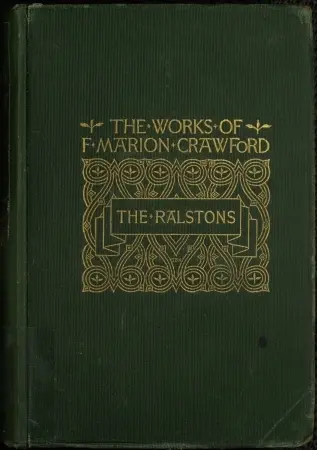
THE CLASSIC COLLECTION · 1893
"The Ralstons" by F. Marion Crawford is a novel written in the late 19th century. The story revolves around the lives and relationships of the Lauderdale family, particularly focusing on the two daughters, Charlotte and Katharine, and their father, Alexander Lauderdale, against the backdrop of wealth, societal expectations, and personal conflicts. The novel scrutinizes issues of class, morality, and the consequences of familial ties. The opening of the narrative introduces Alexander Lauderdale Jr., a man deeply concerned about the futures of his daughters, highlighting the contrasts between them: Charlotte, married to a congressman, and Katharine, who remains at home. The father's strict demeanor and unwavering religious convictions set the stage for familial tensions, particularly regarding his daughters' lives choices and the expectations he has placed upon them. As the story unfolds, a looming family crisis emerges with the impending death of the wealthy Robert Lauderdale, their uncle, which threatens to complicate existing relationships and reveal the underlying secrets and desires of the characters, especially concerning Katharine's secret marriage to John Ralston. This rich tapestry of character dynamics ensures a compelling exploration of love, duty, and the struggle for individual identity within the constraints of family and society.
Introduction adapted from the source catalogue; source summaries may be automatically generated.
Free to read · English · 157,798 words · No account needed
MAKE TIME FOR A GOOD BOOK
On by default. Untick to stop anonymous reading totals. Each page counts after 10 seconds in view. How this works.
Anonymous counting is on unless you have switched it off.
Mrs. Lauderdale went slowly upstairs, thinking over what she should say, as she climbed from one story to another. At the door she knocked softly, and Katharine’s voice bade her enter.
Katharine was standing at the window, looking out, and did not turn round as her mother entered. The evening light was on the houses opposite, and the glow was gently sinking into the darker street. Katharine watched the horse-cars go by, and listened mechanically to the jingle of the bells, hardly conscious of either.
“What is it?” she asked, as she heard the door close.
Her voice had that peculiar reedy sound which comes of speaking through the closed teeth by the lips only. It seems to mean that the speaker is on the defensive and not to be trifled with.
“Your father--Katharine--he’s so angry! He wanted me to speak to you.”
“Oh--it’s you, mother?” The girl’s tone changed a very little, and she turned and came forward. “Well--I’m sorry,” she said, after a short pause. “It can’t be helped, I suppose.”
Mrs. Lauderdale sat down in the one small arm-chair, by the toilet-table, and clasped her hands over her knee, leaning back, and looking up rather wistfully at Katharine.
“I think--in a way--it can be helped,” said Mrs. Lauderdale, in a conciliatory manner. “If you would go downstairs now, and just say quietly that you’re sorry, you know. Just as you said it now. I’m sure he’d be willing to accept that as an apology.”
“Apology?” Katharine laughed bitterly. “I--make an apology to him? No, mother--I won’t.”
“You ought to--really,” objected Mrs. Lauderdale, earnestly. “Why, my dear child! Have you any idea of what you’ve been saying downstairs? Some of the things you said were dreadful.”
“They were all true, and he knows it,” answered Katharine, stubbornly.
She leaned against the chest of drawers, and looked down into her
mother’s upturned face.
“Oh, no! they weren’t all true, dear,” protested the latter. “You exaggerated very much. It’s quite possible that your father may have saved something in all these years--he’s so careful! But as for having a million, as you said--”
“But, dear mother--there isn’t a doubt of it! I didn’t promise uncle Robert that I wouldn’t tell that--”
“What? Did uncle Robert tell you?”
“Yes! Of course! Did you suppose I was inventing?”
“Well--not exactly. But I thought you might have heard some gossip--or something Jack Ralston said--”
“Not at all. Uncle Robert told me that he knew it to be a positive fact--a million, at least, he said. And he’s quite as truthful as papa--”
Your reading position is saved on this browser. Take it to another device with a library code. Reading pages adapt to text, rather than matching a printed edition.
F. Marion (Francis Marion) Crawford
F. Marion (Francis Marion) Crawford
F. Marion (Francis Marion) Crawford
F. Marion (Francis Marion) Crawford
BEHIND THE BOOK
This eBook is for the use of anyone anywhere in the United States and most other parts of the world at no cost and with almost no restrictions whatsoever. You may copy it, give it away or re-use it under the terms of the Project Gutenberg License included with this eBook or online at www.gutenberg.org. If you are not located in the United States, you will have to check the laws of the country where you are located before using this eBook. Read the source licence.
The original source file, including credits and licence, is retained by this library. Request an original-format copy at no charge. Please include the book title and Project Gutenberg identifier #49954.
KEEP YOUR CURIOSITY GOING
Coulson Kernahan

Maurice Baring
Frances Wright
Cécile Tormay

Frederic Jesup Stimson

W. H. P. (William Henry Pope) Jarvis