THE CLASSIC COLLECTION✦Salve Venetia, gleanings from Venetian history; vol. IICLASSIC FREE BOOKS
Salve Venetia, gleanings from Venetian history; vol. II
F. Marion (Francis Marion) Crawford
THE CLASSIC COLLECTION · 1893
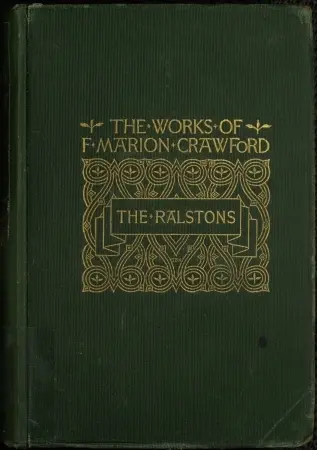
"The Ralstons" by F. Marion Crawford is a novel written in the late 19th century. The story revolves around the lives and relationships of the Lauderdale family, particularly focusing on the two daughters, Charlotte and Katharine, and their father, Alexander Lauderdale, against the backdrop of wealth, societal expectations, and personal conflicts. The novel scrutinizes issues of class, morality, and the consequences of familial ties. The opening of the narrative introduces Alexander Lauderdale Jr., a man deeply concerned about the futures of his daughters, highlighting the contrasts between them: Charlotte, married to a congressman, and Katharine, who remains at home. The father's strict demeanor and unwavering religious convictions set the stage for familial tensions, particularly regarding his daughters' lives choices and the expectations he has placed upon them. As the story unfolds, a looming family crisis emerges with the impending death of the wealthy Robert Lauderdale, their uncle, which threatens to complicate existing relationships and reveal the underlying secrets and desires of the characters, especially concerning Katharine's secret marriage to John Ralston. This rich tapestry of character dynamics ensures a compelling exploration of love, duty, and the struggle for individual identity within the constraints of family and society.
Introduction adapted from the source catalogue; source summaries may be automatically generated.
Free to read · English · 157,798 words · No account needed
MAKE TIME FOR A GOOD BOOK
On by default. Untick to stop anonymous reading totals. Each page counts after 10 seconds in view. How this works.
Anonymous counting is on unless you have switched it off.
“More so,” said Mrs. Lauderdale, absently; “I mean,” she added, very quickly, with a frightened look, for she had not realized what she was saying--“I mean--quite as truthful. They’re both perfectly truthful--”
“Yes,” answered Katharine in a doubtful tone, and smiling in spite of herself. “Not but that, if it came to believing, you know, I’d believe uncle Robert sooner than papa--”
“Hush, child--don’t!”
Katharine said nothing, but still leaned back, resting both elbows on the high chest of drawers on each side behind her, and looking down thoughtfully at the points of her shoes. Mrs. Lauderdale was silent, too, for several seconds.
“Well?” Katharine uttered the convenient word interrogatively, without
looking up.
“Well--yes,” responded Mrs. Lauderdale. “I was going to say that--” She hesitated. “My dear,” she continued, at last, “you’ll have to say something to your father, after all this.”
“Something like what I’ve said already?” asked Katharine, raising her black eyebrows and glancing at her mother.
“No, no! I’m serious, my dear.”
“So am I--very. You began to talk of an apology. It’s quite useless, mother--I can’t and I won’t apologize.”
“But, Katharine, darling--he says he won’t see you unless you do--he’s dreadfully angry still!”
“Oh--he won’t see me? What does that mean? That I’m to stay in my room?” She laughed a little.
“He’s in earnest about it,” said Mrs. Lauderdale. “That’s what he said--he--I don’t like to say it--but I must, I suppose. That’s just it. He means you to stay in your room whenever he’s in the house.”
“How childish!” exclaimed Katharine, scornfully. “What do I care? I don’t want to see him particularly. But, just for curiosity--if he happens to meet me on the stairs, for instance, what will he do? Throw things at me? Box my ears? He’s quite capable of it--as you saw just now--”
“Please don’t talk like that, dear,” said Mrs. Lauderdale. “He was terribly angry--and you were saying the most dreadful things--he only meant to stop you from speaking.”
“He hurt my mouth, and he hurt my arm--there’ll be black and blue marks here to-morrow, I’m sure, by the way it feels.” She laid her left hand on her right forearm at the point where her father had seized it. “That’s rather like violence, you know, mother.”
Katharine turned perceptibly paler as she spoke of it. Mrs. Lauderdale was pained at the recollection, and looked away from her, clasping her hands a little more tightly over her knee.
“Did he ever touch you in that way, mother?” asked the young girl,
slowly.
Your reading position is saved on this browser. Take it to another device with a library code. Reading pages adapt to text, rather than matching a printed edition.
F. Marion (Francis Marion) Crawford
F. Marion (Francis Marion) Crawford

F. Marion (Francis Marion) Crawford

F. Marion (Francis Marion) Crawford
BEHIND THE BOOK
This eBook is for the use of anyone anywhere in the United States and most other parts of the world at no cost and with almost no restrictions whatsoever. You may copy it, give it away or re-use it under the terms of the Project Gutenberg License included with this eBook or online at www.gutenberg.org. If you are not located in the United States, you will have to check the laws of the country where you are located before using this eBook. Read the source licence.
The original source file, including credits and licence, is retained by this library. Request an original-format copy at no charge. Please include the book title and Project Gutenberg identifier #49954.
KEEP YOUR CURIOSITY GOING
Coulson Kernahan

Maurice Baring
Frances Wright
Cécile Tormay

Frederic Jesup Stimson

W. H. P. (William Henry Pope) Jarvis