THE CLASSIC COLLECTION✦An outlaw’s diary: the CommuneCLASSIC FREE BOOKS
An outlaw’s diary: the Commune
Cécile Tormay
THE CLASSIC COLLECTION · 1907
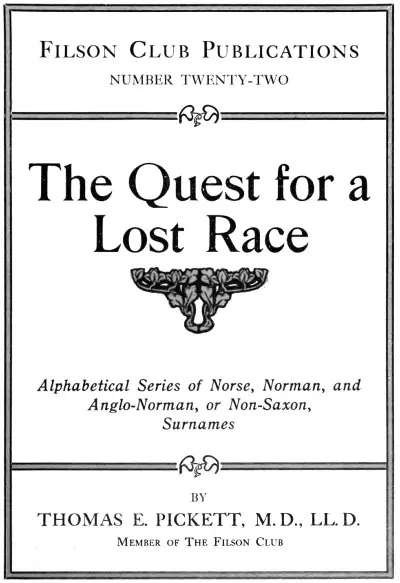
"The Quest for a Lost Race" by Thomas Edward Pickett is a historical account written in the early 20th century. This work presents the theory proposed by ethnologist Paul B. Du Chaillu, which claims that contemporary English-speaking people are more closely descended from Scandinavians than from Teutonic tribes. The author discusses the cultural, historical, and genealogical implications of this theory, particularly in relation to Kentuckians. At the start of the text, Pickett describes the welcoming atmosphere of Maysville, Kentucky, where the prominent explorer Du Chaillu was once celebrated for his discoveries. He captures the essence of this community and their deep-rooted traditions, as they participated in a heated discussion regarding their ancestry and cultural identity. The narrative explores Du Chaillu's experiences in Kentucky, drawing parallels between the social customs and traits of Kentuckians and those of their Scandinavian ancestors. Through this lens, the book sets the stage for a broader examination of race, identity, and cultural heritage in American society, particularly in the context of historical migrations.
Introduction adapted from the source catalogue; source summaries may be automatically generated.
Free to read · English · 57,017 words · No account needed
MAKE TIME FOR A GOOD BOOK
On by default. Untick to stop anonymous reading totals. Each page counts after 10 seconds in view. How this works.
Anonymous counting is on unless you have switched it off.
Jeffreys (with various forms), Geoffrey, Geoffrey's son, Jefferson. In the home-coming reception Mason and Jefferson hold the extremes of the receiving line.
Jennings, from Genn or Canon, Chanum, Chanon, Chanoun, Jenun, Jenning or Jennings, William Jennings Bryan. Vide Bryan.
Jewell, from Juel or Judæ de Mayenne.
Jewett, or Guet, Normandy, 1180.
Johnson. The Johnsons of Ayscough-Fee, County Lincoln, claim from the house of FitzJohn of Normandy (Guillim's Display of Heraldry). A distinguished name in Maryland, Virginia, and Kentucky.
Johnston is Scandinavian. Probably the most conspicuous and influential Scandinavian in the United States at this time bears that name. He is a native of Scandinavia. The most notable American of that race and name was the Confederate General Albert Sidney Johnston. There are two pictures of him that will live in the popular mind: (1) As he stood, silent and absorbed, beside his camp fire on the night before Shiloh; (2) As he led that dashing and successful charge on the following day. A soldier worthy of his race.
Julian. From St. Julian, Normandy.
Karr.
Kays.
Kerr. Appears to be a branch of the Norman house of Espec. The name is variously given as Kerr, Karr, Carr, Cairo, Carum. Lucien Carr was author of a History of Missouri.
Keats, for Keate. Keats the poet had a brother who lived in
Louisville, Ky.
Keats, Keat, Keyt, Kate. In Collins' History, page 557, Vol. 2, the reader notes the following reference to this name--"The most celebrated female school in the West at the time was in Washington, 1807-12; that of Mrs. Louisa Caroline Warburton Fitzherbert Keats, sister of Sir George Fitzherbert, of St. James Square, and wife of Reverend Mr. Keats, a relation of the celebrated poet."--The Keats family of Louisville (closely related to the poet) was conspicuous in the early history of that city. They were connections of the famous Speed family of Kentucky.
Kehoe. (French) Cahot; Cahut; Cayeux, p. n.
Kenney (De Kani, 1198, Normandy).
Kentain, for Kintan or Quentin. Simon Kenton was always known among the plain people as Kinton, though, in early Kentucky statutes, the name is spelled Canton, no doubt as then pronounced, even by "scollards." Kenton, a "place" name near the northeast coast of England. Much of our old Kentucky stock is Northumbrian.
Keith.
Key.
Keyes.
Kimball, for Kemble.
King (Rex de LeRoy, Normandy, 1180).
Kinsey, for Kensey.
Kirk, or Quirk, de Querçu.
Kissill. For Cecil, which is also sometimes Sissell, Knight (Miles
or Knight, Normandy).
Knott, for Canot or Canute.
Knott (Danish), Knouth. Norse Knöttr (a ball or knob, as a Knot on
oak).
Kydd, or Kidd.
Kyle, or Keyle.
Your reading position is saved on this browser. Take it to another device with a library code. Reading pages adapt to text, rather than matching a printed edition.
BEHIND THE BOOK
This eBook is for the use of anyone anywhere in the United States and most other parts of the world at no cost and with almost no restrictions whatsoever. You may copy it, give it away or re-use it under the terms of the Project Gutenberg License included with this eBook or online at www.gutenberg.org. If you are not located in the United States, you will have to check the laws of the country where you are located before using this eBook. Read the source licence.
The original source file, including credits and licence, is retained by this library. Request an original-format copy at no charge. Please include the book title and Project Gutenberg identifier #47627.
KEEP YOUR CURIOSITY GOING
Cécile Tormay

Moritz Busch
John L. Ransom
Frances Wright
Cécile Tormay

Mabel Potter Daggett