THE CLASSIC COLLECTION✦An outlaw’s diary: the CommuneCLASSIC FREE BOOKS
An outlaw’s diary: the Commune
Cécile Tormay
THE CLASSIC COLLECTION · 1907
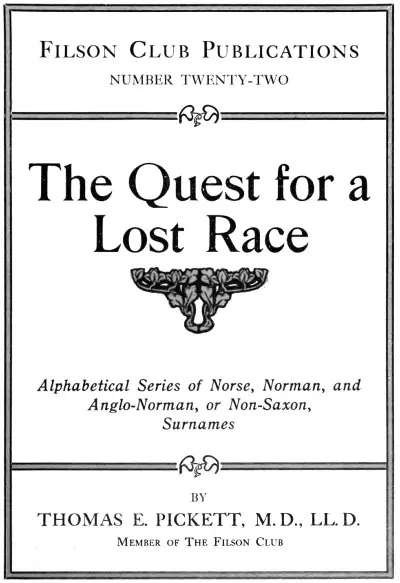
"The Quest for a Lost Race" by Thomas Edward Pickett is a historical account written in the early 20th century. This work presents the theory proposed by ethnologist Paul B. Du Chaillu, which claims that contemporary English-speaking people are more closely descended from Scandinavians than from Teutonic tribes. The author discusses the cultural, historical, and genealogical implications of this theory, particularly in relation to Kentuckians. At the start of the text, Pickett describes the welcoming atmosphere of Maysville, Kentucky, where the prominent explorer Du Chaillu was once celebrated for his discoveries. He captures the essence of this community and their deep-rooted traditions, as they participated in a heated discussion regarding their ancestry and cultural identity. The narrative explores Du Chaillu's experiences in Kentucky, drawing parallels between the social customs and traits of Kentuckians and those of their Scandinavian ancestors. Through this lens, the book sets the stage for a broader examination of race, identity, and cultural heritage in American society, particularly in the context of historical migrations.
Introduction adapted from the source catalogue; source summaries may be automatically generated.
Free to read · English · 57,017 words · No account needed
MAKE TIME FOR A GOOD BOOK
On by default. Untick to stop anonymous reading totals. Each page counts after 10 seconds in view. How this works.
Anonymous counting is on unless you have switched it off.
"Humpsy, Dumpsy,
Humpsy, Dumpsy,
Colonel Johnson killed Tecumseh."
Harrison. Heriçon, Normandy, 1180.
Harrop. La Herupe.
Harrow.
Hart.
Hart. LeCerf, Ralph Cerfus, Normandy, 1180-1198. In England translated into Herte, also Harte.
Harvey, Harvie, Hervey, Herveus, 1198, Normandy. Sire Hervey is mentioned in Piers Plowman. The early pronunciation of Hervey was Harvey. Now, generally pronounced as spelled.
Hatcher.
Haughton.
Hawes. Richard Hawes, Confederate Governor of Kentucky.
Hawkins. From the Manor of Hawkings, Kent, held by Walter Hawkins, 1326. Colonel Tom Hawkins of Kentucky, who fought with Lopez in Cuba, was a typical Anglo-Norman.
Hawley.
Hay, or de la Haye.
Hay, or de la Hey, Hay. Armorially identified with Hayes, from Hayes, near Blois. Vide Desha or Deshayes.
Hayles.
Hayley.
Hayne, or Haynes.
Hearn, from Heron, near Rouen.
Hedge.
Helm. Andrew de Helm, England, 1262. (Normandy, 1198.)
Herd, for Hert, Hart.
Hert.
Hewett, or Hewitt. From Huest or Huet, near Evreux. Also, Hewettson.
Hibberd.
Hickey, Hequet, Normandy.
Hicks.
Higgin, Hequet, Normandy. Higginson.
Hill. The English form of De Morete. For Helle or de Heille, near Beaurais. The family was spread throughout Kent and Surrey.
Himes.
Hitt.
Hoare. Aure from Auray, in Bretagne. Aure, with aspirate, becomes
Hoare.
Hogg, or De Hoge. From La Hogue in the Contentin.
Hoghton, Hocton.
Hoide.
Hoile, or Hoyle. Norman Hoel, a familiar name in Kentucky.
Holburd, Halbert, Alberd, Albert.
Holiday, or Holliday. Ben Holliday, forerunner of the Stanfords and
Huntingtons.
Holland, de Hoilant, Normandy, 1180.
Holles, for Hollis. Robert de Holis, Normandy, 1198.
Holmes (William der Holme).
Holmes. From Norse Holmer (an islet in a lake). D. B. de Holme, a tenant in chief. William du Holme, 1180-95.
Hood. Norse Udi. Danish Hude. The popular hero, Robin, seems to have been of Scandinavian descent. John Hood, of Kentucky, was pre-eminently a "fighting general." Jesse James was the Robin Hood of our day.
Hooker.
Hooper.
Hord. A Swedish name, borne by a general of Charles XII.
Howel.
Hudson. Hudson of Maysville, an intimate friend of General Grant.
Hughes.
Hulbard. For Hubert.
Humfrey.
Humphry.
Humphrey. Notably a Norman name. As theologians, lawyers, scholars, the Humphreys of Kentucky have sustained the ancient distinction of the name.
Hunt, Le Huant, Normandy, 1198.
Hunter (Venator or Le Veneur).
Hunter. English form of Le Veneur.
Huntley.
Hurt.
Hutchings, or Hutchins, Houchin.
Hyatt (Haytt).
Ingall. For Angall.
Ingle. For Angle.
Inglis, or Anglicus.
Ingram.
Innes (the Baronets Innes).
Ireland (DeHibernis, Normandy, 1180).
Jack. For Jacques; William Jack, England, 172.
Jackson. A name of the family Lascelles.
James. St. James, Normandy.
Janvier. (January.) At least three branches in this country from a common ancestor in France. The name is sometimes anglicized--notably in Missouri and Kentucky.
Jarvis (Gervasius, Normandy, 1180).
Your reading position is saved on this browser. Take it to another device with a library code. Reading pages adapt to text, rather than matching a printed edition.
BEHIND THE BOOK
This eBook is for the use of anyone anywhere in the United States and most other parts of the world at no cost and with almost no restrictions whatsoever. You may copy it, give it away or re-use it under the terms of the Project Gutenberg License included with this eBook or online at www.gutenberg.org. If you are not located in the United States, you will have to check the laws of the country where you are located before using this eBook. Read the source licence.
The original source file, including credits and licence, is retained by this library. Request an original-format copy at no charge. Please include the book title and Project Gutenberg identifier #47627.
KEEP YOUR CURIOSITY GOING
Cécile Tormay

Moritz Busch
John L. Ransom
Frances Wright
Cécile Tormay

Mabel Potter Daggett