THE CLASSIC COLLECTION✦An outlaw’s diary: the CommuneCLASSIC FREE BOOKS
An outlaw’s diary: the Commune
Cécile Tormay
THE CLASSIC COLLECTION · 1907
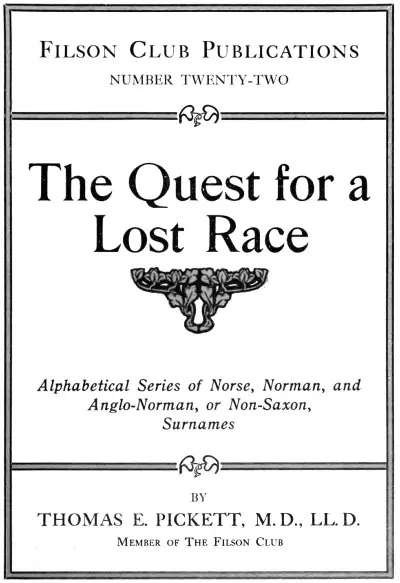
"The Quest for a Lost Race" by Thomas Edward Pickett is a historical account written in the early 20th century. This work presents the theory proposed by ethnologist Paul B. Du Chaillu, which claims that contemporary English-speaking people are more closely descended from Scandinavians than from Teutonic tribes. The author discusses the cultural, historical, and genealogical implications of this theory, particularly in relation to Kentuckians. At the start of the text, Pickett describes the welcoming atmosphere of Maysville, Kentucky, where the prominent explorer Du Chaillu was once celebrated for his discoveries. He captures the essence of this community and their deep-rooted traditions, as they participated in a heated discussion regarding their ancestry and cultural identity. The narrative explores Du Chaillu's experiences in Kentucky, drawing parallels between the social customs and traits of Kentuckians and those of their Scandinavian ancestors. Through this lens, the book sets the stage for a broader examination of race, identity, and cultural heritage in American society, particularly in the context of historical migrations.
Introduction adapted from the source catalogue; source summaries may be automatically generated.
Free to read · English · 57,017 words · No account needed
MAKE TIME FOR A GOOD BOOK
On by default. Untick to stop anonymous reading totals. Each page counts after 10 seconds in view. How this works.
Anonymous counting is on unless you have switched it off.
Returning now to the discussion of the masterly paper read by M. Du Chaillu at the British Association,[4] we may consider certain aspects of the question more in detail; conceding at the same time full credit to the ability of the disputants who dissented from the views expressed by the foreign savant. M. Du Chaillu was peculiarly fortunate in his critics. If his theory should survive the searching and trenchant criticisms of such men, his scholarship would command respect even if they should decline to accept his conclusions in full.
[4] British Association for the Advancement of Science, Newcastle
Meeting, 1889.
A loyal Briton does not lightly abandon what he conceives to be established or traditional views. This trait does not imply defect of philosophic insight or want of wide research. It denotes simply the influence of prepossession, opinionated habit, and conscious power. Nor is this influence unusual. Scholars differ even as "doctors" disagree. Dr. George Craik, whose name is familiar to every scholar of the English race, was liberal enough to concede, a quarter of a century before the advent of Du Chaillu as a Scandinavian protagonist, that the English language might have more of a Scandinavian than of a purely Germanic character; or, in other words, "more nearly resembled the Danish or Swedish than the modern German." The invading bands, he adds, by whom the dialect was originally brought over into Britain in the Fifth and Sixth centuries, were in all probability drawn in great part from the Scandinavian countries. At a still later date, too, this English population was directly and largely recruited from Denmark and the regions around the Baltic. Eastern and Northern England, from the middle of the Ninth Century, "was as much Danish as English." In the Eleventh Century the sovereign was a Dane.
M. Du Chaillu's theory rests upon other and perhaps stronger grounds, but these concessions from a thoughtful scholar at least will carry weight. The continuous existence of Scandinavian influence in England is suggestive of the circumstance that the Danish conquest of England preceded the Norman conquest by "exactly half a century." An Englishman (Odericus Vitalis), writing almost contemporaneously with the Norman conquest, describes his countrymen as having been found by the Normans "a rustic and almost illiterate people" (agrestes et pene illiteratos). And yet, says Dr. Craik, the dawn of the revival of letters in England may properly be dated from a point about fifty years antecedent to the Norman conquest. To what, then, must be ascribed this scholastic renascence? Very clearly to the intimate relations established between England and Normandy by Edward the Confessor. But there is no trace of the new literature (that of the Arabic school which was prevalent in Europe) having found its way to England "before the Norman conquest swept into the benighted old kingdom, carrying the torch of learning in its train." The name of Lanfranc alone gives splendor to that civilization which his genius created for the English race. He not only lighted the torch of learning, but he strengthened the reins of power. He restrained the lawless impetuosity of William the Conqueror; he imposed iron conditions upon the accession of William Rufus; he checked the atrocities, and finally broke the power, of Odo of Bayeux. His work was well done, and its effects are visible to this day. He was the real power behind the throne. It is not easy, says an eminent English writer, to trace through the length of centuries "the measureless and invisible benefits which the life of one scholar bequeaths to the world." But such was the life, the work, the bequest of this Norman scholar, who died honored and beloved even by the rude, sullen, and implacable race which had been subjugated by the Norman kings. But Dr. Craik, with all his liberality and learning, is not disposed to accept the theory of a great migration or settlement preceding, or accompanying or following, the Norman conquest in the Eleventh Century. To be sure, this theory was not elaborately or effectively presented until of late years; but Dr. Craik, writing as far back as the opening of our "War between the States," seems to contradict this theory by anticipation--"In point of fact, the Normans never transferred themselves in a body, or generally, to England. It was never thus taken possession of by the Normans. It was never colonized by these foreigners, or occupied by them in any other than a military sense. It received a foreign government, but not at all a new population." Yet even Dr. Craik seems to appreciate the lesson of "names." He thinks it remarkable, for instance, that though we find a good many names of natives of Gaul in connection with the last age of Roman literature, scarcely a British name has been preserved. Even in Juvenal's days the pleaders of Britain were trained by the eloquent scholars of Gaul. The significance of a name in determining family origin is a common assumption of our familiar speech. "That is a Virginian name," we say; and if we find many Virginian names in a given locality we naturally infer that the town, or the county, or the locality, large or small, was originally settled by Virginians. In one of our old Bluegrass counties two of these settlements were made in pioneer times, about two miles apart. One is known as "Jersey Ridge," the other as "Tuckahoe." If in both localities we find an English stock with Anglo-Norman names we should naturally assume a common derivation from the Anglo-Norman branch of the great British race.
Your reading position is saved on this browser. Take it to another device with a library code. Reading pages adapt to text, rather than matching a printed edition.
BEHIND THE BOOK
This eBook is for the use of anyone anywhere in the United States and most other parts of the world at no cost and with almost no restrictions whatsoever. You may copy it, give it away or re-use it under the terms of the Project Gutenberg License included with this eBook or online at www.gutenberg.org. If you are not located in the United States, you will have to check the laws of the country where you are located before using this eBook. Read the source licence.
The original source file, including credits and licence, is retained by this library. Request an original-format copy at no charge. Please include the book title and Project Gutenberg identifier #47627.
KEEP YOUR CURIOSITY GOING
Cécile Tormay

Moritz Busch
John L. Ransom
Frances Wright
Cécile Tormay

Mabel Potter Daggett