THE CLASSIC COLLECTION✦An outlaw’s diary: the CommuneCLASSIC FREE BOOKS
An outlaw’s diary: the Commune
Cécile Tormay
THE CLASSIC COLLECTION · 1907
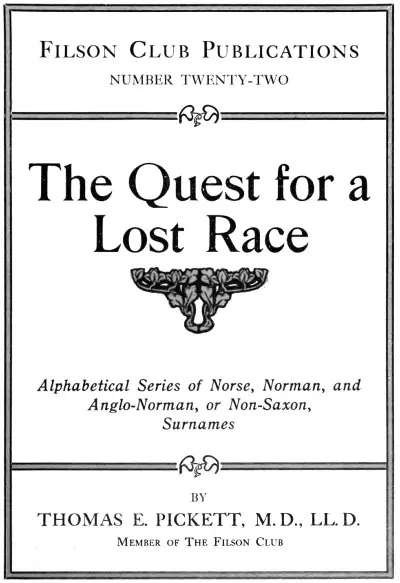
"The Quest for a Lost Race" by Thomas Edward Pickett is a historical account written in the early 20th century. This work presents the theory proposed by ethnologist Paul B. Du Chaillu, which claims that contemporary English-speaking people are more closely descended from Scandinavians than from Teutonic tribes. The author discusses the cultural, historical, and genealogical implications of this theory, particularly in relation to Kentuckians. At the start of the text, Pickett describes the welcoming atmosphere of Maysville, Kentucky, where the prominent explorer Du Chaillu was once celebrated for his discoveries. He captures the essence of this community and their deep-rooted traditions, as they participated in a heated discussion regarding their ancestry and cultural identity. The narrative explores Du Chaillu's experiences in Kentucky, drawing parallels between the social customs and traits of Kentuckians and those of their Scandinavian ancestors. Through this lens, the book sets the stage for a broader examination of race, identity, and cultural heritage in American society, particularly in the context of historical migrations.
Introduction adapted from the source catalogue; source summaries may be automatically generated.
Free to read · English · 57,017 words · No account needed
MAKE TIME FOR A GOOD BOOK
On by default. Untick to stop anonymous reading totals. Each page counts after 10 seconds in view. How this works.
Anonymous counting is on unless you have switched it off.
Dye, for Deye.
Dyer.
Eames. Ames.
Edmonds, or Edmunds.
Egerton.
Eckert.
Eliot.
Ellis, or Alis, from Alis near Pont de l'Arche. The sensational duel between Major Thomas Marshall and Captain Charles Mitchell was fought upon the place of Mr. Washington Ellis, near Maysville, Ky. It has been well described by Dr. Anderson Nelson Ellis, his son, an accomplished writer and physician.
Ellison.
Emet, or Emmett, from Amiot, Normandy.
English, or Inglis; families of this name are all Norman. England is another form of Anglicus.
Eve, or Ives.
Everett, from Evreux. (Normandy.)
Fail, for Faiel, Fales. William Faiel, Normandy, 1180. Reginald
Fale, England, 1272.
Faint for Fant.
Falconer, or Falkner.
Farish, or Fariss or Ferris.
Farley, or Varley.
Farrer, armorially identified with Ferrers of Bere. Ferrers, Farrow, the same. A large family, well and widely connected in Virginia and Kentucky. Archdeacon Farrer is of the same gens. The name is variously spelled Farrer, Farrow, Farra, Farrers.
Faulconer, for Falconer; also Faulkner.
Fell, Fayle, or Fail, Fales.
Fickling.
Field. Richard de la Felda is mentioned in Normandy, temp. John (Mem. Soc. Ant. Norm. V. 126). Burke (Landed Gentry) states under the head De la Field that this family was originally seated in Alsace near the Vosges Mountains. The author of "The Norman People" says the name embraces both English and Norman families. Pierce's great two-volume "Genealogy" (profusely illustrated) exhibits the prodigious growth in America, including such names as Cyrus Field, Justice Field, Marshall Field, and Judge Curtis Field. The Kentucky Fields were connected by marriage with the Clays of Bourbon. Pierce's genealogy gives very pleasing views of "Auvergne," the home of the Field-Clays. This estate was inherited by Hon. Cassius M. Clay, Jr., of Bourbon. Henry Field (Eng. 1611) came to Virginia in 1635. Lieutenant Henry Field, Culpeper County, Virginia, married Ann Lightfoot, May, 1771. His will made November 19, 1777. His daughter, Judith Field, married Francis Taylor, of Maryland, in Louisville, Ky., February 14, 1774. Francis Taylor studied law with Judge Sebastian in Louisville. Lucretia, a daughter of Francis and Judith Taylor, married Captain James B. Robinson. The Fields family of Tennessee (afterward of Kentucky) are now in the North, the brothers James and Henry being conspicuous in the management of important steel and iron trusts. Their sister, Mrs. Charles D. Lanier, is a resident of New York City. Her husband (a son of the famous Southern poet) is now at the head of "The Review of Reviews."
Fillpot or Philpot, from Philipot, diminutive of Philip.
Finch.
Finney.
Fisher.
Fisk, or Fyska.
Fitch, or Fitz.
Fitzgerald.
Flanders, or Flamders. Common in England after the Conquest.
Fleet.
Fleming. The Flemings of Fleming are derived from the Flemings of
Virginia.
Your reading position is saved on this browser. Take it to another device with a library code. Reading pages adapt to text, rather than matching a printed edition.
BEHIND THE BOOK
This eBook is for the use of anyone anywhere in the United States and most other parts of the world at no cost and with almost no restrictions whatsoever. You may copy it, give it away or re-use it under the terms of the Project Gutenberg License included with this eBook or online at www.gutenberg.org. If you are not located in the United States, you will have to check the laws of the country where you are located before using this eBook. Read the source licence.
The original source file, including credits and licence, is retained by this library. Request an original-format copy at no charge. Please include the book title and Project Gutenberg identifier #47627.
KEEP YOUR CURIOSITY GOING
Cécile Tormay

Moritz Busch
John L. Ransom
Frances Wright
Cécile Tormay

Mabel Potter Daggett