THE CLASSIC COLLECTION✦An outlaw’s diary: the CommuneCLASSIC FREE BOOKS
An outlaw’s diary: the Commune
Cécile Tormay
THE CLASSIC COLLECTION · 1907
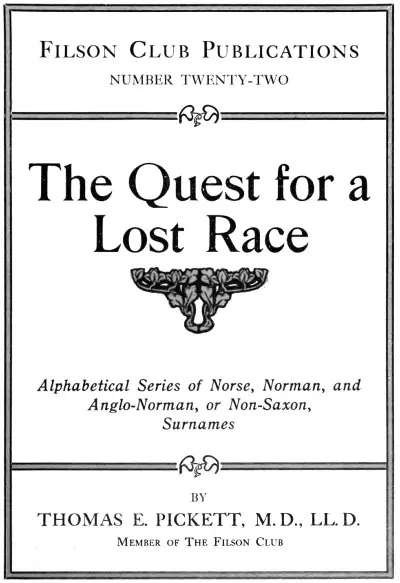
"The Quest for a Lost Race" by Thomas Edward Pickett is a historical account written in the early 20th century. This work presents the theory proposed by ethnologist Paul B. Du Chaillu, which claims that contemporary English-speaking people are more closely descended from Scandinavians than from Teutonic tribes. The author discusses the cultural, historical, and genealogical implications of this theory, particularly in relation to Kentuckians. At the start of the text, Pickett describes the welcoming atmosphere of Maysville, Kentucky, where the prominent explorer Du Chaillu was once celebrated for his discoveries. He captures the essence of this community and their deep-rooted traditions, as they participated in a heated discussion regarding their ancestry and cultural identity. The narrative explores Du Chaillu's experiences in Kentucky, drawing parallels between the social customs and traits of Kentuckians and those of their Scandinavian ancestors. Through this lens, the book sets the stage for a broader examination of race, identity, and cultural heritage in American society, particularly in the context of historical migrations.
Introduction adapted from the source catalogue; source summaries may be automatically generated.
Free to read · English · 57,017 words · No account needed
MAKE TIME FOR A GOOD BOOK
On by default. Untick to stop anonymous reading totals. Each page counts after 10 seconds in view. How this works.
Anonymous counting is on unless you have switched it off.
AN ANGLO-NORMAN FAMILY. Dr. Basil Duke, born in Calvert County, Maryland, 1766; died in Washington, Ky., 1828; married, 1794, Charlotte Marshall, born, 1777, in Fauquier County, Virginia; died in Washington, Kentucky, April 17, 1817. She was a sister of Chief-Justice Marshall.
1. Thomas Marshall Duke, born 1795, died about 1870; married:
1. Bettie Taylor.
2. Nancy Ashby.
3. ---- McCormick.
2. Mary Wilson Duke, born February 7, 1797; married, May 7, 1818, Dr. John F. Henry; died September, 1823.
3. James Keith Duke, born, Washington, Ky., 1799; died August 2, 1863; married, February 5, 1822, Mary Buford.
4. Nathaniel Wilson Duke, born 1806; died at Paris, Ky., July, 1850; married, October 4, 1833, Mary Currie. Parents of General Basil Duke.
5. John Marshall Duke, born, Washington, Ky., October 29, 1811, died in Maysville, Ky., 1880; married Hannah Morton.
6. Lucy Ann Duke born Washington, Ky., January 11, 1814; died Rock Island, Ill.; married, January 20, 1835, Charles Buford.
7. Charlotte Jane Duke, born Washington, Ky., January 20, 1817; died February, 1886; married, January 14, 1840, Harrison Taylor, "War" Speaker of the House of Representatives. (Kentucky.)
The Dukes of South Mason are descended from Alexander Duke of Maryland, a tall, vigorous specimen of the Anglo-Norman breed who lived to be nearly one hundred years of age. His son, Dr. Basil Duke, was a brigade surgeon in the Confederate service.
Durrell, from Durell. Armorially identified with Darrell, Durrant, Durran, Durrock, and possibly Durrett. (Vide Durrett.) Note how slight a change converts the Norman name Clarte into Claret. So, Druett into Durrett.
Durrett. A surname traceable beyond the Conquest, and having all the marks of a Norman surname. If not of literal record in our various lists, it is evidence of defect in the list itself. It is a familiar tradition in Colonel Paul Durrett's family that the original form of the surname was Duret, and that the family was of French extraction. Widely separated branches of the same stock have the same tradition. Every village in Normandy--says Camden--has "surnamed" a family in England. It is easy to perceive, therefore, that the number of surnames thus derived, added to the number derived from other sources, would oblige the compilers of genealogical dictionaries from sheer exhaustion to omit many names. There is a simple process of linguistic mutation which explains the genesis of many words. It is known as transposition. It may be a transposition of letters, as in the simple name Crisp, transpose the terminal letters and we have the familiar name Crips; or it may be a transposition of syllables, of which we have a famous example in Al-macks, decelticized for Anglican uses by a simple transposition of the syllables in the Celtic surname--Mack-All. So, Durand, Durant (vide Battle Abbey Roll and D. B.), DeRuelle, Durelle, Druell, Durell, Durel, Durell (Huguenot, London, 1697), Durrell; so, too, Drouet (Nor. Fr.), Druet, Druett, Durrett. Duré is a French surname easily Normanized by the addition of the diminutive suffix et or ett, giving us Duré, Duret, or Durett; and when consonantally braced (more Anglico) by doubling the "r," we have Durrett--a familiar surname in Kentucky. Dur, the adjective, means hard, durable, enduring; the noun Dur is door; ett is a Norman suffix; giving the ancient surname Durrett a characteristic Norman stamp, structure, and cachet.
Your reading position is saved on this browser. Take it to another device with a library code. Reading pages adapt to text, rather than matching a printed edition.
BEHIND THE BOOK
This eBook is for the use of anyone anywhere in the United States and most other parts of the world at no cost and with almost no restrictions whatsoever. You may copy it, give it away or re-use it under the terms of the Project Gutenberg License included with this eBook or online at www.gutenberg.org. If you are not located in the United States, you will have to check the laws of the country where you are located before using this eBook. Read the source licence.
The original source file, including credits and licence, is retained by this library. Request an original-format copy at no charge. Please include the book title and Project Gutenberg identifier #47627.
KEEP YOUR CURIOSITY GOING
Cécile Tormay

Moritz Busch
John L. Ransom
Frances Wright
Cécile Tormay

Mabel Potter Daggett