
The Writing of News A Handbook with Chapters on Newspaper Correspondence and Copy Reading
Charles G. (Charles Griffith) Ross
THE CLASSIC COLLECTION · 1920
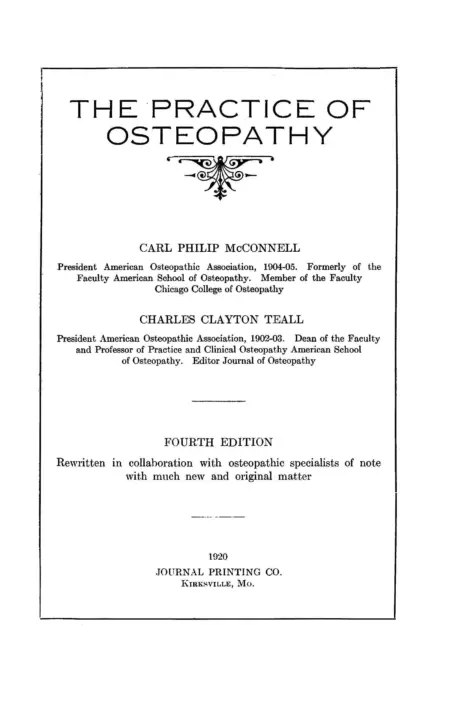
"The Practice of Osteopathy" by Carl Philip McConnell and Charles Clayton Teall is a scientific publication written in the early 20th century. The work serves as a comprehensive textbook on osteopathic medicine, providing both foundational theory and practical instruction for students and practitioners in the field. Its primary focus is the explanation, diagnosis, and treatment of disease according to osteopathic principles, particularly emphasizing anatomical causes and manual correction over pharmaceutical or primarily surgical interventions. The opening of this work introduces the philosophy and historical context of osteopathy, highlighting Andrew Taylor Still as the founder and his revolutionary departure from conventional medicine. The authors stress that osteopathy is defined by its unique approach to the causes of disease—specifically the identification and correction of structural lesions (malalignments and dysfunctions in bones, muscles, ligaments, and other tissues) believed to impede nerve and blood flow, thus leading to illness. The text details the types of lesions, their etiological significance, and their systemic impact, setting the stage for how osteopaths diagnose through meticulous physical examination, particularly of the spine and related musculoskeletal structures. The beginning also establishes the rigorous diagnostic and philosophical distinctions between osteopathy and other forms of manual therapy or drug-based medicine, positioning it as an integrative, holistic discipline grounded in anatomy, physiology, and respect for the body's natural healing capabilities.
Introduction adapted from the source catalogue; source summaries may be automatically generated.
Free to read · English · 323,560 words · No account needed
MAKE TIME FOR A GOOD BOOK
On by default. Untick to stop anonymous reading totals. Each page counts after 10 seconds in view. How this works.
Anonymous counting is on unless you have switched it off.
=Hernia.=—There are several methods of replacing a hernia. The first endeavor, in every instance, must be to reduce it, whether it be strangulated, incarcerated or simply protruded. One of the easiest and commonest methods is to place the patient on his back, the buttocks elevated, the legs flexed upon the thighs, the thighs flexed upon the abdomen, and the limb on the affected side slightly rotated inward, so that the columns of the ring about the hernia may be relaxed. After the hernia is protruded a little more, so that its contents may be emptied readily, a gentle pressure with the thumb and finger is made upon the upper part of the tumor, when the rest will follow. A gurgling noise is heard upon reduction. Cases that cannot be reduced and are causing acute obstruction of the intestines, should be treated surgically. Incomplete hernia, which does not show externally, may be present and cause severe reflex symptoms. Considerable attention has been given to this by some investigators. The patient is placed in the Trendelenburg position and the bowel lifted out of the fossa. If any signs of hernia are present a well fitting truss will often cause it to heal. Exercises, in a few instances, will be beneficial.
Appendicitis
=Appendicitis= is an inflammation of the appendix vermiformis. In a few cases the cecum and surrounding tissues are involved (typhlitis, perityphlitis). The vasomotor nerve supply comes from the lower three dorsals and upper two lumbars. The sensory nerves make their exit from the three lower dorsals. Appendicitis is nearly always predisposed by injury to the innervation of the vermiform appendix and immediate region, vertebral derangements or subdislocations from the tenth dorsal to the third lumbar. The vermiform appendix is a peculiarly constructed organ, and its function has not been determined with positiveness. It undoubtedly has a function and possibly a very useful one. Sir William Macewen[82] does not share in the general belief that the appendix is without function, but protests against its indiscriminate removal, believing it has a powerful influence over the function of the colon. “Yet thousands have been operated and show no ill effect.” This is in keeping with the ideas of Dr. Still, who always maintained that the appendix is of importance to the human economy. Although the organ has been found in various localities of the abdomen, this fact and others do not necessarily indicate that it is a functionless relic. It is richly supplied with lymphatic and blood-vessels and has a peristaltic action peculiar to itself. When the organ is in perfect condition, foreign material probably would not find a lodging point in it, on account of its peristalsis. Dr. Still[83] suggests that the appendix has a sphincter, also the power to contract, dilate or shorten, should any foreign substance enter, and he worked with this idea in view with uniform success. The truth of this theory has been proved by Abrams[84] who has demonstrated by the aid of the fluoroscope that peristalsis of the appendix can be stimulated by percussion at the 10th dorsal and it made to empty and fill itself. Abrams makes use of this fact in the treatment of catarrhal appendicitis. Appendicitis may also be caused by fecal impactions and foreign bodies in the bowel contiguous to the appendix. In these cases there is usually an impaired innervation from the spine, due to vertebral and lower rib lesions, resulting in a weakened muscular coat and catarrhal congestion of the mucosa. In a word, prolapse of the bowel at this point is a predisposing common cause. In various instances abrasions of the coats of the tube occur, or the innervation or vascular supply is impaired, and pathogenic bacteria, as bacilli coli communis, streptococci pyogenes, staphylococci pyogenes aureus, typhoid bacilli, tubercle bacilli and others, find a favorable lodging point and determine the nature of the disease. Injuries to the spinal column and displacements of the vertebræ in the lower dorsal and lumbar regions, straining and lifting, tight lacing, torsion of the appendix, traumatism, impaction of feces, concretions and foreign bodies, acute indigestion, indigestible food, overeating, exposure to wet and cold, and infectious diseases (as typhoid fever, tuberculosis and influenza), are all in the list of causes of appendicitis.
Your reading position is saved on this browser. Take it to another device with a library code. Reading pages adapt to text, rather than matching a printed edition.
BEHIND THE BOOK
This eBook is for the use of anyone anywhere in the United States and most other parts of the world at no cost and with almost no restrictions whatsoever. You may copy it, give it away or re-use it under the terms of the Project Gutenberg License included with this eBook or online at www.gutenberg.org. If you are not located in the United States, you will have to check the laws of the country where you are located before using this eBook. Read the source licence.
The original source file, including credits and licence, is retained by this library. Request an original-format copy at no charge. Please include the book title and Project Gutenberg identifier #75696.
KEEP YOUR CURIOSITY GOING
Charles G. (Charles Griffith) Ross
Hannah Webster Foster

Emily Lawless
Edwin Hamlin Carr

Charles De Lano Hine
Andrew Ure