
The Writing of News A Handbook with Chapters on Newspaper Correspondence and Copy Reading
Charles G. (Charles Griffith) Ross
THE CLASSIC COLLECTION · 1920
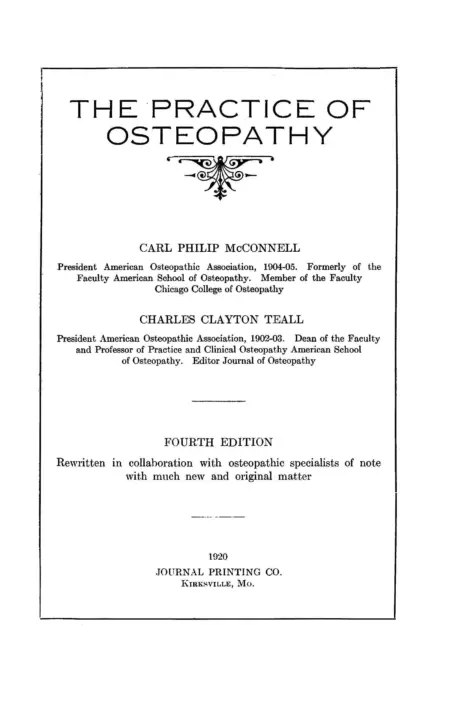
"The Practice of Osteopathy" by Carl Philip McConnell and Charles Clayton Teall is a scientific publication written in the early 20th century. The work serves as a comprehensive textbook on osteopathic medicine, providing both foundational theory and practical instruction for students and practitioners in the field. Its primary focus is the explanation, diagnosis, and treatment of disease according to osteopathic principles, particularly emphasizing anatomical causes and manual correction over pharmaceutical or primarily surgical interventions. The opening of this work introduces the philosophy and historical context of osteopathy, highlighting Andrew Taylor Still as the founder and his revolutionary departure from conventional medicine. The authors stress that osteopathy is defined by its unique approach to the causes of disease—specifically the identification and correction of structural lesions (malalignments and dysfunctions in bones, muscles, ligaments, and other tissues) believed to impede nerve and blood flow, thus leading to illness. The text details the types of lesions, their etiological significance, and their systemic impact, setting the stage for how osteopaths diagnose through meticulous physical examination, particularly of the spine and related musculoskeletal structures. The beginning also establishes the rigorous diagnostic and philosophical distinctions between osteopathy and other forms of manual therapy or drug-based medicine, positioning it as an integrative, holistic discipline grounded in anatomy, physiology, and respect for the body's natural healing capabilities.
Introduction adapted from the source catalogue; source summaries may be automatically generated.
Free to read · English · 323,560 words · No account needed
MAKE TIME FOR A GOOD BOOK
On by default. Untick to stop anonymous reading totals. Each page counts after 10 seconds in view. How this works.
Anonymous counting is on unless you have switched it off.
In =invagination=, raising the buttocks and lowering the chest, with thorough injection of oil or tepid soapsuds, or an inflation of the colon with air, may give relief. In addition to thorough but cautious manipulation of the bowels as in =impaction=, irrigation of the lower bowel with warm water, soapsuds, or glycerine and water, will usually be of material aid. In =strangulation=, high injections of warm water, and assuming the knee-elbow or lateral position, may straighten out the acute obstruction. =Twists= and =knots= are best relieved by direct treatment, although injections may be of aid. =Kinks= of the pelvic colon, ileum, and duodenum are best treated with the patient in the knee-chest position. =Tumors= and =strictures= will require, sooner or later, surgical interference in most cases, but to treat as in impaction will be effective for a short time at least. If there is no indication of immediate =relief within three days, surgical interference should be instituted=. Besides the ordinary treatment for the nausea and vomiting, washing out the stomach will help allay such disorder, quiet the peristalsis and relieve the abdominal distention and pressure above the seat of obstruction. Strong thorough treatment of the spinal nerves to the stomach and intestines will be of great help in lessening pain, establishing normal peristaltic action and in suppressing inflammation. The vagi also should be treated for perverted peristalsis. Hot fomentations will be of service. The nutrition of the patient is best retained by rectal injections of food.
=Spastic= states, particularly of the pelvic colon, frequently cause constipation of various degrees of chronicity. Reaching beneath the spastic area and inhibiting and raising (knee-chest position) the parts will often give marked relief.
=Adhesions= can often be stretched sufficiently to restore normal
function of the bowels.
Treatment of =impactions= and =abnormal contents= requires an additional word. The first step is to free the colon of the fecal mass. The enema is of great assistance in this, for cases of long standing present a hard, dry mass, often adherent, and the mucous membrane is sensitive from inflammation. Much abdominal treatment must not be given until the mass is softened by water. When in the sigmoid or rectum it may, if not dislodged by repeated enemata, have to be removed by a colon spoon, perhaps under anesthesia. Impaction of the small intestine is rare and out of reach of the enema, although if taken as hot as can be borne, it will exert considerable influence high up. In these tendencies and in constipation, when the bowel must be kept open before treatment has produced much effect, there should be an effort made to break up any cathartic habit which may be formed. The enema is a most valuable aid, but it must be given correctly. The patient should be instructed that a fountain syringe is preferable, and that it must never be taken standing. This merely fills and distends the rectum, or lower sigmoid at the best, and is passed without any or with very little effect. Lying on the right side is a very good position, as is also on the back with hips elevated, but the knee and chest is best in most cases. The water should be a little above body temperature and can be saponified or used clear. The effect will be about the same. The tube should be perfectly smooth and well lubricated and introduction must be made with care so as not to bruise or irritate. The water, having been allowed to run to expel the air, may be now started and will separate the mucous folds and allow easy penetration. The rubber tube should be held between the thumb and finger, so the flow can be stopped as soon as it meets an obstruction. When this is passed the flow can begin again and continue until the required amount (from one to two quarts for an adult), has been taken, or until the feeling of distention becomes too great. By following this method, much of the distress and colicky pains which sometimes accompany an enema, may be avoided. Water should be held for some minutes, to allow softening of the fecal mass. In many impactions it is important to get the water into the ascending colon. For that purpose nothing is better than a Coles sigmoid irrigator. This is shaped somewhat like the letter S and is about a foot long from tip to tip. Its introduction is not difficult, but care must be used. Place the patient on the right side and stand in front, having the bag suspended near. Introduce the tube and with slow, gentle pressure let it follow the course of the bowel. When the splenic flexure is reached, it will stop, but by letting a little water flow, the bowel will distend and it will pass. When in the full length, the end will be near the median line and in the transverse colon. Now let the water flow slowly, stopping frequently, and with one hand gently lift and work the abdomen. This will both soften the contents and aid the water in reaching the farthest point. It is not well to give more than a quart the first time, as there is apt to be some prostration. The tube also has the mechanical effect of raising and replacing the sigmoid, descending colon and splenic flexure. When there is lack of tone to the bowel or when very little stimulus is needed, a half pint of cold water taken in the morning, will often act quickly. Appliances which force the water into the bowel when the patient is sitting, are not recommended, as they tend to stretch the muscular coat by pressure from lifting a column of water.
Your reading position is saved on this browser. Take it to another device with a library code. Reading pages adapt to text, rather than matching a printed edition.
BEHIND THE BOOK
This eBook is for the use of anyone anywhere in the United States and most other parts of the world at no cost and with almost no restrictions whatsoever. You may copy it, give it away or re-use it under the terms of the Project Gutenberg License included with this eBook or online at www.gutenberg.org. If you are not located in the United States, you will have to check the laws of the country where you are located before using this eBook. Read the source licence.
The original source file, including credits and licence, is retained by this library. Request an original-format copy at no charge. Please include the book title and Project Gutenberg identifier #75696.
KEEP YOUR CURIOSITY GOING
Charles G. (Charles Griffith) Ross
Hannah Webster Foster

Emily Lawless
Edwin Hamlin Carr

Charles De Lano Hine
Andrew Ure