
The Writing of News A Handbook with Chapters on Newspaper Correspondence and Copy Reading
Charles G. (Charles Griffith) Ross
THE CLASSIC COLLECTION · 1920
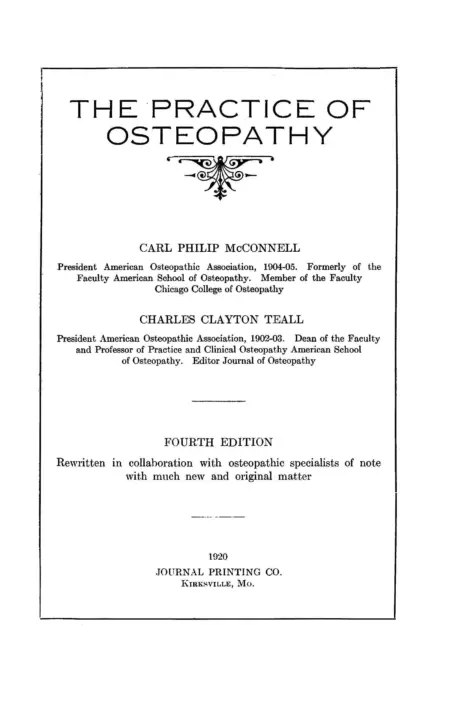
"The Practice of Osteopathy" by Carl Philip McConnell and Charles Clayton Teall is a scientific publication written in the early 20th century. The work serves as a comprehensive textbook on osteopathic medicine, providing both foundational theory and practical instruction for students and practitioners in the field. Its primary focus is the explanation, diagnosis, and treatment of disease according to osteopathic principles, particularly emphasizing anatomical causes and manual correction over pharmaceutical or primarily surgical interventions. The opening of this work introduces the philosophy and historical context of osteopathy, highlighting Andrew Taylor Still as the founder and his revolutionary departure from conventional medicine. The authors stress that osteopathy is defined by its unique approach to the causes of disease—specifically the identification and correction of structural lesions (malalignments and dysfunctions in bones, muscles, ligaments, and other tissues) believed to impede nerve and blood flow, thus leading to illness. The text details the types of lesions, their etiological significance, and their systemic impact, setting the stage for how osteopaths diagnose through meticulous physical examination, particularly of the spine and related musculoskeletal structures. The beginning also establishes the rigorous diagnostic and philosophical distinctions between osteopathy and other forms of manual therapy or drug-based medicine, positioning it as an integrative, holistic discipline grounded in anatomy, physiology, and respect for the body's natural healing capabilities.
Introduction adapted from the source catalogue; source summaries may be automatically generated.
Free to read · English · 323,560 words · No account needed
MAKE TIME FOR A GOOD BOOK
On by default. Untick to stop anonymous reading totals. Each page counts after 10 seconds in view. How this works.
Anonymous counting is on unless you have switched it off.
Immediate consanguinous offspring may manifest a high degree of intellectual or physical attainment but successive processes tend to neurotic types and are prone to physical weaknesses and insanity. This practice is found among Quakers and Jewish peoples, inhabitants of the Islands north of Scotland, in isolated rural localities, and among African tribes.
Mental Deficiency in Children
=Synonyms.=—Amentia; feeble-mindedness.
There are three grades of amentia:
=1. Morons:= those whose mental age corresponds closely to their chronological age or is nearly normal.
=2. Imbeciles:= those in whom there is a wide disparity between the mental age and the chronological age.
=3. Idiots:= the lowest form of arrested mentality or those whom it is
impossible to teach.
=Definition.=—Mental deficiency is a pathological stage in which the mind has failed to attain normal development.
=Various degrees of intelligence= or mental capacity in man lie between:
(=1=) =Genius= such as Bacon, Newton, Plato, Galileo, Shakespeare.
(=2=) =Lesser Ability= but still conspicuous in development such as our great leaders in science, literature, reform and the arts and medicine, furthering, each their respective causes. These merge easily into
(=3=) =Average= mass of mankind.
(=4=) =Dullards= or those of inferior intelligence.
(=5=) =Feeble minded=, merging imperceptibly into
(=6=) =Imbeciles= and by insensible gradation into
(=7=) =Idiots= and gross idiots.
The mentally defective is wholly incapable at maturity of adapting himself to his environment or local conditions in order to maintain existence independent of any external support.
=Dementia= is a disease of the mind or that which was once possessed, and by some neuronic disturbance is lost totally or partially.
=Insanity= is a disturbance of neuronic function which may or may not end in degeneration of brain tissue.
=Physiology.=—The normal brain begins its development shortly after fertilization of the germ cell, by the expansion of the anterior end of the rudimentary spinal cord into four primary cerebral vesicles. These develop into a series of elaborate infoldings, each with multiple cells around them. At or about the sixth month of fetal life this embryonic brain assumes the shape of the adult brain, minus the secondary fissures and convolutions which are characteristic of full development.
At birth there are sometimes many convolutions and the brain weighs from 280 to 330 grams. Growth is then rapid and at six months it weighs from 560 to 680 grams;
At one year, 750 grams. It continues to increase until
At 12 to 14 years it weighs 1150 grams in the female, and 1300 in the
male;
At 20 to 21 years the weight is 1244 grams in the female and 1374 in
the male.
Growth is slow from this time until at 25 to 35 years the average weight of the brain is 1269 grams (45 oz.) in the female, 1421 grams (50 oz.) in the male.
Your reading position is saved on this browser. Take it to another device with a library code. Reading pages adapt to text, rather than matching a printed edition.
BEHIND THE BOOK
This eBook is for the use of anyone anywhere in the United States and most other parts of the world at no cost and with almost no restrictions whatsoever. You may copy it, give it away or re-use it under the terms of the Project Gutenberg License included with this eBook or online at www.gutenberg.org. If you are not located in the United States, you will have to check the laws of the country where you are located before using this eBook. Read the source licence.
The original source file, including credits and licence, is retained by this library. Request an original-format copy at no charge. Please include the book title and Project Gutenberg identifier #75696.
KEEP YOUR CURIOSITY GOING
Charles G. (Charles Griffith) Ross
Hannah Webster Foster

Emily Lawless
Edwin Hamlin Carr

Charles De Lano Hine
Andrew Ure