
Last letters from the living dead man
David Patterson (Spirit) Hatch
THE CLASSIC COLLECTION · 1848
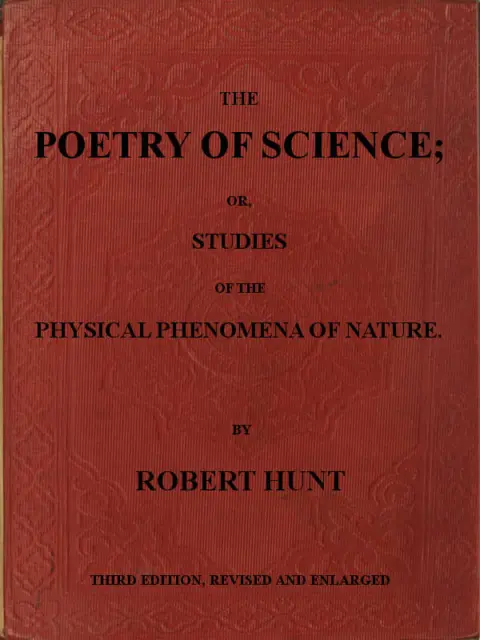
"The Poetry of Science; or, Studies of the Physical Phenomena of Nature" by Robert Hunt is a scientific publication written in the mid-19th century. The book explores the intersection of science and poetry, particularly focusing on the physical phenomena of nature and their beauty. Hunt aims to elevate scientific truths to an aesthetic level, suggesting that there is inherent beauty in the laws of nature, making science appealing to a broader audience. The opening of the work sets a philosophical tone, encouraging readers to contemplate existence and the forces of nature that shape our world. Hunt introduces the concept that everything in the universe, from rocks to living beings, is constituted of atoms and is subject to continual change. He reflects on the transmutation of matter, wherein different states and forms arise from the same fundamental particles, suggesting a unifying principle in the diverse phenomena of nature. The text emphasizes that while science has uncovered many truths, it also highlights the mystery that remains, inviting us to appreciate the beauty and complexity of the physical world.
Introduction adapted from the source catalogue; source summaries may be automatically generated.
Free to read · English · 144,154 words · No account needed
MAKE TIME FOR A GOOD BOOK
On by default. Untick to stop anonymous reading totals. Each page counts after 10 seconds in view. How this works.
Anonymous counting is on unless you have switched it off.
Footnote 94: Schouw, Grundzüge der Pflanzengeographie. Also his Originally: Schouw, Grundüzge der Pflanzengeographie. Also his
Footnote 95: Fraunhofer’s measure of illuminating power is as Originally: Frauenhofer’s measure of illuminating power is as
Footnote 99: Sur une Propriété de la Lumière Réfléchie: Mémoires Originally: Sur une Propriété de la Lumière Réfléchie: Memoires
Page 176: the strongest sunlight which has passed through Originally: the strongest sun-light which has passed through
Page 179: productions of the photographer as on those of the Originally: productions of the photograper as on those of the
Page 180: preserve the lineaments of those who have benefited Originally: preserve the lineaments of those who have benefitted
Page 185: line, over which no action takes place, is preserved at Originally: line, over which no action takes plates, is preserved at
Page 185: presented to us by a circular body: calorific action seems Originally: present to us by a circular body: calorific action seems
Page 188: piece of wood is used instead of a metal, there will, by Originally: piece of wood is used instead of a medal, there will, by
Footnote 126: dans la végétation: by Senebier; Genève et Paris, 1788 Originally: dans la végetation: by Senebier; Genève et Paris, 1788
Page 198: Leyden phial,--so called from its inventor, Musschenbroek, Originally: Leyden phial,--so called from its inventor, Muschenbrock,
Page 219: may be made a measurer of nervous irritability.[154] There Originally: may be made a measurer of nervous iritability.[154] There
Footnote 141: Traité Expérimental de l’Électricité et du Magnétisme: Originally: Traité Expérimental de l’Electricité et du Magnétisme:
Footnote 146: Traité Expérimental de l’Électricité et du Magnétisme. Originally: Traité Expérimental de l’Electricité et du Magnétisme
Footnote 160: where the cobalt was discovered between two portions of Originally: where the cobalt was discovered betweed two portions of
Page 235: Storms--Magnetic conditions of Matter--Diamagnetism, Originally: Storms--Magnetic conditions of Matter--Dia-Magnetism,
Page 236: Magnêtum, quia sit patriis in finibus ortus. Originally: Magnêtum, buia sit patriis in finibus ortus.
Page 251: conditions of change in this our earth: an element to Originally: conditions of change in this our earth: an elemeut to
Page 257: Wiedemann, by employing a fine point through which Originally: Wiedmann, by employing a fine point through which
Page 258: than in any other. M. Wiedemann comes to the conclusion Originally: than in any other. M. Wiedmann comes to the conclusion
Page 260: salt, the protosulphate, ordinarily crystallizes so that Originally: salt, the proto-sulphate, ordinarily crystallizes so that
Footnote 176: Humboldt: Exposé des Variations Magnétiques. Originally: Humboldt: Exposé des Variations Magnetiques.
Footnote 188: Electro-Magnetic Influence, by Professor Zantedeschi. Originally: Electro-Magnetic Influence, by Professor Zandeteschi.
Your reading position is saved on this browser. Take it to another device with a library code. Reading pages adapt to text, rather than matching a printed edition.
BEHIND THE BOOK
This eBook is for the use of anyone anywhere in the United States and most other parts of the world at no cost and with almost no restrictions whatsoever. You may copy it, give it away or re-use it under the terms of the Project Gutenberg License included with this eBook or online at www.gutenberg.org. If you are not located in the United States, you will have to check the laws of the country where you are located before using this eBook. Read the source licence.
The original source file, including credits and licence, is retained by this library. Request an original-format copy at no charge. Please include the book title and Project Gutenberg identifier #51897.
KEEP YOUR CURIOSITY GOING
David Patterson (Spirit) Hatch
Coulson Kernahan

Ralph Waldo Emerson
Frances Wright

Edwin Abbott Abbott

Joseph Droz