
Last letters from the living dead man
David Patterson (Spirit) Hatch
THE CLASSIC COLLECTION · 1848
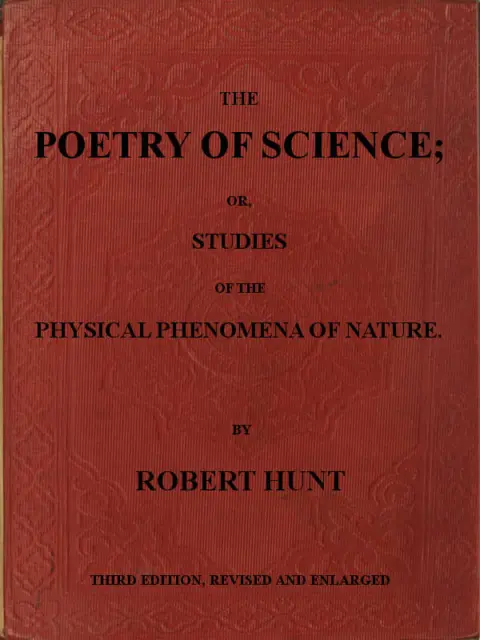
"The Poetry of Science; or, Studies of the Physical Phenomena of Nature" by Robert Hunt is a scientific publication written in the mid-19th century. The book explores the intersection of science and poetry, particularly focusing on the physical phenomena of nature and their beauty. Hunt aims to elevate scientific truths to an aesthetic level, suggesting that there is inherent beauty in the laws of nature, making science appealing to a broader audience. The opening of the work sets a philosophical tone, encouraging readers to contemplate existence and the forces of nature that shape our world. Hunt introduces the concept that everything in the universe, from rocks to living beings, is constituted of atoms and is subject to continual change. He reflects on the transmutation of matter, wherein different states and forms arise from the same fundamental particles, suggesting a unifying principle in the diverse phenomena of nature. The text emphasizes that while science has uncovered many truths, it also highlights the mystery that remains, inviting us to appreciate the beauty and complexity of the physical world.
Introduction adapted from the source catalogue; source summaries may be automatically generated.
Free to read · English · 144,154 words · No account needed
MAKE TIME FOR A GOOD BOOK
On by default. Untick to stop anonymous reading totals. Each page counts after 10 seconds in view. How this works.
Anonymous counting is on unless you have switched it off.
Footnote 190: detailed account of the experiments of Faraday, Plücker, Originally: detailed account of the experiments of Faraday, Plucker,
Page 276: light determine these changes? It is evident, although Originally: light determine these change? It is evident, although
Page 281: chemical change. Döbereiner next discovered that Originally: chemical change. Dœbereiner next discovered that
Page 282: a fearful example in the progress of Asiatic Originally: a fearful example in the progress of Asatic
Page 300: as being either peroxide of hydrogen, or an allotropic Originally: as being either per-oxide of hydrogen, or an allotropic
Page 304: the gas which we employ so advantageously for illumination Originally: the gas which we emply so advantageously for illumination
Page 306: increasing,--true combustion takes place. In this way Originally: increasing,--true combustion takes plaee. In this way
Page 306: sawdust, &c., frequently ignite; and to such an Originally: saw-dust, &c., frequently ignite; and to such an
Page 316: Mr. Darwin remarks, that if the immense sea-weeds of Originally: Mr. Darwin remarks, that if the immense seaweeds of
Page 317: When Shakespeare made his charming Ariel sing-- Originally: When Shakspeare made his charming Ariel sing--
Footnote 212: (Redundant line removed before item 2 in table.) Originally: According to one view, | According to the other view,
Page 334: speculation, which may have occasional marks of ingenuity, Originally: speculation, whieh may have occasional marks of ingenuity,
Page 337: origin, the rational inference is against the speculation; Originally: orgin, the rational inference is against the speculation;
Page 370: capsule of nigella orientalis consists of pods assembled Originally: capsule of nigilla orientalis consists of pods assembled
Page 370: a centre, and partially united; in nigella damascena Originally: a centre, and partially united; in nigilla damascena
Page 399: whose minds are sceptical upon any development of the Originally: whose mind are sceptical upon any development of the
Page 406: evidence of a beautiful adjustment of the balance of Originally: evidence of a beautifnl adjustment of the balance of
Page 408: Let but a slight disturbance occasion a vibration Originally: Let but a slight disturbance occcasion a vibration
Page 409: A cheerless philosophy, derived from the transcendentalism Originally: A cheerless philosophy, derived from the transendentalism
Page 410: which are allowed the privilege of tracing out its Originally: which are alowed the privilege of tracing out its
Page 413: Aëreal currents dependent on heat, 80. Originally: Æreal currents dependent on heat, 80.
Page 413: Animal electricity, 211, 392.
Originally: Magnetic electricity, 211, 392.
Page 413: Bartholin on Iceland spar, 140.
Originally: Bartolin on Iceland spar, 140.
Page 414: Cagniard de la Tour state, 106.
Originally: Caignard de la Tour state, 106.
Page 415: Döbereiner’s lamp, 281.
Originally: Doebereiner’s lamp, 281.
Page 415: Eye, mechanism of, 149.
Originally: Eye, mechanism of, 491.
Page 416: ---- on diamagnetism, 254.
Originally: ---- on dia-magnetism, 254.
Page 418: Musschenbroek of Leyden, 198.
Originally: Muschenbrock of Leyden, 198.
Your reading position is saved on this browser. Take it to another device with a library code. Reading pages adapt to text, rather than matching a printed edition.
BEHIND THE BOOK
This eBook is for the use of anyone anywhere in the United States and most other parts of the world at no cost and with almost no restrictions whatsoever. You may copy it, give it away or re-use it under the terms of the Project Gutenberg License included with this eBook or online at www.gutenberg.org. If you are not located in the United States, you will have to check the laws of the country where you are located before using this eBook. Read the source licence.
The original source file, including credits and licence, is retained by this library. Request an original-format copy at no charge. Please include the book title and Project Gutenberg identifier #51897.
KEEP YOUR CURIOSITY GOING
David Patterson (Spirit) Hatch
Coulson Kernahan

Ralph Waldo Emerson
Frances Wright

Edwin Abbott Abbott

Joseph Droz