
Last letters from the living dead man
David Patterson (Spirit) Hatch
THE CLASSIC COLLECTION · 1848
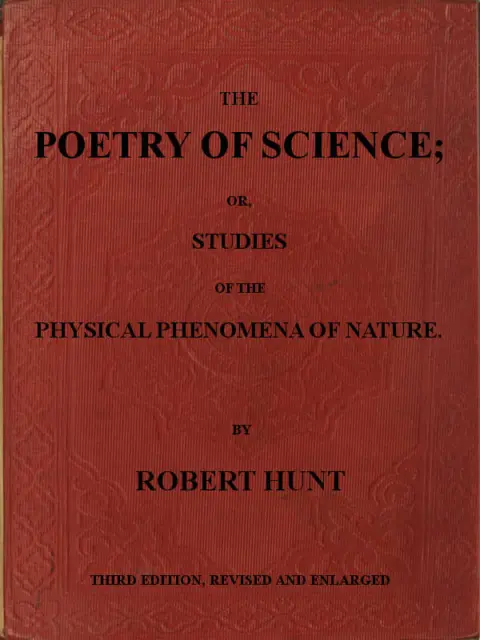
"The Poetry of Science; or, Studies of the Physical Phenomena of Nature" by Robert Hunt is a scientific publication written in the mid-19th century. The book explores the intersection of science and poetry, particularly focusing on the physical phenomena of nature and their beauty. Hunt aims to elevate scientific truths to an aesthetic level, suggesting that there is inherent beauty in the laws of nature, making science appealing to a broader audience. The opening of the work sets a philosophical tone, encouraging readers to contemplate existence and the forces of nature that shape our world. Hunt introduces the concept that everything in the universe, from rocks to living beings, is constituted of atoms and is subject to continual change. He reflects on the transmutation of matter, wherein different states and forms arise from the same fundamental particles, suggesting a unifying principle in the diverse phenomena of nature. The text emphasizes that while science has uncovered many truths, it also highlights the mystery that remains, inviting us to appreciate the beauty and complexity of the physical world.
Introduction adapted from the source catalogue; source summaries may be automatically generated.
Free to read · English · 144,154 words · No account needed
MAKE TIME FOR A GOOD BOOK
On by default. Untick to stop anonymous reading totals. Each page counts after 10 seconds in view. How this works.
Anonymous counting is on unless you have switched it off.
Page 45: bromine, &c., are the results of different allotropic Originally: bromime, &c., are the results of different allotropic
Page 46: which,--from the imperfections of science,--resisting Originally: which,--from the imperfectious of science,--resisting
Page 46: The experiments of Faraday and of Plücker prove Originally: The experiments of Faraday and of Plucker prove
Footnote 25: Young’s Natural Philosophy; ed. by Rev. P. Kelland. Originally: Young’s Natural Philosophy; ed. by Rev. P. Lelland.
Footnote 35: Hence the origin of compound and visible bodies; hence Originally: Hence the origin of compouud and visible bodies; hence
Page 50: her operations, but the very processes themselves. Originally: her operations, but the very processes themselvss.
Paqe 59: combination appears to the eye in no respect different Originally: combinatiou appears to the eye in no respect different
Page 61: Those fissures formed by the first system of crystalline Originally: Those fissures formed by the first sytsem of crystalline
Page 68: luminous power are sufficiently striking to convince us Originally: luminous power are sufficienlty striking to convince us
Page 109: of temperature is experienced.[79] Professor Plücker, of Originally: of temperature is experienced.[79] Professor Plucker, of
Footnote 55: this motion. He was followed by Musschenbroek, and then Originally: this motion. He was followed by Muschenbroek, and then
Footnote 61: regarding the internal temperature of the Earth: by Originally: regarding the internal temperature of tha Earth: by
Footnote 78: en vertu de l’état sphéroïdal dans un creuset Originally: en vertu de l’état sphérodïal dans un creuset
Page 121: Fraunhofer, Herschel, Brewster, and others, but proceed Originally: Frauenhofer, Herschel, Brewster, and others, but proceed
Page 123: between charcoal points at the poles of a powerful voltaic Originally: between charcoal points a the poles of a powerful voltaic
Page 129: of quinine, and the fluor spar, we obtain the same results Originally: of quinine, and the flour spar, we obtain the same results
Page 140: the first instance, by Erasmus Bartholin, in Iceland-spar, Originally: the first instance, by Erasmus Bartolin, in Iceland-spar,
Page 145: from what has been already stated, that some Originally: from what has beeen already stated, that some
Page 153: to prove that light is absolutely necessary to Originally: to prove that light is absolutely neccessary to
Page 159: of light behind them.[113] By microscopic examination Originally: of light behind them.[113] By miscroscopic examination
Page 159: Benvenuto Cellini gave a curious account of a carbuncle Originally: Benvenuto Cellini give a curious account of a carbuncle
Page 160: near a fire. From this it may be inferred that the Originally: near a a fire. From this it may be infered that the
Footnote 88: Brande’s Manual of Chemistry; or, indeed, any work Originally: Brande’s Mannal of Chemistry; or, indeed, any work
Your reading position is saved on this browser. Take it to another device with a library code. Reading pages adapt to text, rather than matching a printed edition.
BEHIND THE BOOK
This eBook is for the use of anyone anywhere in the United States and most other parts of the world at no cost and with almost no restrictions whatsoever. You may copy it, give it away or re-use it under the terms of the Project Gutenberg License included with this eBook or online at www.gutenberg.org. If you are not located in the United States, you will have to check the laws of the country where you are located before using this eBook. Read the source licence.
The original source file, including credits and licence, is retained by this library. Request an original-format copy at no charge. Please include the book title and Project Gutenberg identifier #51897.
KEEP YOUR CURIOSITY GOING
David Patterson (Spirit) Hatch
Coulson Kernahan

Ralph Waldo Emerson
Frances Wright

Edwin Abbott Abbott

Joseph Droz