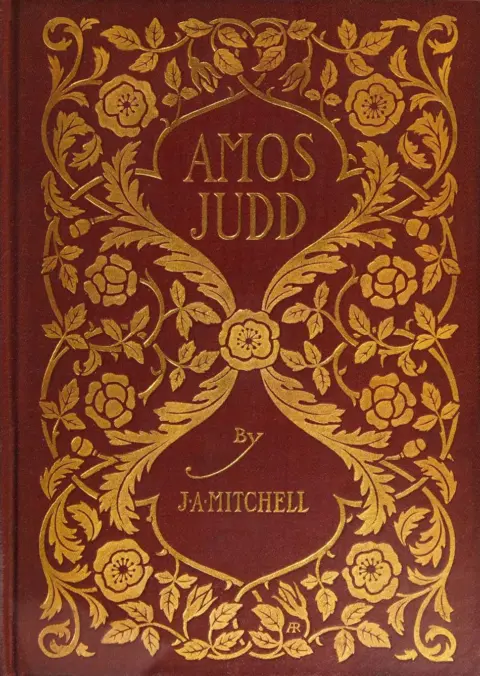
Amos Judd
John Ames Mitchell
THE CLASSIC COLLECTION · 1901
"The Pines of Lory" by John Ames Mitchell is a novel written in the early 20th century. The story introduces an intriguing connection between two main characters, Patrick Boyd, a man returning from Africa, and Elinor Marshall, an orphan with a generous heart. Their adventure begins when they find themselves passengers on a steamer bound for Boyd's Island, but soon they encounter unexpected circumstances that challenge their understanding of each other and compel them to confront deeper themes of love, virtue, and destiny. At the start of the novel, readers are introduced to the atmosphere aboard the steamer as the characters prepare for their journey. Boyd bears the scars of his recent past, still recovering physically and emotionally from his experiences in Africa. The narrative invites readers to witness his playful banter with his friend Billy Townsend, as well as the magnetic charm of Elinor, who is set to visit the Boyds’ house. Tension escalates amidst the humorous and social exchanges when the steamer unexpectedly lands at the wrong location, leaving both characters stranded in an isolated wilderness without someone to guide them. The initial light-heartedness gives way to a gripping tale intertwined with themes of romance and existential contemplation, as both characters are forced to confront their own vulnerabilities amidst unforeseen trials.
Introduction adapted from the source catalogue; source summaries may be automatically generated.
Free to read · English · 39,693 words · No account needed
MAKE TIME FOR A GOOD BOOK
On by default. Untick to stop anonymous reading totals. Each page counts after 10 seconds in view. How this works.
Anonymous counting is on unless you have switched it off.
Among early victims was Mr. Appleton Marshall. After storing his mind with the financial news and social gossip of the morning paper, he had rejoined his friends. Sitting beside his niece, he participated, at intervals, in the conversation, his manner becoming more and more distant until, at last, it vanished altogether. To all who cared to see, it was plain that this stately and usually complacent gentleman was losing interest in external matters.
He seemed annoyed when a steward, about one o'clock, appeared on deck and rang a bell, announcing dinner. At this summons Patrick Boyd took out his watch and was obviously astonished at the flight of time.
"I had forgotten my friend," he exclaimed, and he hurried below.
At the dinner-table Elinor Marshall sat between her confessor and her uncle, the latter clinging bravely to his post through the soup and fish. Then, after watching for a moment the various viands as they rose and fell with the heaving of the ship, accompanied, as it seemed to him, by a similar rising and sinking of his own digestive apparatus, he remarked, with some severity, that he felt no hunger. And he left the table with dignity, yet with a certain expedition. As the uncle disappeared, Patrick Boyd came in and took a seat opposite the lady and the priest.
"How did you find your friend?" Father Burke inquired.
"Discouraged."
"Poor fellow! Nothing serious, I hope."
"No. But he doesn't quite understand this starting right off again on
another voyage."
"Is he--er--is his mind affected?"
This question appeared to surprise Captain Boyd. "No. But they have fastened him to a windlass, near the engine-room, and he resents it."
This reply merely intensified the curiosity of the questioner.
"Did you say they have fastened him?"
"Yes. It seems to be a rule of the boat."
The young lady also opened her eyes. After a pause, she inquired, in a low voice, "Is he dangerous?"
"No, indeed! Not at all!"
"Then why tie him?"
"It is a rule of the boat, as I said."
"A rule of the boat to tie passengers?"
At this question Pats smiled, for a light broke in upon him. "My friend is a dog. I thought I told you."
"A dog!" and she seemed to find diversion in the seriousness with which Father Burke accepted the explanation. "I love dogs. Why shouldn't I go down and see him?"
"The honor would be appreciated."
"I will go after dinner. What sort of a dog is he?"
"A setter."
"And what is his name?"
Pats hesitated. "Do you really wish to know?"
"Of course!"
"Well, his full name is Jan Bartholomeus Van Vlotens Couwenhorn Van der
Helst Poffenburgh."
Your reading position is saved on this browser. Take it to another device with a library code. Reading pages adapt to text, rather than matching a printed edition.
John Ames Mitchell
John Ames Mitchell

Francis Davis Millet & W. Hamilton (William Hamilton) Gibson & Will H. (Will Hicok) Low & John Ames Mitchell & Francis Hopkinson Smith
John Ames Mitchell
BEHIND THE BOOK
This eBook is for the use of anyone anywhere in the United States and most other parts of the world at no cost and with almost no restrictions whatsoever. You may copy it, give it away or re-use it under the terms of the Project Gutenberg License included with this eBook or online at www.gutenberg.org. If you are not located in the United States, you will have to check the laws of the country where you are located before using this eBook. Read the source licence.
The original source file, including credits and licence, is retained by this library. Request an original-format copy at no charge. Please include the book title and Project Gutenberg identifier #30600.
KEEP YOUR CURIOSITY GOING
Coulson Kernahan

Maurice Baring
Frances Wright
Cécile Tormay

Frederic Jesup Stimson

W. H. P. (William Henry Pope) Jarvis