
Last letters from the living dead man
David Patterson (Spirit) Hatch
THE CLASSIC COLLECTION · 1920
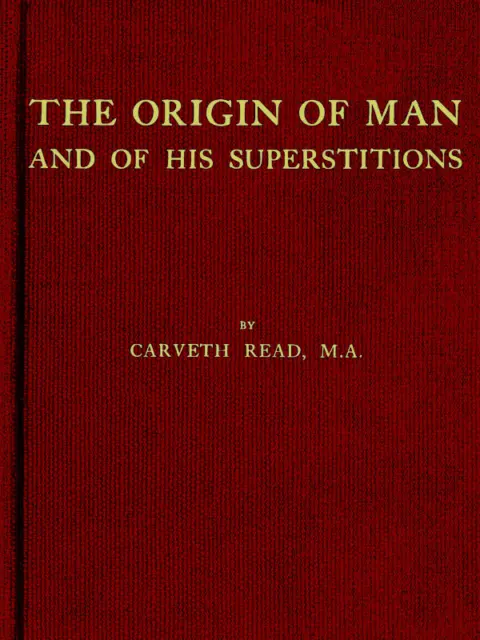
"The Origin of Man and of His Superstitions" by Carveth Read is a scientific publication written in the early 20th century. The work presents a hypothesis regarding the evolutionary development of humans from ape-like ancestors and explores the subsequent emergence of superstitions and magical beliefs as social constructs. Read aims to connect human evolution, particularly through hunting practices, with the psychological and sociocultural evolution leading to superstitions. The opening of the work delivers a comprehensive explanation of the author's hypothesis regarding human ancestry linked to ape-like stocks, highlighting the pivotal role of adopting a hunting lifestyle. Read outlines how this shift not only transformed human physical attributes—such as erect posture and specialized hands—but also shaped social cooperation and early mental capacities. He discusses the implications of transitioning from a frugivorous diet to a carnivorous one and the essential changes in human behavior, cognition, and society that arose as a consequence of social hunting, setting the stage for exploring the development of superstitions in later chapters.
Introduction adapted from the source catalogue; source summaries may be automatically generated.
Free to read · English · 131,342 words · No account needed
MAKE TIME FOR A GOOD BOOK
On by default. Untick to stop anonymous reading totals. Each page counts after 10 seconds in view. How this works.
Anonymous counting is on unless you have switched it off.
MacBride, E. W., on specialisation of Man, 4 n.
McDougall, W., on self-abasement, 44, 124. See also Hose and
McDougall
Magic, 35, Chap. IV., see Contents;
relation to government, 68-69, 253-4;
relation to Animism, Chap. VI., see Contents;
to Fine Art, 262;
to Religion, 194-7, 254-5;
to Omens, 227-34;
its equivalent for inspiration, 245;
relation to Totemism, 314-8;
to science, 111, Chap. X. §§ 1, 2, 3, see Contents;
to Medicine, 260, 328-31
Major premise of primitive reasoning, 94, 95, 98
Mana, 121, 122, 193
Marett, R. R., on Animatism, 120, 149
Marriage, seasonal, 13;
and Totemism, 307-11
Mathew, J., on source of magical power, 263 n.
Maxim, H. S., on precedence, 45
Memory and Belief, 73, 80
Mercier, C., on paranoia, 276
Metamorphosis, 213-14, 314-15
Methodology, none for the primitive mind, 82, 117
Mill, J. S., on Comte, 108;
on induction, 117
Mimesis, principle of, 136
Minor premise not understood in primitive reasoning, 95-6
Mousterian culture, 13
Müller, Max, on Totemism, 299
Natural selection of best hunters, 4;
of the gregarious, 8;
of the intelligent, 11;
adapted Man to the hunting life, not to civilisation, 51;
except partially, 64;
within limits favoured the superstitious, 70, 114
Neanderthal Man, 49, 50, 52
Neolithic culture, 50, 51
Nordic Race, 19-20
Odour as soul-stuff, 139, 162
Oligocene supposed age of the differentiation of Hominidæ, 3, 24;
landscape, flora and fauna then, 22-8
Omen, magical or spiritual, 200, 204, Chap. VII., see Contents
Oracles, dreams and omens, 236-7;
in Greece, 241-3;
in Fiji, 243;
often obscure, 246
Origin and Development of Moral Ideas, 109, 309
Palæolithic Culture, 50
Panætius on Divination, 248
Participation, principle of, 136
Pausanias, 244
Pawnee chief on the good man, 64
Pekin Gazette, 222
Perception as source of belief, 79, 85;
among savages, 36, 137
Philosophy and Animism, 342
Photograph and soul, 312
Pithecanthropus, 49, 55
Pliny (the Elder) on Ancient Medicine, 329, 331
Plutarch, 242
Poet respected, 126;
inspired, 237 n.;
and wizard, 267
Polybius on Roman Religion, 248
Positivism, 108
Possession, 210-11, 212, 237, 242-3
Prayers, at first seem dangerous, 195-6;
from spells, also spontaneous, 200, 201;
become spells, 204, 205
Precedence in the hunting-pack, 44;
amongst Australians, 45
Priest, 68-9;
and sorcerer, 254-5;
and learning, 341
Primal Law, 38, 306
Property, 43, 56-8
Psychology of the hunting-pack, Chap. II. § 4 (40-8)
Psychological Animism, 145, Chap. V. § 2 (147-53)
Races of Men, 19
Rain-rites, 202, 335-7
Ray, S. H., on the Lifuans, 142 n., 156
Reason and imagination, 74-5;
in immature minds, Chap. III. § 6
Reflection and ghost, 154, 158
Reinach, S., on sex-taboo, 56
Reincarnation, 174
Relations in savage thought, 101
Religion, 69;
meaning of word, 184;
and Magic, 193-7;
and Totemism, 321-5
Retrogradation, Ch. VI. § 4 (203-7)
Rigveda, 152, 168, 219
Rivera, W. H. R., on suggestibility in savages, 86;
on savage thought, 89, 100;
on Totemic gods, 167, 321-2;
on Toda prayers, 205;
blindness of savages to deceit, 283;
on a custom at Mota, 301, 303
Roosevelt on dogs, 44, 45;
elephant and bear, 147
Roth, W. E., on prayer to Totem, 319
Roy, S. C., on Oraon rain-rites, 202
Your reading position is saved on this browser. Take it to another device with a library code. Reading pages adapt to text, rather than matching a printed edition.
BEHIND THE BOOK
This eBook is for the use of anyone anywhere in the United States and most other parts of the world at no cost and with almost no restrictions whatsoever. You may copy it, give it away or re-use it under the terms of the Project Gutenberg License included with this eBook or online at www.gutenberg.org. If you are not located in the United States, you will have to check the laws of the country where you are located before using this eBook. Read the source licence.
The original source file, including credits and licence, is retained by this library. Request an original-format copy at no charge. Please include the book title and Project Gutenberg identifier #46884.
KEEP YOUR CURIOSITY GOING
David Patterson (Spirit) Hatch
Coulson Kernahan

Ralph Waldo Emerson
Frances Wright

Edwin Abbott Abbott

Joseph Droz