
Last letters from the living dead man
David Patterson (Spirit) Hatch
THE CLASSIC COLLECTION · 1920
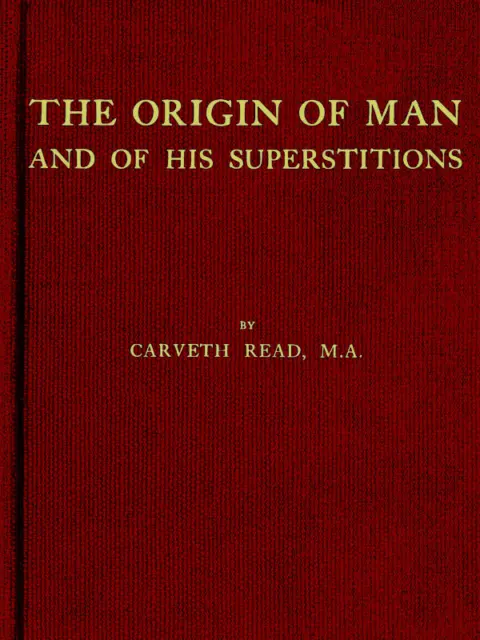
"The Origin of Man and of His Superstitions" by Carveth Read is a scientific publication written in the early 20th century. The work presents a hypothesis regarding the evolutionary development of humans from ape-like ancestors and explores the subsequent emergence of superstitions and magical beliefs as social constructs. Read aims to connect human evolution, particularly through hunting practices, with the psychological and sociocultural evolution leading to superstitions. The opening of the work delivers a comprehensive explanation of the author's hypothesis regarding human ancestry linked to ape-like stocks, highlighting the pivotal role of adopting a hunting lifestyle. Read outlines how this shift not only transformed human physical attributes—such as erect posture and specialized hands—but also shaped social cooperation and early mental capacities. He discusses the implications of transitioning from a frugivorous diet to a carnivorous one and the essential changes in human behavior, cognition, and society that arose as a consequence of social hunting, setting the stage for exploring the development of superstitions in later chapters.
Introduction adapted from the source catalogue; source summaries may be automatically generated.
Free to read · English · 131,342 words · No account needed
MAKE TIME FOR A GOOD BOOK
On by default. Untick to stop anonymous reading totals. Each page counts after 10 seconds in view. How this works.
Anonymous counting is on unless you have switched it off.
Sanderson, G. P., on Indian wild dogs, 43
Scapulomancy, 239
Schopenhauer on female beauty, 15
Scientists in barbarism, 339
Secret of the Totem, 305
Seligman on sex-taboo, 131;
on departmental experts, 257, 284
Selous, F. C., on the hunter’s joy, 41
Seneca on Omens, 249
Seton, Thompson, on Indians’ love of killing, 41;
on wolves, 42, 44, 56
Sexual selection as cause of naked skin, 14
Shadow and ghost, 154, 158
Shaman derivation of word, 274
Shamanism, 217-8, 254
Skeat and Blagden on the Semang, 149, 168;
on Malay Magic, 172, 261
Skin naked, 14-18
Skull changes in, 7;
capacity of, 50
Social life of Primates, 7, 32;
of Man, 8, 34-6, 37-8
Social Origins, 305
Societies of Wizards, 256
Sollas on geological time, 3 n., 49 n.
Sorcerer and Magician, 252;
and Priest, 254
Sorcery, 129;
defined, 189
Soul and soul-stuff, 147, 151, 154, 155, 161-3, 171;
how many, 172;
origin and destiny of, 174-7;
of Totem and clansman, 312, 313
Southey, R., The Curse of Kehama, 265
Species of Man, 31
Speech in apes and men, 9, 54, 55
Speisser on Animism in Ambrym, 152
Spell, 68, 111, 113, 130;
tends to personify, 152, 156;
and prayer, 200, 201
Spencer, H., Pol. Institutions, 8, 59;
on Laughter, 60;
Sociology, 108;
on Animism, 153, 165, 167, 183;
on Totemism, 298
Spencer and Gillen on savage imagination, 83;
on Guanjis, 146;
on magic stones, 120-1, 263 n.;
emotions of Australians, 244;
foreign Magic, 270;
account of a Wizard, 285;
list of Totems, 296
Spirits and ghosts, Chap. V. §§ 6-7 (164-73);
power of, 212-3;
controlled by Magic, 216-24;
and Omens, 234-8
Stages in development of Magic, 129
Stanbridge, W., on aborigines’ scepticism, 279
Standard of truth for savages, 89
Stefánson on Esquimo, 160
Stigand, G. H., on the Masai, 146
Stoics and divination, 248
Stoll, Otto, on self-suggestion, 274
Struggle over prey, 45-6
Substitution in Magic, 141
Suggestibility, 84, 275
Superstition, Chap. III., see Contents;
utility of, 69;
its dark side, 107;
innate disposition to, 114, 153
Syllogism and savage thinking, 92-7
Symbols, 139;
may fulfil Omens, 246
Sympathy, perceptive, contagious, effective in the pack, 48;
and moral sense, 63-4
Taboo, 68;
on persons and things, 131-2;
on words, 133;
names of dead and of spirits, 201;
on kings, 219;
connected with Totemism, 315, 316
Talisman, 68, 131, etc.
Testimony, 80, 82
Thompson, Basil, on Tongan rejection of coincidence, 291
Thurn, E. F. im, on savage belief, 116, 151, 155;
on the peaiman, 260
Torday, E., on Bahuana, 150;
dead cast no shadow, 154 n.
Totemism, 68, 151, 166, 167, 173;
Chap. IX. (293-325), see Contents
Transmigration, 171, 175
Trotter on herd-instinct, 64
Turner, G., on Samoan gods, 322
Turner (Am. B. of Ethn.) on Esquimo Angoqok, 328
Tylor, E. B., Primitive Culture, 108;
on Animism, 153, 183;
on motivation of Magic, 195;
on spell and prayer, 207
Tyndall on the Scientific Uses of the Imagination, 74
Your reading position is saved on this browser. Take it to another device with a library code. Reading pages adapt to text, rather than matching a printed edition.
BEHIND THE BOOK
This eBook is for the use of anyone anywhere in the United States and most other parts of the world at no cost and with almost no restrictions whatsoever. You may copy it, give it away or re-use it under the terms of the Project Gutenberg License included with this eBook or online at www.gutenberg.org. If you are not located in the United States, you will have to check the laws of the country where you are located before using this eBook. Read the source licence.
The original source file, including credits and licence, is retained by this library. Request an original-format copy at no charge. Please include the book title and Project Gutenberg identifier #46884.
KEEP YOUR CURIOSITY GOING
David Patterson (Spirit) Hatch
Coulson Kernahan

Ralph Waldo Emerson
Frances Wright

Edwin Abbott Abbott

Joseph Droz