
Last letters from the living dead man
David Patterson (Spirit) Hatch
THE CLASSIC COLLECTION · 1920
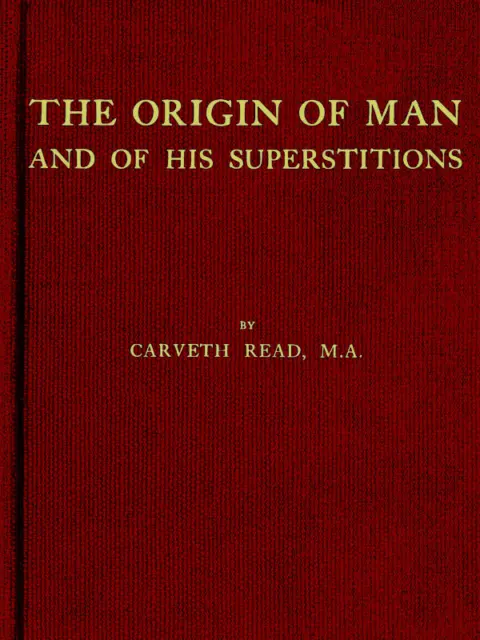
"The Origin of Man and of His Superstitions" by Carveth Read is a scientific publication written in the early 20th century. The work presents a hypothesis regarding the evolutionary development of humans from ape-like ancestors and explores the subsequent emergence of superstitions and magical beliefs as social constructs. Read aims to connect human evolution, particularly through hunting practices, with the psychological and sociocultural evolution leading to superstitions. The opening of the work delivers a comprehensive explanation of the author's hypothesis regarding human ancestry linked to ape-like stocks, highlighting the pivotal role of adopting a hunting lifestyle. Read outlines how this shift not only transformed human physical attributes—such as erect posture and specialized hands—but also shaped social cooperation and early mental capacities. He discusses the implications of transitioning from a frugivorous diet to a carnivorous one and the essential changes in human behavior, cognition, and society that arose as a consequence of social hunting, setting the stage for exploring the development of superstitions in later chapters.
Introduction adapted from the source catalogue; source summaries may be automatically generated.
Free to read · English · 131,342 words · No account needed
MAKE TIME FOR A GOOD BOOK
On by default. Untick to stop anonymous reading totals. Each page counts after 10 seconds in view. How this works.
Anonymous counting is on unless you have switched it off.
[295] Heimskringla, St. Olaf’s Saga, chs. cciv. and ccxl.
[296] Primitive Culture, II. p. 273 (2nd ed.).
[297] Codrington, The Melanesians, p. 145.
[298] S. H. C. Hawtrey, “The Lengua Indians,” Journal of the Royal Anthropological Institute, 1901.
[299] “Shamanism,” Journal of the Royal Anthropological Institute,
XXIV. (1894-5).
[300] Comparetti, The Traditionary Poetry of the Finns, p. 184.
[301] Howitt, op. cit., p. 404. Is this type of the neophyte’s behaviour, which is conformed to on certain occasions by magicians and inspired priests in every age and country, itself conformed to the natural type of insanity or epilepsy; and, if so, consciously or unconsciously?
[302] J. H. Weeks, Among Congo Cannibals, pp. 145 and 276.
[303] Grey, Polynesian Mythology, chs. i. and vii.
[304] Origin and Growth of Religion as illustrated by Celtic
Heathendom, p. 225.
[305] Corpus Poeticum Boreale, pp. 24, 34, 181, 196.
[306] Heimskringla Saga, Yuglingasaga, chs. xvii.-xviii.
[307] “Shamanism,” Journal of the Royal Anthropological Institute,
X., XIV. p. 85.
[308] Weeks, Congo Cannibals, p. 265.
[309] The fullest and most dramatic account of such possession may be found in Williams’ Fiji and the Fijians, p. 190. See below, p. 243.
[310] Weeks, Primitive Bokongo, p. 215.
[311] Spencer and Gillen, Native Tribes of Central Australia, pp.
480-8.
[312] “Shamanism,” Journal of the Royal Anthropological Institute,
XXIV. p. 130.
[313] Howitt, op. cit., p. 374.
[314] Ibid., p. 437.
[315] P. A. Talbot, In the Shadow of the Bush, p. 230.
[316] G. Borrow, Wild Wales, ch. lxxxviii.
[317] Spencer and Gillen, op. cit., p. 388.
[318] H. Spencer, Principles of Sociology, § 55.
[319] E. B. Tylor, Primitive Culture, I. 308 et seq.
[320] In a paper on Leopard Men of the Naga Hills, read at a meeting of the R.A.I. (December 9, 1919), Mr. J. J. H. Hutton reported that such men do not change into leopards; but sometimes their souls involuntarily pass into them. If the leopard be injured or killed he whose soul was in it suffers or dies—when he hears of it. Such men are not feared, because their leopards do very little harm.
For this reason (I suppose) the belief is not exploited by wizards, who have no use for innocent superstition, and it remains pure folklore. There may not be any connexion between this animistic doctrine of human souls possessing animals and the magical doctrine of shape-changing. If they are connected, it is easy to see that in a certain atmosphere of popular philosophy, if shape-changing were believed in, the possession theory might be accepted as the true explanation upon merely being proposed. Indeed, it would make intelligible such a case as this: a man’s leopard is seen on the skirts of the village; but he himself is known to be in his hut.
Your reading position is saved on this browser. Take it to another device with a library code. Reading pages adapt to text, rather than matching a printed edition.
BEHIND THE BOOK
This eBook is for the use of anyone anywhere in the United States and most other parts of the world at no cost and with almost no restrictions whatsoever. You may copy it, give it away or re-use it under the terms of the Project Gutenberg License included with this eBook or online at www.gutenberg.org. If you are not located in the United States, you will have to check the laws of the country where you are located before using this eBook. Read the source licence.
The original source file, including credits and licence, is retained by this library. Request an original-format copy at no charge. Please include the book title and Project Gutenberg identifier #46884.
KEEP YOUR CURIOSITY GOING
David Patterson (Spirit) Hatch
Coulson Kernahan

Ralph Waldo Emerson
Frances Wright

Edwin Abbott Abbott

Joseph Droz