
Last letters from the living dead man
David Patterson (Spirit) Hatch
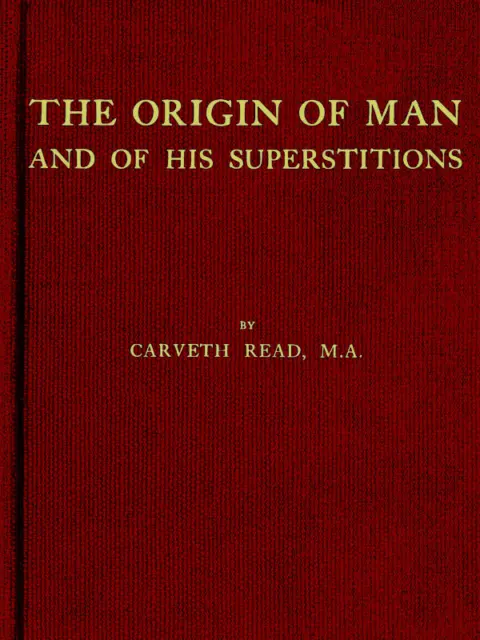
THE CLASSIC COLLECTION · 1920
"The Origin of Man and of His Superstitions" by Carveth Read is a scientific publication written in the early 20th century. The work presents a hypothesis regarding the evolutionary development of humans from ape-like ancestors and explores the subsequent emergence of superstitions and magical beliefs as social constructs. Read aims to connect human evolution, particularly through hunting practices, with the psychological and sociocultural evolution leading to superstitions. The opening of the work delivers a comprehensive explanation of the author's hypothesis regarding human ancestry linked to ape-like stocks, highlighting the pivotal role of adopting a hunting lifestyle. Read outlines how this shift not only transformed human physical attributes—such as erect posture and specialized hands—but also shaped social cooperation and early mental capacities. He discusses the implications of transitioning from a frugivorous diet to a carnivorous one and the essential changes in human behavior, cognition, and society that arose as a consequence of social hunting, setting the stage for exploring the development of superstitions in later chapters.
Introduction adapted from the source catalogue; source summaries may be automatically generated.
Free to read · English · 131,342 words · No account needed
MAKE TIME FOR A GOOD BOOK
On by default. Untick to stop anonymous reading totals. Each page counts after 10 seconds in view. How this works.
Anonymous counting is on unless you have switched it off.
[261] Mythus und Religion, pp. 78, 79.
[262] Op. cit., p. 125 et seq.
[263] Op. cit., p. 202 et seq.
[264] This was also Spencer’s opinion, op. cit., § 133.
[265] Op. cit., p. 263.
[266] Op. cit., p. 267.
[267] See above, pp. 100 and 119-24.
[268] Hume, Inquiry, § vii.
[269] A. H. Sayce, Religion of the Ancient Babylonians, p. 398.
[270] Book II. p. 82; Rawlinson’s Translation.
[271] Vol. I. ch. iv.
[272] But see the footnote at p. 235 of The Magic Art, I.: “faith in magic is probably older than the belief in spirits.” In the same note, a passage in Hegel’s Philosophy of Religion is referred to as anticipating the doctrine of the priority of Magic to Religion. The passage, as translated in an appendix (pp. 423-6), shows, however, no conception of Magic as akin to natural law, as it is described in several passages of The Golden Bough, but treats it as a belief in any human being “as the ruling power over nature in virtue of his own will.” This is rather an anticipation of Prof. Wundt’s doctrine concerning Sorcery; which Hegel seems not to have distinguished from Magic. I need hardly add that a belief in any human being as the ruling power over nature in virtue of his own will has never been discovered in any part of the world.
[273] Op. cit., pp. 237-9.
[274] Primitive Culture, I. 116.
[275] R. H. Coddrington, The Melanesians, p. 125.
[276] H. A. Giles, Chinese Literature, p. 202.
[277] Animism gave the priest another excuse for the failure of rites (besides those enjoyed by a mere magician), namely, that during, or since, the celebration some fresh offence against the gods had been committed.
[278] Spencer and Gillen, Northern Tribes of Central Australia, pp.
453, 463.
[279] A. W. Howitt, Native Tribes of South-East Australia, pp.
359-361-367.
[280] Howitt, op. cit., p. 378.
[281] E. B. Tylor, Primitive Culture, II. p. 148.
[282] The Mafulu, p. 193.
[283] Op. cit., p. 272.
[284] Extract from a spell in Skeat’s Malay Magic, p. 571.
[285] Howitt, op. cit., p. 397.
[286] J. G. Frazer, The Belief in Immortality, p. 288. For similar instances see the same work, pp. 335 and 375.
[287] Sarat Chandra Roy, “Magic and Witchcraft on the Chota Nagpur Plateau,” J.R.A.I., XLIV. p. 330. I have slightly altered the last sentence, which seems to have been misprinted.
[288] Religious Experience of the Roman People, p. 215.
[289] The Todas, pp. 30, 213.
[290] Religious Experience of the Roman People, p. 286. But whether we should expect the idea to weaken with advancing civilisation must depend upon whether intelligent belief in the gods was increasing. Perhaps this was not the case at Rome.
[291] Polynesian Researches, II. pp. 144 and 157 (1st ed.).
[292] Reports of the Cambridge Expedition to Torres Straits, VI. p.
199.
[293] Thomas Williams, Fiji and the Fijians, p. 209.
[294] J. Mooney, “Sacred Formulas of the Cherokees” in Am. B. of Ethn., VII. p. 314 (1885-6).
Your reading position is saved on this browser. Take it to another device with a library code. Reading pages adapt to text, rather than matching a printed edition.
BEHIND THE BOOK
This eBook is for the use of anyone anywhere in the United States and most other parts of the world at no cost and with almost no restrictions whatsoever. You may copy it, give it away or re-use it under the terms of the Project Gutenberg License included with this eBook or online at www.gutenberg.org. If you are not located in the United States, you will have to check the laws of the country where you are located before using this eBook. Read the source licence.
The original source file, including credits and licence, is retained by this library. Request an original-format copy at no charge. Please include the book title and Project Gutenberg identifier #46884.
KEEP YOUR CURIOSITY GOING
David Patterson (Spirit) Hatch
Coulson Kernahan

Ralph Waldo Emerson
Frances Wright

Edwin Abbott Abbott

Joseph Droz