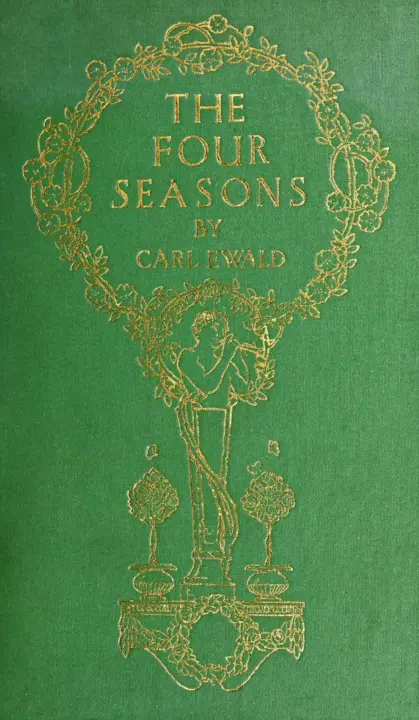
The Four Seasons
Carl Ewald

THE CLASSIC COLLECTION · 1908
"The Old Room" by Carl Ewald is a novel written in the early 20th century. The story unfolds within the confines of a mysterious and grand room in a home, primarily focusing on the intertwined lives of its owners, Cordt and his wife, Fru Adelheid. The book explores themes of love, marriage, and the complexities of emotional intimacy, reflecting on how personal desires can conflict with societal expectations. At the start of the narrative, readers are introduced to the titular room, a richly decorated chamber that serves as a secret and sacred space for the couple. This opening portion sets a tone of introspection, revealing the struggles within Cordt and Adelheid's marriage as they navigate their feelings about love, fidelity, and societal roles. As they prepare for an evening out, tension arises between their desires for independence and the bonds of their relationship. The vivid descriptions of the room emphasize its significance as both a physical and symbolic space for the couple, illustrating their inner conflicts and the weight of tradition on their modern lives.
Introduction adapted from the source catalogue; source summaries may be automatically generated.
Free to read · English · 44,218 words · No account needed
MAKE TIME FOR A GOOD BOOK
On by default. Untick to stop anonymous reading totals. Each page counts after 10 seconds in view. How this works.
Anonymous counting is on unless you have switched it off.
Fru Adelheid stood in her wraps at the window and looked out. The horses were stamping in the porch below; the footman stood by the carriage-door and waited.
They were going to the station to fetch Finn.
He had been abroad the whole summer.
This was the first time he had been away alone and he had not enjoyed himself abroad. From Florence, Spain and Paris he had written to ask if he might not come home. But Cordt was resolved that he should remain abroad for the time agreed upon.
He wrote oftenest to Fru Adelheid ... and stupidly and awkwardly, because he knew that his father would read the letters. Cordt noticed this, but said nothing. He hurried through the letters as though he were looking for something positive and put them down with a face as though he had not found it.
He always gave Fru Adelheid the letters he received, although she never
asked for them.
Fru Adelheid looked impatiently at her watch. She sat down, closed her eyes and pressed her forehead against the pane.
She thought how empty the house had been during the summer.
Cordt had not said a word about the old room, but, from the day when Finn had moved up there, things had altered between him and her. Something had happened ... something indefinite and nameless, but none the less fateful on that account.
And, while Finn was abroad, this had grown between them ... without their doing anything to further or prevent it. Neither of them thought about it. Both led their own lives and drifted farther apart in their yearning for their quiet child. The day was long for them, their rooms were cold.
But inside her was a growing anxiety for Cordt, who became ever more silent and wore such a melancholy look in his eyes.
A door opened and she sprang up:
“We shall be late, Cordt.”
“Not at all,” he said, calmly. “You ordered the carriage too early.”
“Let us go, Cordt. We may just as well wait there as here.”
Cordt sat down with his hat on his knee and looked at her. She stood with bent head and buttoned her gloves.
“Sit down for a moment,” he said and pushed a chair towards her.
“Do you want to talk to me?”
“Sit down, Adelheid,” he said, impatiently. “Sit down for a moment.”
Fru Adelheid leant against the chair and remained standing.
“It is long since we talked together, Adelheid ... many, many years. Do
you know that?”
She shrugged her shoulders:
“Very likely,” she said and made her voice as firm as she could. “We have peace now, you see.”
Your reading position is saved on this browser. Take it to another device with a library code. Reading pages adapt to text, rather than matching a printed edition.
BEHIND THE BOOK
This eBook is for the use of anyone anywhere in the United States and most other parts of the world at no cost and with almost no restrictions whatsoever. You may copy it, give it away or re-use it under the terms of the Project Gutenberg License included with this eBook or online at www.gutenberg.org. If you are not located in the United States, you will have to check the laws of the country where you are located before using this eBook. Read the source licence.
The original source file, including credits and licence, is retained by this library. Request an original-format copy at no charge. Please include the book title and Project Gutenberg identifier #62883.
KEEP YOUR CURIOSITY GOING
Coulson Kernahan

Maurice Baring
Frances Wright
Cécile Tormay

Frederic Jesup Stimson

W. H. P. (William Henry Pope) Jarvis