
The Truth About an Author
Arnold Bennett
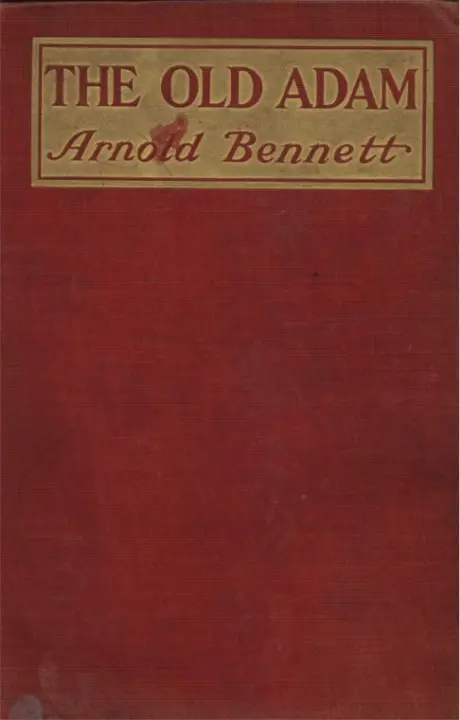
THE CLASSIC COLLECTION · 1913
"The Old Adam: A Story of Adventure" by Arnold Bennett is a novel written in the early 20th century. The story follows Edward Henry Machin, a man grappling with the mundane aspects of life despite recent financial success through stock market speculation. Throughout the opening chapters, Edward navigates complex relationships with his wife, Nellie, and their family, against the backdrop of his self-reflections on wealth and happiness. The beginning of the novel introduces Edward Henry Machin as he returns home, struck by a sense of melancholy despite a recent windfall from his investments. As he enters a domestic space filled with the trappings of both comfort and chaos, Edward reflects on the burdens of his life, such as perceived negligence from his wife and children. The narrative quickly escalates into a familial crisis when his son suffers a minor dog bite, which escalates Nellie's worries about potential rabies, prompting Edward’s internal conflict about duty and desire for escapism. This opening sets the tone for a blend of familial dynamics and self-exploration as Edward seeks both change and reassurance within his relationships and financial endeavors.
Introduction adapted from the source catalogue; source summaries may be automatically generated.
Free to read · English · 85,382 words · No account needed
MAKE TIME FOR A GOOD BOOK
On by default. Untick to stop anonymous reading totals. Each page counts after 10 seconds in view. How this works.
Anonymous counting is on unless you have switched it off.
"Well, would you like to go to London with me?"
"When?" the boy demanded cautiously. He still did not move, but his
ears seemed to prick up.
"To-morrow?"
"No thanks ... Father." His ears ceased their activity.
"No? Why not?"
"Because there's a spellings examination on Friday, and I'm going to be
top boy."
It was a fact that the infant (whose programmes were always somehow arranged in advance, and were in his mind absolutely unalterable) could spell the most obstreperous words. Quite conceivably he could spell better than his father, who still showed an occasional tendency to write "separate" with three e's and only one a.
"London's a fine place," said Edward Henry.
"I know," said Robert negligently.
"What's the population of London?"
"I don't know," said Robert with curtness, though he added after a pause: "But I can spell population--p-o-p-u-l-a-t-i-o-n."
"I'll come to London, Father, if you'll have me," said Ralph, grinning
good-naturedly.
"Will you!" said his father.
"Fahver," asked Maisie, wriggling, "have you brought me a doll?"
"I'm afraid I haven't."
"Mother said p'r'aps you would."
It was true, there had been talk of a doll; he had forgotten it.
"I tell you what I'll do," said Edward Henry, "I'll take you to London, and you can choose a doll in London. You never saw such dolls as there are in London--talking dolls that shut and open their eyes and say Papa and Mamma, and all their clothes take off and on."
"Do they say 'Father?'" growled Robert.
"No, they don't," said Edward Henry.
"Why don't they?" growled Robert.
"When will you take me?" Maisie almost squealed.
"To-morrow."
"Certain sure, Father?"
"Yes."
"You promise, Father?"
"Of course I promise."
Robert at length stood up to judge for himself this strange and agitating caprice of his father's for taking Maisie to London. He saw that, despite spellings, it would never do to let Maisie alone go. He was about to put his father through a cross-examination, but Edward Henry dropped Ralph, who had been climbing up him as up a telegraph-pole, on to the bed and went over to the window, nervously, and tapped thereon.
Carlo followed him, wagging an untidy tail.
"Hello, Trent!" murmured Edward Henry, stooping and patting the dog.
Ralph exploded into loud laughter.
"Father's called Carlo 'Trent,'" he roared. "Father, have you forgotten his name's Carlo?" It was one of the greatest jokes that Ralph had heard for a long time.
Then Nellie hurried into the room, and Edward Henry, with a "Mustn't be late for tea," as hurriedly left it.
Three minutes later, while he was bent over the lavatory basin, someone burst into the bathroom. He lifted a soapy face.
Your reading position is saved on this browser. Take it to another device with a library code. Reading pages adapt to text, rather than matching a printed edition.
Arnold Bennett

Arnold Bennett
Arnold Bennett
Arnold Bennett
BEHIND THE BOOK
This eBook is for the use of anyone anywhere in the United States and most other parts of the world at no cost and with almost no restrictions whatsoever. You may copy it, give it away or re-use it under the terms of the Project Gutenberg License included with this eBook or online at www.gutenberg.org. If you are not located in the United States, you will have to check the laws of the country where you are located before using this eBook. Read the source licence.
The original source file, including credits and licence, is retained by this library. Request an original-format copy at no charge. Please include the book title and Project Gutenberg identifier #40168.
KEEP YOUR CURIOSITY GOING
Coulson Kernahan

Maurice Baring
Frances Wright
Cécile Tormay

Frederic Jesup Stimson

W. H. P. (William Henry Pope) Jarvis