THE CLASSIC COLLECTION✦My diaries, being a personal narrative of events 1888-1914, Part 2 (1900-1914)CLASSIC FREE BOOKS
My diaries, being a personal narrative of events 1888-1914, Part 2 (1900-1914)
Wilfrid Scawen Blunt
THE CLASSIC COLLECTION · 1915
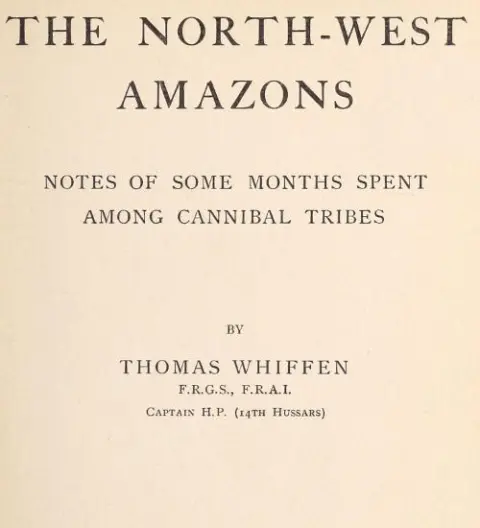
"The North-West Amazons: Notes of some months spent among cannibal tribes" by Thomas Whiffen is a historical account written in the early 20th century. The work details the author's months spent exploring the remote regions near the upper Amazon River, specifically focusing on the cannibal tribes and their cultures. Whiffen shares his observations of the tribes' customs, daily life, and interactions with nature, providing readers with an ethnographic glimpse into a largely untouched world. At the start of the narrative, Whiffen recounts his motivations for embarking on this journey following a period of unemployment due to ill health. He reflects on previous travel experiences and the influence of Dr. Alfred Russel Wallace's writings, which inspired him to explore the Amazon. Arriving in Manaos, he quickly realizes the challenges of accessing the interior and securing a reliable party, and the narrative unfolds with his detailed accounts of the difficulties faced in navigating the forest, river routes, and the dynamics with local tribes. The opening section sets the stage for an immersive exploration of the Amazonian wilderness and the indigenous peoples residing there, capturing both the allure and the difficulties of his expedition.
Introduction adapted from the source catalogue; source summaries may be automatically generated.
Free to read · English · 110,454 words · No account needed
MAKE TIME FOR A GOOD BOOK
On by default. Untick to stop anonymous reading totals. Each page counts after 10 seconds in view. How this works.
Anonymous counting is on unless you have switched it off.
[267] Or potacea, a nut of bitter taste the size of an acorn.
[268] See von Martius, i. 113. For similar instances cf. Westermarck, p.
151.
[269] This confirms the account given by Wallace, p. 346; von Martius, i.
600.
[270] See for similar etiquette, Alcedo-Thompson, Dictionary of America and the West Indies, i. 416; E.R. Smith, The Aurocanians, p. 215; Westermarck, pp. 383-4.
[271] This seems to be the same as the Hottentot custom (Kolben, Present State of the Cape of Good Hope, i. 157).
[272] These are, I believe, the same ants that are used in the manufacture of the curare poison. They are fairly common. In lingoa-geral they are called tucaudera.
[273] “The Carayas maintain quasi-husbands for widows at the public cost, lest they should be a source of disturbance to the general peace” (Ratzel, ii. 126). Widows are repi, prostitutes among some Melanesians (Codrington, p. 235).
[274] See, for similar belief among the Zaparo, Simson, p. 174.
[275] For example, among the Bororo when the medicine-man has announced that the patient will die in a given time, “if at the end of this time he still lives, the executioner, sent of course by the priest, will suddenly appear in the hut, sit astride his stomach, and strangle him to death” (Cook, p. 55).
[276] See Joyce, p. 249.
[277] See supra, p. 151.
[278] The idea of blood crying for vengeance is familiar enough, and the most universally-known example is that of the fratricide Cain informed that his brother’s blood cried for vengeance from the ground (Gen. iv. 10).
[279] See supra, p. 31.
[280] “A microscopic scarlet Acarus” (Orton, p. 485).
[281] “To an Indian smallpox is certain death--the most dreaded enemy, who has over and over again swept off entire tribes, and the name or passing suspicion of which from youth up has always been trembled at and fled from as from death itself” (Simson, p. 142).
[282] There are many varieties of this complaint. In one kind the patient wastes away. With another it assumes the characteristics of elephantiasis, the legs swell, the flesh becomes soft and podgy, the skin unhealthy and white. It is said by the rubber-gatherers that a cure can only be effected when the patient sees the sea, in other words through complete change of air.
[283] Simson speaks of a “skin-disease common amongst all Indians of the higher Marañon, called ‘carata.’ The skin is ‘scaly and blotched all over with black’” (Simson, p. 178). This seems to be similar to the “cutaneous disease” mentioned by Bates, except that he explicitly mentions “the black spots were hard and rough but not scaly” (Bates, ii. 382). The Purupura Indians have also a skin complaint that causes them to be “spotted and blotched with white, brown, or nearly black patches” (Wallace, p. 357).
Your reading position is saved on this browser. Take it to another device with a library code. Reading pages adapt to text, rather than matching a printed edition.
BEHIND THE BOOK
This eBook is for the use of anyone anywhere in the United States and most other parts of the world at no cost and with almost no restrictions whatsoever. You may copy it, give it away or re-use it under the terms of the Project Gutenberg License included with this eBook or online at www.gutenberg.org. If you are not located in the United States, you will have to check the laws of the country where you are located before using this eBook. Read the source licence.
The original source file, including credits and licence, is retained by this library. Request an original-format copy at no charge. Please include the book title and Project Gutenberg identifier #55540.
KEEP YOUR CURIOSITY GOING
Wilfrid Scawen Blunt
Wilfrid Scawen Blunt

E. W. (Edgar Watson) Howe
Cécile Tormay

Moritz Busch
John L. Ransom