THE CLASSIC COLLECTION✦My diaries, being a personal narrative of events 1888-1914, Part 2 (1900-1914)CLASSIC FREE BOOKS
My diaries, being a personal narrative of events 1888-1914, Part 2 (1900-1914)
Wilfrid Scawen Blunt
THE CLASSIC COLLECTION · 1915
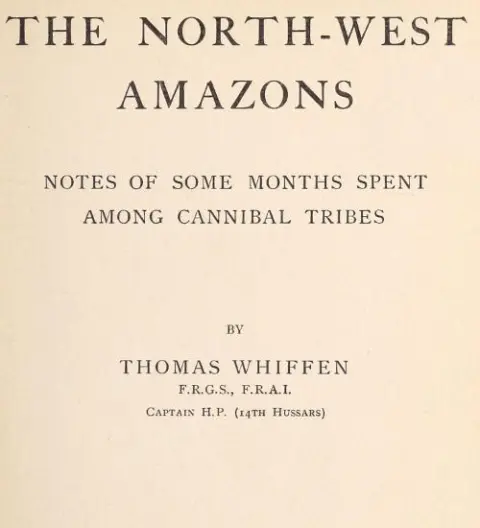
"The North-West Amazons: Notes of some months spent among cannibal tribes" by Thomas Whiffen is a historical account written in the early 20th century. The work details the author's months spent exploring the remote regions near the upper Amazon River, specifically focusing on the cannibal tribes and their cultures. Whiffen shares his observations of the tribes' customs, daily life, and interactions with nature, providing readers with an ethnographic glimpse into a largely untouched world. At the start of the narrative, Whiffen recounts his motivations for embarking on this journey following a period of unemployment due to ill health. He reflects on previous travel experiences and the influence of Dr. Alfred Russel Wallace's writings, which inspired him to explore the Amazon. Arriving in Manaos, he quickly realizes the challenges of accessing the interior and securing a reliable party, and the narrative unfolds with his detailed accounts of the difficulties faced in navigating the forest, river routes, and the dynamics with local tribes. The opening section sets the stage for an immersive exploration of the Amazonian wilderness and the indigenous peoples residing there, capturing both the allure and the difficulties of his expedition.
Introduction adapted from the source catalogue; source summaries may be automatically generated.
Free to read · English · 110,454 words · No account needed
MAKE TIME FOR A GOOD BOOK
On by default. Untick to stop anonymous reading totals. Each page counts after 10 seconds in view. How this works.
Anonymous counting is on unless you have switched it off.
[243] With the Issa-Japura tribes the father is subjected to no such torturing processes at the hands of his friends as are recorded of other tribes and peoples, “in such sort that from being sick by pure imagination they often make a real patient of him” (Tylor, loc. cit. p. 288 et seq.; J.A.I. xviii. 248; cf. also Crevaux, Spix, and Martius, p. 381; Schomburg, Reisen in Britisch Guiana, ii.).
[244] Bird names, as is commonly the case in South America, are attempts to repeat the cry of the birds themselves. Kweko, for instance, is a most suggestive name for a parrot. Birds, it may here be noted, very seldom sing in Amazonia.
[245] See Brinton on this subject, Religions of Primitive Peoples, p.
196. Cf. Howitt, p. 739.
[246] Witoto.
[247] Boro.
[248] Cf. Tylor, Early History of Mankind; im Thurn, p. 220; Hodson, Naga Tribes, p. 176; Spencer and Gillen, op. cit. p. 139; Brinton, p. 195, etc.; Seligmann, p. 140; André, p. 16; Lang, Origin of Religion, etc.
[249] See Folklore Journal; Mitchell, Past in the Present.
[250] Every Indian man has two names, his own name and his secret name (name of genitalia). The latter is generally a significant name, and is used in ribald jesting round the fire, e.g. “the Okaina (a rodent) went to the stream to bathe,” etc. etc., ad nauseam.
[251] The converse of this holds good elsewhere, for the names of the dead are often tabu. See Rivers, Todas, pp. 625-6; Tylor, p. 142; Brinton, pp. 94-5.
[252] Brinton, p. 197.
[253] Pace Ratzel, ii. 128.
[254] Simson, p. 92; Ratzel, ii. 128.
[255] Markham, Clough, p. 104.
[256] Wallace, p. 360.
[257] According to Waitz the Carib medicine-man was accorded the jus primae noctis (Anthropologie der Naturvölker, iii. 382); Westermarck, p. 76. Von Martius also attributes this custom to certain Brazilian tribes, the chief, not the medicine-man, claiming the right (i. 113, 428, 485).
[258] Letourneau, The Evolution of Marriage, p. 52.
[259] Wallace, p. 355.
[260] This is quite usual of course. See Westermarck, pp. 445-7.
[261] Cf. custom among the Muskoks (Ratzel, ii. 125. See also im Thurn, p. 221; Westermarck, p. 18).
[262] Wallace, p. 346.
[263] Westermarck puts the disparity of years at from five to six among natives of Brazil (op. cit. p. 137; Spix and Martius, ii. 248).
[264] This invariably takes place in the forest, for no intimacy, even between husband and wife, is ever permitted in the publicity of the house. According to Westermarck a similar custom prevailed in Fiji (op. cit. pp. 151-2), but this is denied by Thomson, The Fijians, p. 202.
[265] im Thurn, pp. 186, 221.
[266] As De Morgan remarked of a somewhat similar practice among the Sakai of Perak, this is a form of marriage by purchase “modified by the smallness of the price paid … a purely formal substitute” (Bulletin de la Société Normande de Géographie, vii. 422; Skeat and Blagden, ii. 60-61).
Your reading position is saved on this browser. Take it to another device with a library code. Reading pages adapt to text, rather than matching a printed edition.
BEHIND THE BOOK
This eBook is for the use of anyone anywhere in the United States and most other parts of the world at no cost and with almost no restrictions whatsoever. You may copy it, give it away or re-use it under the terms of the Project Gutenberg License included with this eBook or online at www.gutenberg.org. If you are not located in the United States, you will have to check the laws of the country where you are located before using this eBook. Read the source licence.
The original source file, including credits and licence, is retained by this library. Request an original-format copy at no charge. Please include the book title and Project Gutenberg identifier #55540.
KEEP YOUR CURIOSITY GOING
Wilfrid Scawen Blunt
Wilfrid Scawen Blunt

E. W. (Edgar Watson) Howe
Cécile Tormay

Moritz Busch
John L. Ransom