THE CLASSIC COLLECTION✦My diaries, being a personal narrative of events 1888-1914, Part 2 (1900-1914)CLASSIC FREE BOOKS
My diaries, being a personal narrative of events 1888-1914, Part 2 (1900-1914)
Wilfrid Scawen Blunt
THE CLASSIC COLLECTION · 1915
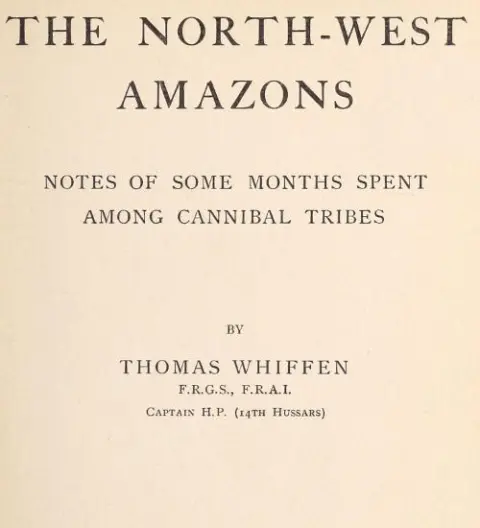
"The North-West Amazons: Notes of some months spent among cannibal tribes" by Thomas Whiffen is a historical account written in the early 20th century. The work details the author's months spent exploring the remote regions near the upper Amazon River, specifically focusing on the cannibal tribes and their cultures. Whiffen shares his observations of the tribes' customs, daily life, and interactions with nature, providing readers with an ethnographic glimpse into a largely untouched world. At the start of the narrative, Whiffen recounts his motivations for embarking on this journey following a period of unemployment due to ill health. He reflects on previous travel experiences and the influence of Dr. Alfred Russel Wallace's writings, which inspired him to explore the Amazon. Arriving in Manaos, he quickly realizes the challenges of accessing the interior and securing a reliable party, and the narrative unfolds with his detailed accounts of the difficulties faced in navigating the forest, river routes, and the dynamics with local tribes. The opening section sets the stage for an immersive exploration of the Amazonian wilderness and the indigenous peoples residing there, capturing both the allure and the difficulties of his expedition.
Introduction adapted from the source catalogue; source summaries may be automatically generated.
Free to read · English · 110,454 words · No account needed
MAKE TIME FOR A GOOD BOOK
On by default. Untick to stop anonymous reading totals. Each page counts after 10 seconds in view. How this works.
Anonymous counting is on unless you have switched it off.
[284] I did myself, and so did my boy Brown and others of the party.
[285] André, pp. 16-110.
[286] Spix and Martius, p. 31.
[287] Simson, pp. 148, 194. A very common practice among Indians.
[288] Koch-Grünberg, pp. 134, 165.
[289] I do not mean the body of an infant killed at birth, which, as I have said, is done as quietly and secretly as possible.
[290] “Primary urn-burial is characteristic in the main of the Tupi-Guarani family” (Joyce, p. 270).
[291] For the same reason that prompted similar proceeding among the Norsemen, an influence still alive in many parts of our own country. Cf. Mitchell, Past in the Present. An instance is reported from Hampshire within the last few years of a child’s toys being broken on its grave. (Read, Folklore Journal, vol. xxii. p. 322.)
[292] Ratzel, ii. 155.
[293] Shaman is in more general use among Americans. It should be remembered that the Zaparo, with whom Simson mentions the shimano (Simson, pp. 174-5, 177), have had considerably more intercourse with western civilisation than the tribes away from the Napo line of communication.
[294] Vol. xxiv.
[295] “The chief ‘medicine’ of the Payes on the affluents of the Amazon, both northern and southern, and on the Orinoco” (Spruce, ii. 436).
[296] Crevaux, p. 300.
[297] im Thurn, p. 312; Wallace, p. 347; Crevaux, p. 299.
[298] im Thurn, p. 368.
[299] Spruce mentions Barré Indians “sucking out the rheumatism” from each other’s shoulders (Spruce, ii. 435).
[300] I am unable to say whether the medicine-man believes that an actual stick has been literally in the patient’s flesh, or whether he believes that the stick concealed in his mouth becomes a habitation for the supernatural power causing the sickness, or if he merely does the whole thing to impress his audience, and confirm their belief in his magical powers. Quite possibly all these reasons combined in varying degrees are present in any case. See Marett, Anthropology, p. 247.
[301] A boy “with epileptic tendency being preferred,” as im Thurn noted was the case in British Guiana (im Thurn, p. 334).
[302] Waterton, p. 449.
[303] Cf. im Thurn, p. 349.
[304] Cf. Westermarck, p. 152.
[305] Spruce, ii. 430-31.
[306] I have never seen the medicine-man’s palm-leaf boxes mentioned by
Spruce, ii. 431.
[307] Among the Mungaberra the medicine-men “can and often do assume the form of eagle-hawks,” and thus attack other tribes (Spencer and Gillen, p. 533). It may be that the medicine-men of Indian tribes nearer the mountains, where these birds have their habitat, assume the form of a condor, as the medicine-man of the forest districts does that of the jaguar, for the condor is “sacred throughout practically the whole of the Andean region.” See Joyce, p. 175.
[308] The jaguar and the anaconda are both magical beasts. See Chap. XIX.
Your reading position is saved on this browser. Take it to another device with a library code. Reading pages adapt to text, rather than matching a printed edition.
BEHIND THE BOOK
This eBook is for the use of anyone anywhere in the United States and most other parts of the world at no cost and with almost no restrictions whatsoever. You may copy it, give it away or re-use it under the terms of the Project Gutenberg License included with this eBook or online at www.gutenberg.org. If you are not located in the United States, you will have to check the laws of the country where you are located before using this eBook. Read the source licence.
The original source file, including credits and licence, is retained by this library. Request an original-format copy at no charge. Please include the book title and Project Gutenberg identifier #55540.
KEEP YOUR CURIOSITY GOING
Wilfrid Scawen Blunt
Wilfrid Scawen Blunt

E. W. (Edgar Watson) Howe
Cécile Tormay

Moritz Busch
John L. Ransom